How a Euro Profile Cylinder Is Built: Body, Plug, Pins, Springs and Cam (Profilzylinder Aufbau)
A euro profile cylinder (Profilzylinder) is a body, one or two plugs, pin stacks with springs, a cam and, in a double cylinder, a clutch, held in the lock case by one fixing screw. This article names each part in English and German and shows where it sits on our 70 SNKT-1, 70 SNDK, 60 SNDK, 80 SNKT and 45 SNIK cylinders.

Johnson LiuDigital Communications, Canton HylandMA Digital Media, Johns Hopkins University
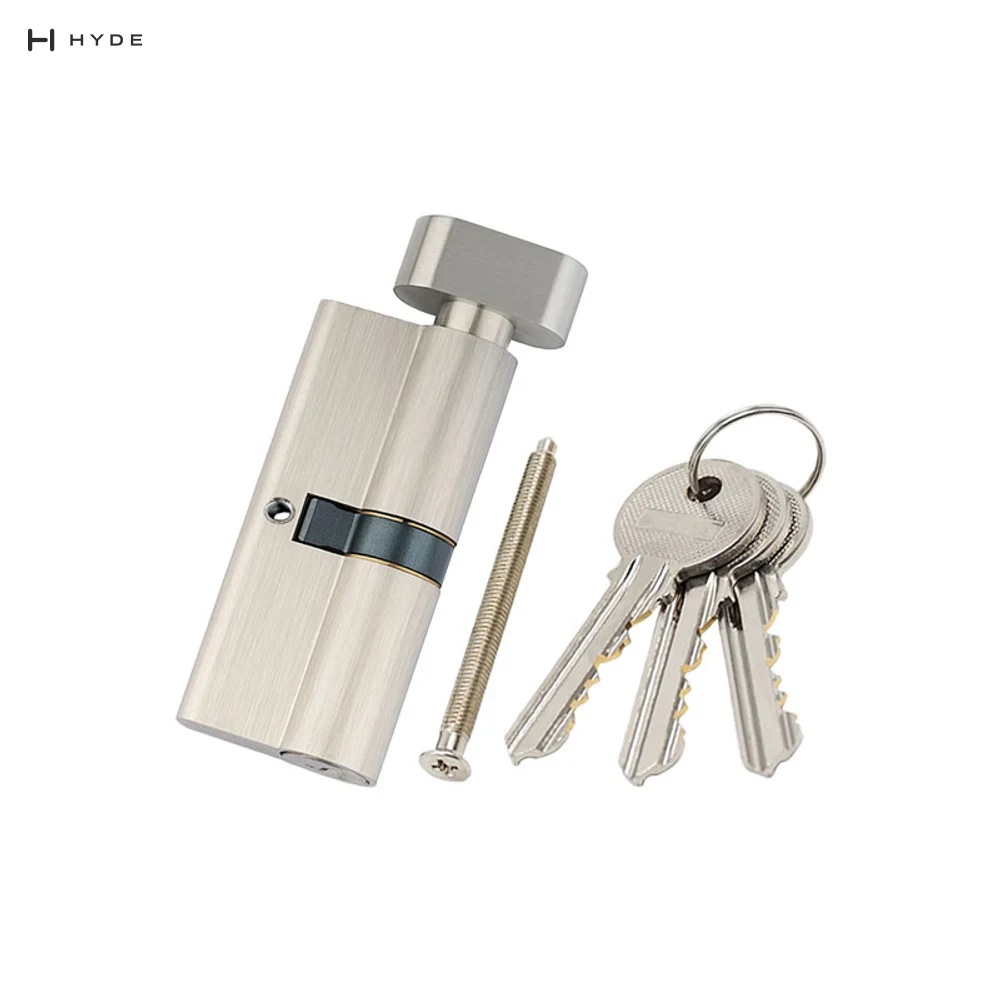
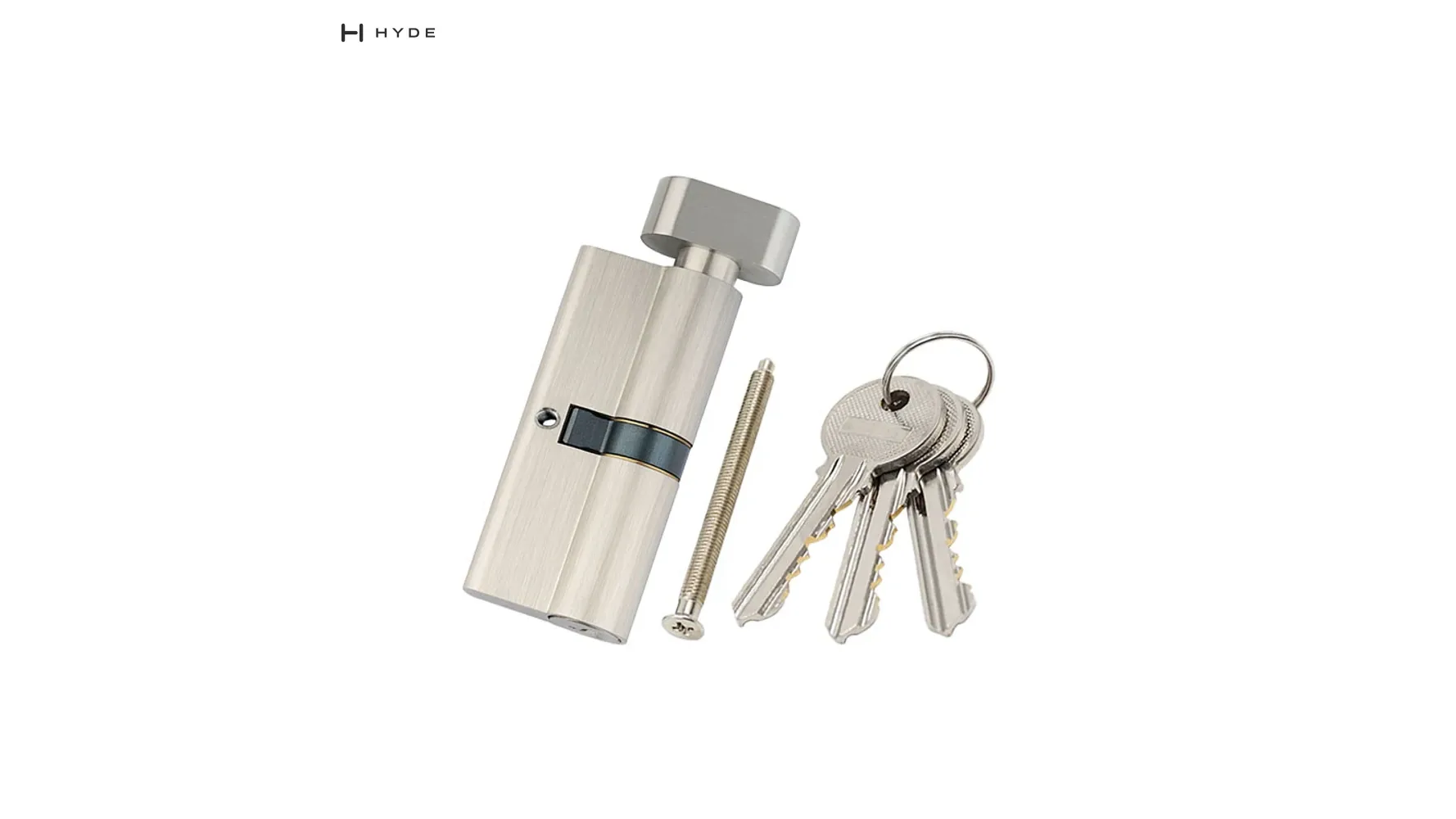
A euro profile cylinder, the Profilzylinder in German, is built from a short list of parts: a body (Gehäuse), one or two plugs (Kern), a row of pin stacks, each made of a key pin and a driver pin (Stifte), the springs (Federn) that push those pins, and the cam (Schließbart) in the middle of the body. A double cylinder adds a clutch (Kupplung) between its two plugs, and a key-and-thumbturn cylinder adds a turn knob (Knauf) on its inner end. One fixing screw (Stulpschraube) holds the whole assembly in the lock case, through a threaded hole in the body.
The chain of movement is short. The right key lines up every pin stack so the plug is free to turn; the plug turns the cam; the cam throws the bolt in the mortise lock case. Every other part of a cylinder exists either to block that chain or to decide which side is allowed to start it. This article names each part in English and German, shows where it sits on five of our cylinders, the 70 SNKT-1, 70 SNDK, 60 SNDK, 80 SNKT and 45 SNIK, and says which details our records publish and which they do not.
The parts at a glance
Scroll sideways to compare columns. Select a column heading to sort; select it three times to restore source order.
| Body (housing) | Gehäuse | Holds every other part and gives the keyhole-shaped profile that fits the lock case | The whole outer shape |
|---|---|---|---|
| Plug | Kern (Zylinderkern) | Rotates when the right key is inserted; carries the keyway | The round face with the key slot |
| Key pins | Kernstifte | Rest on the key; each length matches one cut | Sealed inside |
| Driver pins | Gehäusestifte | Block the plug until the key lifts them clear | Sealed inside |
| Springs | Federn | Push each pin stack back toward the plug | Sealed inside |
| Cam | Schließbart | Turns with the plug and throws the bolt | The dark tab in the slot at the middle |
| Clutch | Kupplung | In a double cylinder, connects the driving plug to the cam | Hidden behind the cam |
| Thumbturn | Knauf | Turns the cam by hand from the inside | Knob on the inner end of key-and-turn models |
| Fixing screw | Stulpschraube | Holds the cylinder in the lock case | Threaded hole in the lower web |
9 rows · Source order
The body: Gehäuse
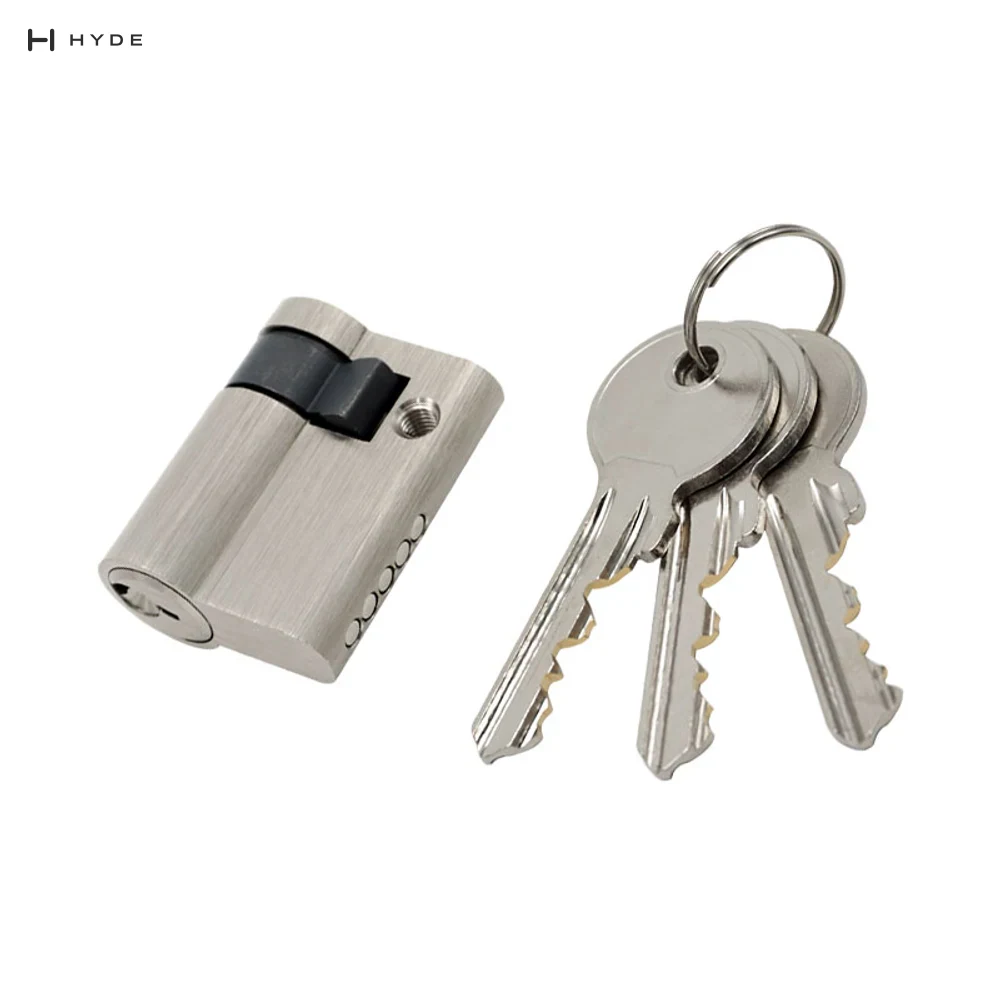
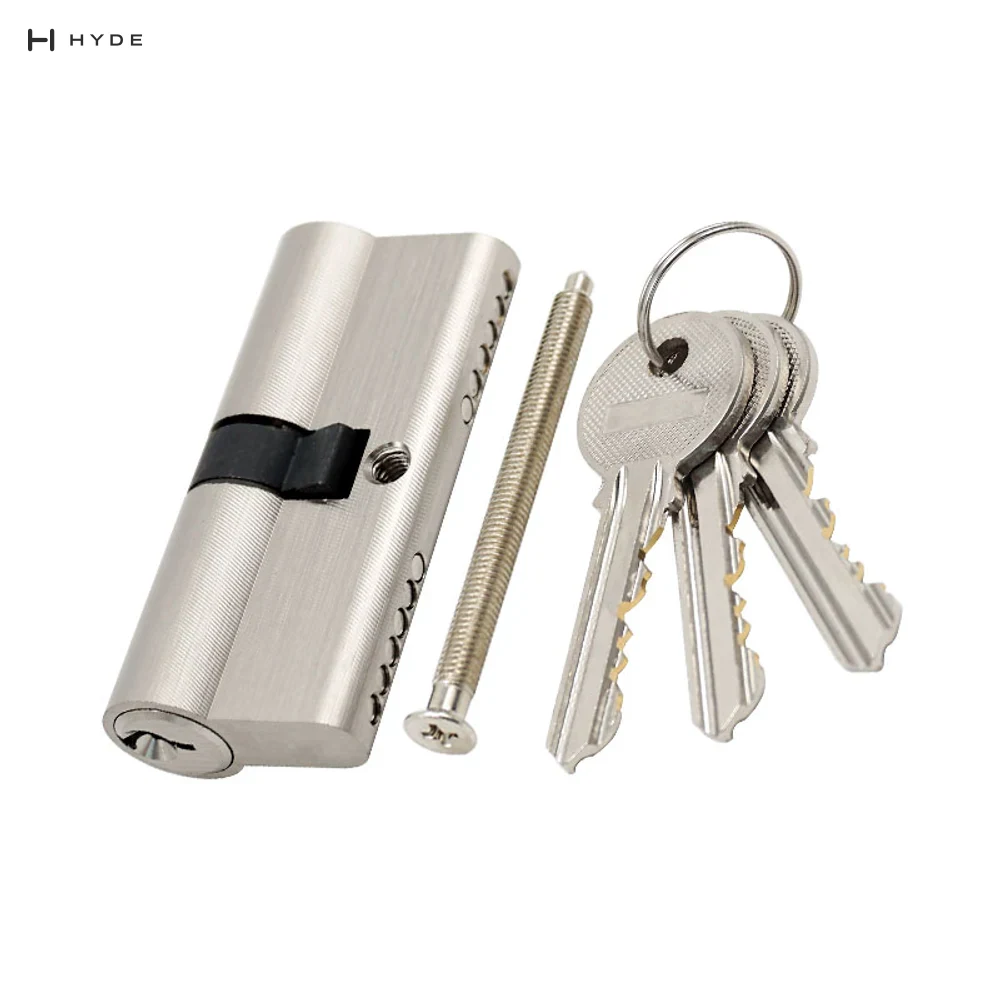
The body gives the euro profile its shape: a round head that houses the plug, and a narrower web below it, which German fitters call the Steg. A common euro profile measures about 17 mm across the round head and about 33 mm from top to bottom. DIN 18252 is the German standard that describes profile cylinders, and the shared profile is the reason a euro cylinder from one maker passes through a euro lock case from another. Our records describe the body of all five cylinders discussed here as solid brass in a satin nickel finish (SN). The pin chambers are drilled through the web into the plug, and their open ends are sealed so that the pins and springs stay in place and cannot be reached from outside. On the 70 SNDK photographs that row of sealed chamber ends runs along the edge of the web on both halves of the body, and the 45 SNIK photographs show the same row on its single half.
The plug: Kern
The plug, Kern or Zylinderkern in German, is the rotating part inside the round head. The keyway runs along its length, and its front face is what you see at the end of the body, with the key slot in it. A retaining clip at its inner end stops it sliding out of the body. With no key inserted, the driver pins sit across the joint between plug and body and hold the plug still.
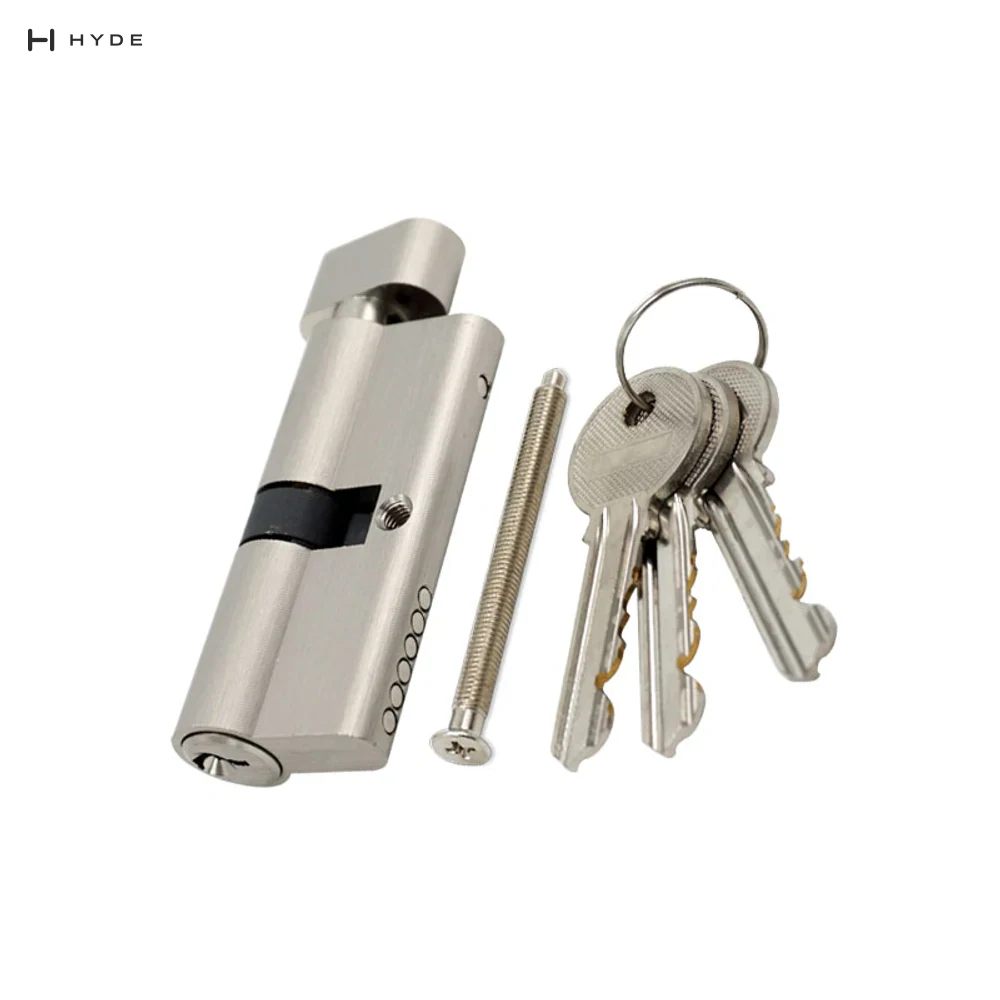
The number of plugs is what separates the three euro cylinder types. A double cylinder (Doppelzylinder) has two plugs, one in each half, and a key works each face; our records give the 60 SNDK and 70 SNDK a double key function. A key-and-thumbturn cylinder (Knaufzylinder) has one plug on the key side and a turn spindle on the other; the 70 SNKT-1 and 80 SNKT are photographed with a thumbturn. A half cylinder (Halbzylinder) has a single plug, and its cam sits at the inner end of the body instead of in the middle; the 45 SNIK photographs show that layout.
Pins, springs and the shear line: Stifte und Federn
Each pin chamber holds a stack of three parts. The key pin (Kernstift) rests on the key, and its length matches the depth of one cut. The driver pin (Gehäusestift) sits behind it. The spring (Feder) presses both toward the plug. With no key, every driver pin sits partly in the plug and partly in the body, so the plug cannot rotate.
Insert the right key and each key pin is lifted by exactly the depth of its cut. The gap between key pin and driver pin then lands on the shear line (Scherlinie, also called Trennlinie), the joint between plug and body, in every chamber at once, and the plug is free. A wrong key leaves at least one pin across that joint. That is the whole of the pin-tumbler principle. Keyed-alike sets and master key systems do not change it; they only change which pin lengths are loaded into which chamber.
The cam: Schließbart
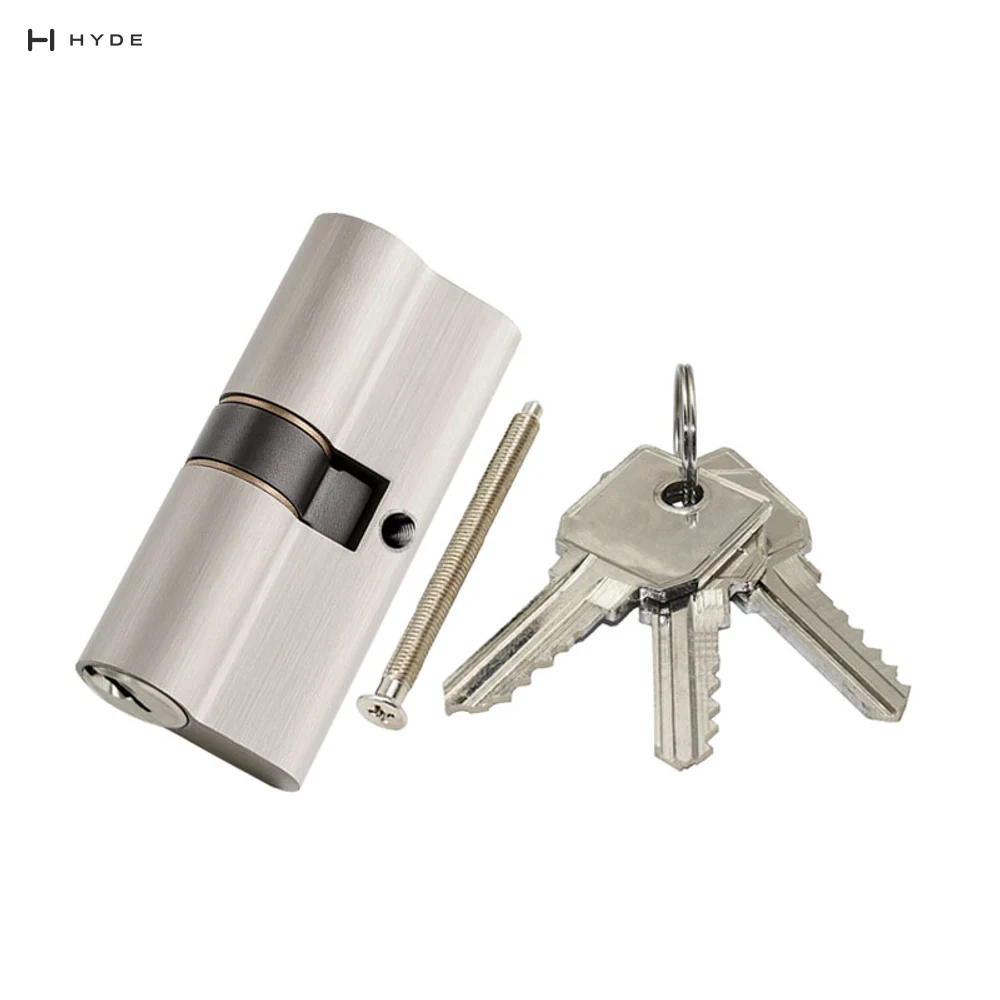
The cam, Schließbart in German and sometimes Schließnase, is the flat tab in the slot at the middle of the body. It is the only part of the cylinder that does work on the lock: as it rotates, it engages the mechanism in the mortise lock case and throws the deadbolt, and on many lock cases it also draws back the latch. On all five cylinders here it is the dark part in the central slot, or at the inner end on the 45 SNIK, and it is clearly visible in the photographs. Because the cam projects from the profile, it has to be turned to sit inside the profile outline before a cylinder will slide in or out of a lock case; that procedure is covered in our article on fitting a euro cylinder. Cams also come in other forms, such as adjustable or multi-position cams. Our photographs show a standard single cam, and our records do not publish an alternative.
The clutch: Kupplung
A double cylinder has two plugs and one cam, so a part has to decide which plug drives it. That part is the clutch (Kupplung), between the two plugs behind the cam. The side with a key inserted engages the cam; the other plug does not. In many designs a key left in one face keeps the clutch engaged on that side, which is why a key left on the inside can stop a key working from the outside. Our records for the 60 SNDK and 70 SNDK do not state the clutch type or whether an emergency function is fitted, so ask before you specify one. In a key-and-thumbturn cylinder the knob drives the cam through its own spindle, and the key drives it from the other side. On the 70 SNKT-1 and 80 SNKT the knob is a flat, rounded knob on a short stem at the inner end of the body.
The fixing screw: Stulpschraube
A euro cylinder is held in the door by one screw. The Stulpschraube passes through the faceplate (Stulp) on the edge of the door, through the lock case, and into a threaded hole in the web of the cylinder, on the center line of the cam. That hole is plainly visible on the 70 SNKT-1, 60 SNDK and 45 SNIK photographs, and the 60 SNDK and 80 SNKT are photographed with a long fixing screw beside the cylinder. Our records do not publish the screw thread or length, so confirm both if screws are being supplied separately.
Five cylinders, one anatomy
Scroll sideways to compare columns. Select a column heading to sort; select it three times to restore source order.
| 70 SNKT-1 | 70 mm | Key and thumbturn (photographs) | Keyway face, cam, threaded fixing hole, thumbturn |
|---|---|---|---|
| 80 SNKT | 80 mm | Key and thumbturn (photographs) | Cam, fixing hole, thumbturn, long fixing screw, keys |
| 70 SNDK | 70 mm | Double key (record) | Keyway face, sealed pin chambers on both halves, cam, keys |
| 60 SNDK | 60 mm | Double key (record) | Keyway face, cam, threaded fixing hole, long fixing screw, keys |
| 45 SNIK | 45 mm | Half cylinder (photographs) | Keyway face, sealed pin chambers, cam at the inner end, fixing hole |
5 rows · Source order
Words that get mixed up
In English, barrel is used for both the body and the plug, which causes confusion on a parts list. In German, Zylinder means the whole assembly and Kern means only the rotating plug, so a German-speaking client who writes Kern is asking about the plug, not the whole cylinder. Schließbart and Schließnase both mean the cam. Zuhaltungen is the general German word for the locking elements; in a pin-tumbler cylinder those are the Stifte. Gehäuse, the body, should not be confused with Schlosskasten, the mortise lock case the cylinder sits in.
Which part is at fault when a cylinder misbehaves
Knowing the parts makes a fault report useful. A key that goes in but will not turn usually points to the pin stacks: dirt in the chambers, worn pins, or a worn key whose cuts no longer lift the pins to the shear line. A key that turns without moving the bolt points to the cam or the clutch, or to a cam that is not engaging the lock case. A key that will not come out after turning usually means the cam has not returned to its rest position, known as a slipped cam, which can happen on a double cylinder when keys are used from both sides at once. Telling a supplier which of the three you see is more useful than reporting that the cylinder is broken.
What our records publish, and what they do not
For the cylinders in this article, our records publish the length (45, 60, 70 or 80 mm), solid brass construction, the satin nickel finish (SN) and, for the 60 SNDK and 70 SNDK, the double key function. They do not publish the pin count, the material of the pins, springs or cam, the clutch type, the fixing-screw thread or the number of keys supplied. Where a detail is not published, we say so rather than print a figure we have not confirmed. Ask our export team and you will receive the measured answer for the model you are ordering.
Questions this answers
What are the parts of a euro cylinder lock?
A euro profile cylinder (Profilzylinder) has a body (Gehäuse), one or two plugs (Kern), pin stacks made of key pins and driver pins (Stifte), springs (Federn) and a cam (Schließbart) in the middle. A double cylinder adds a clutch (Kupplung) between its plugs, a key-and-thumbturn cylinder adds a turn knob (Knauf), and one fixing screw (Stulpschraube) holds the cylinder in the lock case.
What is the Schließbart on a Profilzylinder?
The Schließbart is the cam: the flat tab in the slot in the middle of the cylinder body, or at the inner end of a half cylinder. It turns with the plug and engages the mortise lock case to throw the bolt. It is the only part of the cylinder that does work on the lock.
What is the difference between the plug and the body of a cylinder?
The body (Gehäuse) is the fixed outer part with the euro profile shape. The plug (Kern) is the part that rotates inside the round head of the body and carries the keyway. The pins block the joint between the two until the right key is inserted; that joint is the shear line.
How many pins does a euro cylinder have?
It varies by design and is not visible from outside, because a drilled chamber is not necessarily a loaded one. Our records for the 70 SNKT-1, 70 SNDK, 60 SNDK, 80 SNKT and 45 SNIK do not publish a pin count; ask on the inquiry and we confirm it per model.
What does the clutch do in a double euro cylinder?
A double cylinder has two plugs and one cam. The clutch (Kupplung) between the plugs connects whichever plug has a key in it to the cam. In many designs a key left in one face keeps the clutch on that side, so a key from the other face cannot turn the cam.
Related products
Lock Cylinder
Model 70 SNKT-1
Solid Brass
Lock Cylinder
Model 70 SNDK
Solid Brass
Lock Cylinder
Model 60 SNDK
Solid Brass
About Canton Hyland — Canton Hyland manufactures panic exit devices, locks and architectural door hardware for commercial and institutional projects, supplying specifiers and distributors internationally.