
Which Exit Device Standard Your Project Is Actually Under
EN 1125 and ANSI/BHMA A156.3 are not two grades of the same thing. They come from different building codes, measure different failures, and a device built to one is not automatically acceptable under the other. The standard is decided by where the door is, not by what you prefer.

Johnson LiuDigital Communications, Canton HylandMA Digital Media, Johns Hopkins University
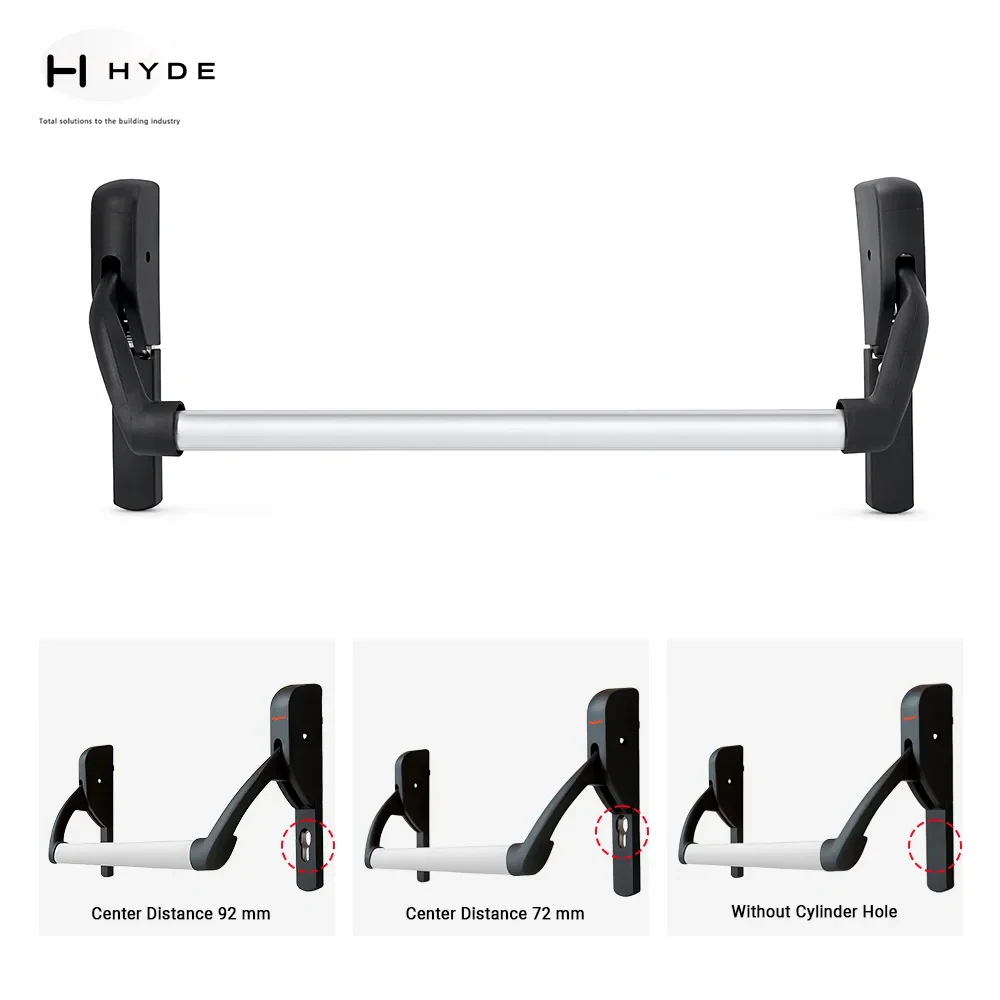
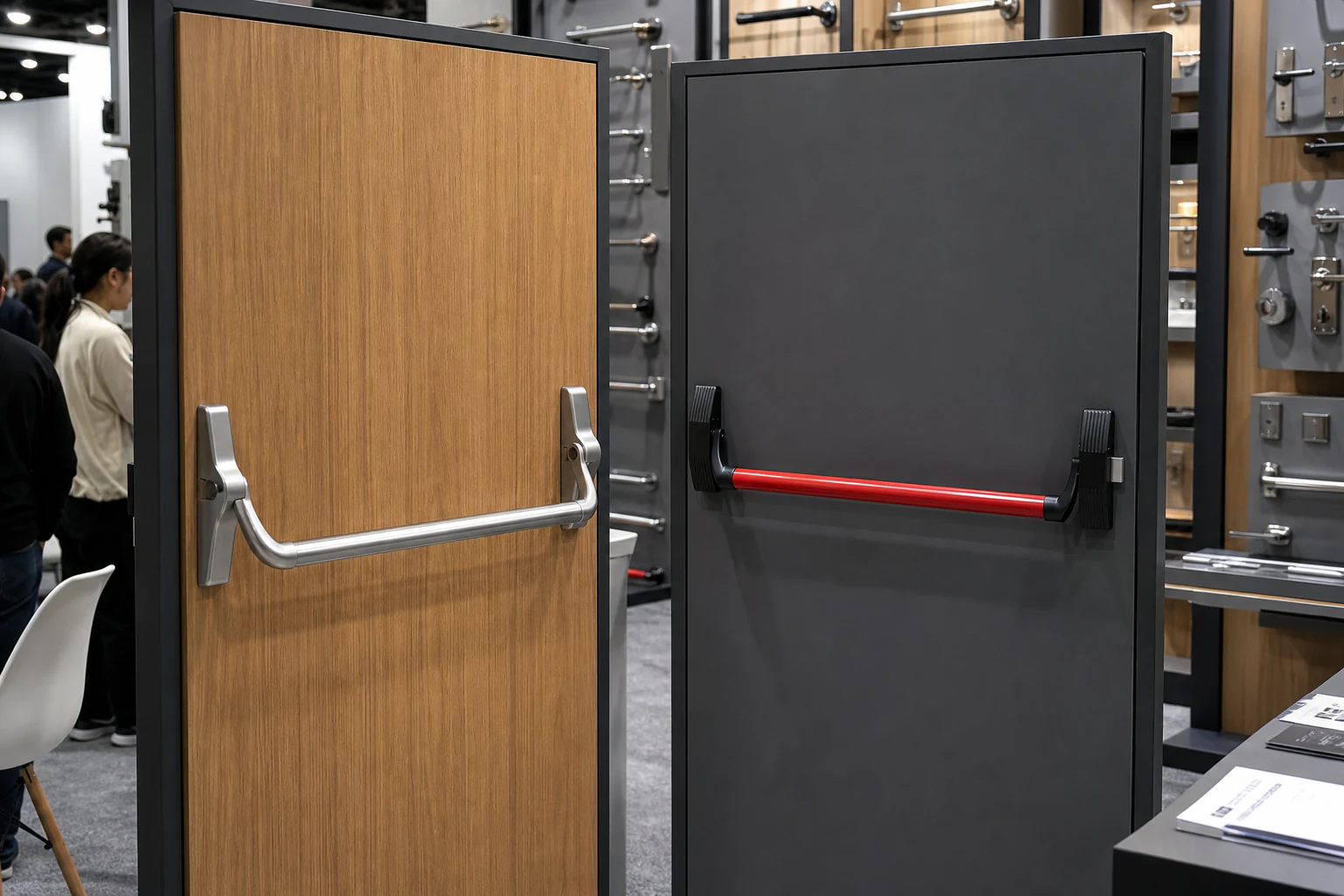
Buyers ask us for "a CE panic bar" or "an ANSI Grade 1 exit device" as though the two were points on one scale, with CE somewhere below ANSI or the other way round. They are not. They are two separate regulatory systems, written by different bodies for different building codes, and the question of which one applies is settled before anyone chooses a supplier, by where the door is and what the authority having jurisdiction there enforces.
HYDE (Canton Hyland, Zhongshan, since 1998) makes the 307, 305 and 310 covered in this article.
EN 1125 is the European standard for panic exit devices operated by a horizontal bar, on escape routes used by the public. Its companion, EN 179, covers emergency exit devices operated by a lever or push pad, for buildings where the occupants know the building and are unlikely to panic, a staff corridor rather than a cinema. The distinction is about the people behind the door, not the hardware: EN 1125 assumes a crowd pressing forward, which is why the operating element has to run most of the door width and release under a load applied anywhere along it.
ANSI/BHMA A156.3 is the North American standard for exit devices, and it grades products 1, 2 or 3 on a cycle-test basis. A Grade 1 device is tested to a higher cycle count than Grade 3; both are Grade-rated exit devices. That is a durability classification, and it is doing a different job from EN 1125's, which is a conformity assessment against a set of pass/fail requirements including fire performance and release force. "Grade 1" and "EN 1125" are not comparable claims. A device can hold one, both, or neither.
Fire rating is a third axis again, and the one most often collapsed into the other two. A fire-rated exit device has been tested as part of a fire door assembly, and the certificate covers that assembly (the leaf, the frame, the hinges, the closer and the device together) not the device on its own. This is why a supplier who answers "is it fire rated?" with a simple yes is either simplifying or has not read their own report. Ask what assembly was tested, and by whom.
So the practical sequence is: where is the door, what does the local authority enforce, is it on an escape route, will the public use it, and is the opening fire rated. Those five answers select the standard. Only then does the hardware conversation start, and by that point most of the catalog has already been excluded.
Where we sit in that: our EN 1125 test evidence is a report from Intertek Testing Services Shenzhen Ltd., Guangzhou Branch, reference 130722068GZU-001, issued 7 November 2013, and it covers one model, KD070/30-290. There is also a CE Certificate of Conformity to EN 1125:2008 from CELAB in Italy, 2010, covering the panic exit device series. We publish both with their exact scope on our certifications page, and we do not present either as blanket approval for every device we make, because it is not. If your specification needs current evidence against the current edition of a standard for a specific model, the honest answer is often that a re-test is required, and it is better to know that before the order than after the inspector asks.
One thing worth checking early, whichever standard applies, is whether the device suits the door leaf you actually have. A rim device fixes to the face of the door and needs a strike on the frame. A mortise device needs a lock case pocket cut into the leaf edge. A vertical-rod device throws bolts into the head and threshold and is what a pair of doors with no center mullion requires. Getting that wrong is not a compliance problem, it is a physical one, and it is discovered on site.
Single leaf, pair of doors: the device follows the opening
Our article comparing ANSI Grade 1 and EN 1125 goes through the certificate itself, the classification digits and the one-line specification. This one is about the step before and after the certificate: whether the device physically suits the opening, because a compliant device on the wrong leaf is still the wrong device.
On a single leaf the usual answer is a rim device: the bar mounts on the face of the door and its latch engages a strike on the frame. The 316-S is that arrangement, surface mounted, push to open, published for fire doors and emergency exit doors, and reversible left or right.
A pair of doors is where specifications go wrong, because the inactive leaf has nothing on the frame to latch into unless there is a center mullion. Without one, the latching has to go up and down instead of sideways. The 316-D is published with top and bottom latching for exactly that case. The 320 engages the head and the threshold as a two-point locking device for tall doors or higher security, and its length is made to the customer's request rather than cut from a standard bar. The 309-D is a paired set that coordinates the active and inactive leaf, published with a 1110mm (43-11/16") bar for fire-rated double escape doors.
One honest gap here: the 306-D is listed as a double-door device, distinguished from the 306-S by leaf count, and its dimensions are not yet published. We will not size it by analogy with its neighbors, ask, and we will measure it.
Top-and-bottom latching brings one site consequence that belongs in the specification, not the snag list. A bottom bolt needs a keep in the floor, and that keep has to be set with the floor finish, not drilled into it afterwards. On a stone or resin floor, forgetting it until the doors are hung means cutting a finished floor.
The outside of the door is a separate decision
The device is on the escape side. What happens on the other side is a second choice, and it changes both the price and the part list, so it deserves its own line on the schedule.
The options run from nothing at all (an exit-only door with a plain outside face) to a lever that is always free, to a lever that is locked and opened by key. Our trims cover that spread. The 023 PS is a passage trim. The 016 is an outside lever with a key, key operated and reversible. The 028 is an external lever with key-operated locking and unlocking. The X2 is a brass trim supplied with three brass keys. The 023 ETAN is an anti-pick keyed trim for doors where the outside face is exposed to tampering.
The row that gets missed is door thickness, because it belongs to the trim as much as to the device. The 028 is published for doors of 35–55mm (1-3/8" to 2-3/16"), the 039 for 45–50mm (1-3/4" to 1-15/16"), the 015 for doors up to 80mm (3-1/8") and the X2 for doors up to 90mm (3-9/16"). A trim that fits the device and not the leaf is a trim that arrives and cannot be fixed. Check the leaf thickness against the trim, not just against the bar.
And check the quotation, because on some of our devices the outside lever is not part of the price. The 316-S and 316-D are both published with the outside lever as optional and not included in the listed price. Comparing that price against a competitor's device-plus-trim figure is comparing half an assembly with a whole one.
Pairs of doors: which leaf closes first
A pair of doors with an overlapping astragal (the strip on one leaf that covers the meeting gap) has to close in order. If the leaf carrying the astragal arrives first, the other leaf closes against it and stops short, and on a fire door a leaf that has not latched is a door that has failed. The fix is a door coordinator, which holds the active leaf open until the inactive leaf has closed, and it belongs on the schedule from the start, not after the first failed test. Our article on the door coordinator for double fire doors covers the fitting in detail.
On the escape side, each leaf still has to open from inside with one movement. That is why a coordinated set such as the 309-D treats the active and inactive leaf as two devices designed to work together, rather than two single devices bolted onto one opening.
Alarms, dogging, and what an authority may refuse
Two optional functions change what the authority will say about a door. An alarmed device, such as our 314, keeps a door available for escape while discouraging casual use: it is published with key access from outside, push-bar exit from inside and a built-in alarm, in 650, 800 and 1000mm lengths (25-5/8", 31-1/2", 39-3/8") or to order. Dogging holds the latch retracted so a door can be pushed freely during opening hours; the 314 lists it as an option.
Dogging is where specifications meet regulation. A door that must latch to perform (a fire door being the usual case) is commonly not allowed to be held unlatched by the hardware, and some authorities have their own rules on alarmed exits. We supply the function; whether it may be used on a particular door is the authority's decision, and the right time to ask is before the device is chosen.
The five lines, filled in
Here is what the door schedule described below looks like when it is actually written for one opening, a hypothetical pair of doors from a school hall onto an escape corridor: timber leaves, 54mm thick; pair of doors, no center mullion, overlapping astragal; fire rated to the local requirement; the authority enforces EN 1125; outside access by keyed lever for staff only.
Those five lines alone decide most of the part list: a top-and-bottom latching or coordinated pair device rather than a rim device, a door coordinator because of the astragal, a keyed trim published for a 54mm leaf, and a question to the authority about dogging before anyone offers it. None of that needed a model number to begin with, which is the point.
Send us the door schedule rather than a product code. What we need is the leaf material and thickness, whether the opening is single or double, whether it is fire rated and to what, which standard the authority enforces, and whether outside access is required, and if so, by lever, by key, or not at all. That is five lines, and it is enough for our engineering desk to name the devices that can actually be specified rather than the ones we would like to sell.
Questions this answers
Is there an ANSI equivalent to the EN standard for exit devices?
There is no equivalent, because the two are not measuring the same thing. ANSI/BHMA A156.3 grades products 1, 2 or 3 on a cycle-test basis, a durability classification. EN 1125 is a conformity assessment against a set of pass/fail requirements including fire performance and release force. "Grade 1" and "EN 1125" are not comparable claims, and a device can hold one, both, or neither.
What is the difference between EN 1125 and EN 179?
The people behind the door, not the hardware. EN 1125 covers panic exit devices operated by a horizontal bar on escape routes used by the public, it assumes a crowd pressing forward, which is why the operating element has to run most of the door width and release under a load applied anywhere along it. EN 179 covers emergency exit devices operated by a lever or push pad, for buildings where the occupants know the layout: a staff corridor rather than a cinema.
Does a fire-rated certificate for an exit device cover the door?
No. A fire-rated exit device has been tested as part of a fire door assembly, and the certificate covers that assembly (the leaf, the frame, the hinges, the closer and the device together) not the device on its own. A supplier who answers "is it fire rated?" with a simple yes is either simplifying or has not read their own report. Ask what assembly was tested, and by whom.
What does Canton Hyland actually hold?
An EN 1125 test report from Intertek Testing Services Shenzhen Ltd., Guangzhou Branch, reference 130722068GZU-001, covering one model (KD070/30-290) and a CE Certificate of Conformity to EN 1125:2008 from CELAB in Italy covering the panic exit device series. Both are published with their exact scope on our certifications page, and neither is presented as blanket approval for every device we make, because it is not.
What exit device does a pair of doors without a center mullion need?
One that latches up and down rather than sideways, because the inactive leaf has nothing on the frame to latch into. Our 316-D is published with top and bottom latching; the 320 is a two-point device engaging head and threshold, made to length; the 309-D is a paired set that coordinates the active and inactive leaf for fire-rated double escape doors. A bottom bolt needs a floor keep set with the floor finish, and a pair with an overlapping astragal also needs a door coordinator.
Is the outside lever included with a panic bar?
Not always, and it changes the comparison. On our 316-S and 316-D the outside lever is optional and not included in the listed price. Outside access is its own decision (none, a lever that is always free, or a keyed lever) and the trim has its own door-thickness range: the 028 is published for 35–55mm doors, the 039 for 45–50mm, the 015 up to 80mm and the X2 up to 90mm. Check the leaf thickness against the trim as well as the bar.
Related products
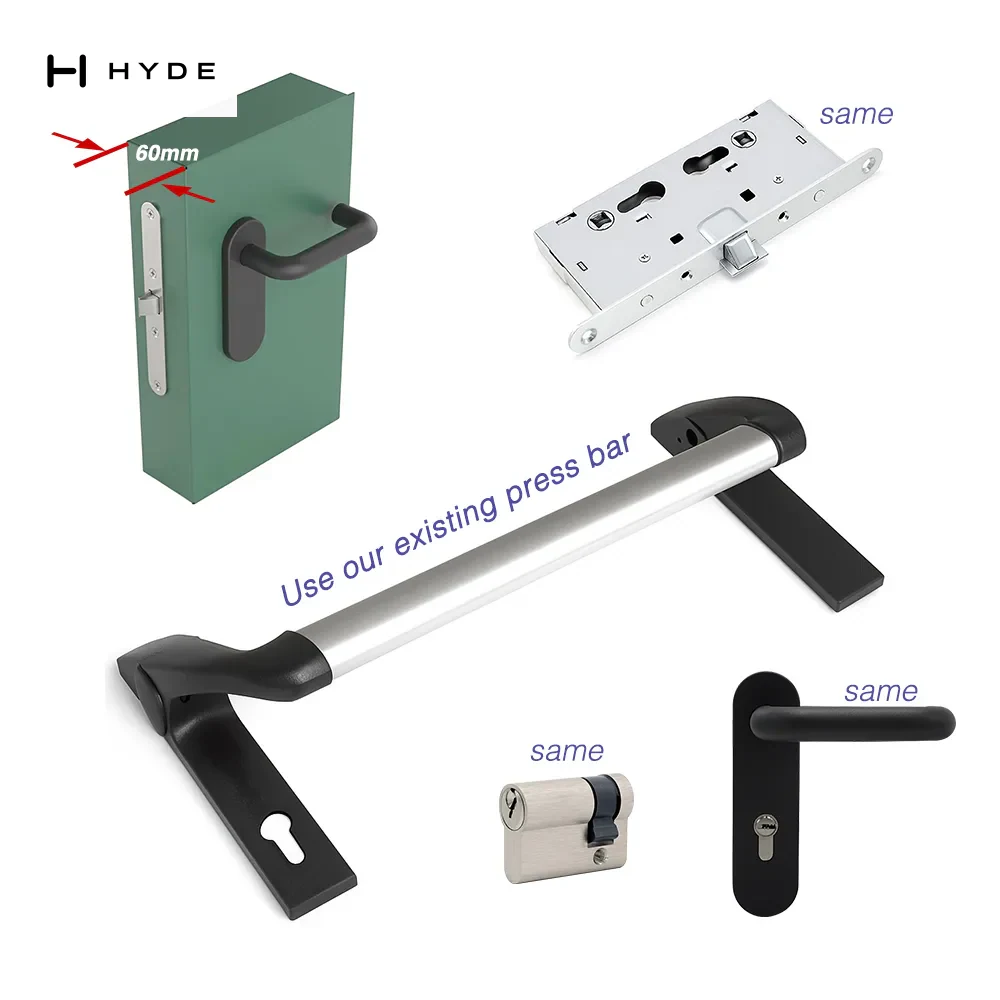
Size 1000mm
Panic Exit Device
Model 307 · Video
Aluminum alloy body, iron bar
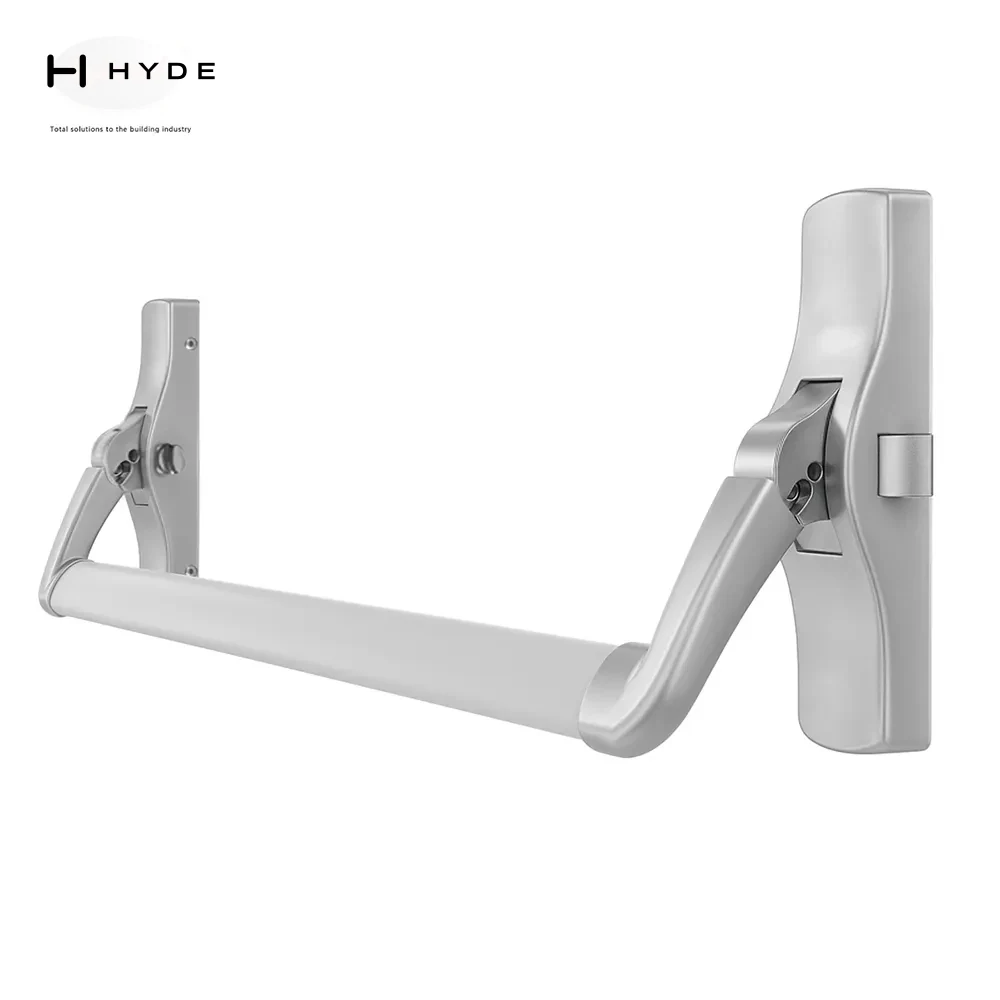
Length 1040mm
Fire Door Panic Exit Device
Model 305 · Video
Aluminum alloy body, iron bar
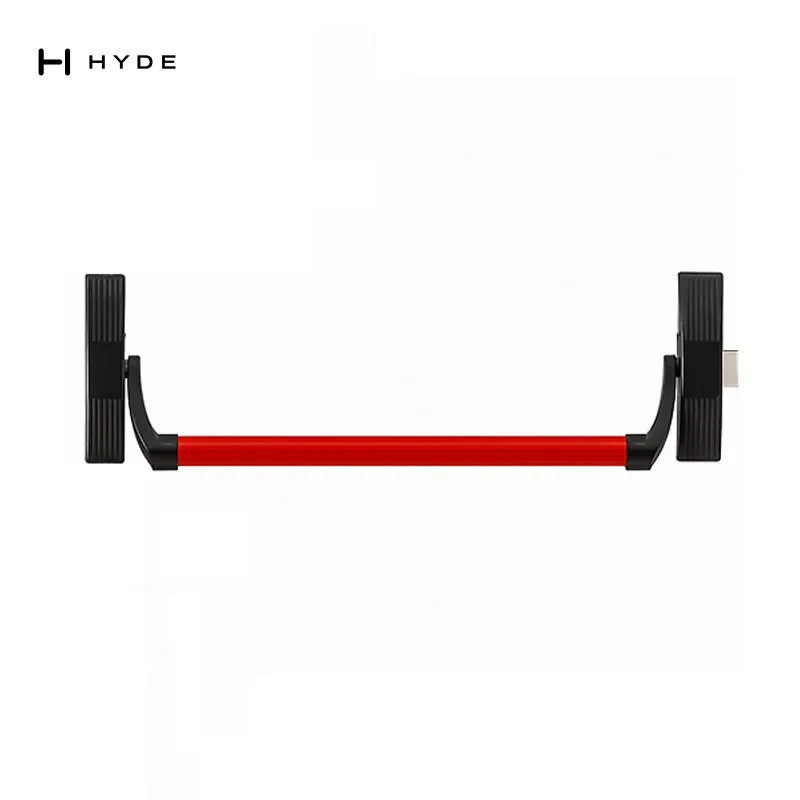
Length 900mm
Panic Exit Device
Model 310 · Video
Aluminum alloy body, iron bar
About Canton Hyland — Canton Hyland manufactures panic exit devices, locks and architectural door hardware for commercial and institutional projects, supplying specifiers and distributors internationally.