
Double-Action Doors: Spring Hinge or Floor Spring
A double-action door swings both ways and returns to center on its own. On a timber kitchen, restaurant or corridor door that is done with double-action spring hinges or with a floor spring and top pivot. This note sets SSH031 against the D-5061 and D-1032 floor springs by what each record publishes, and says plainly where a door weight is not published.

Johnson LiuDigital Communications, Canton HylandMA Digital Media, Johns Hopkins University
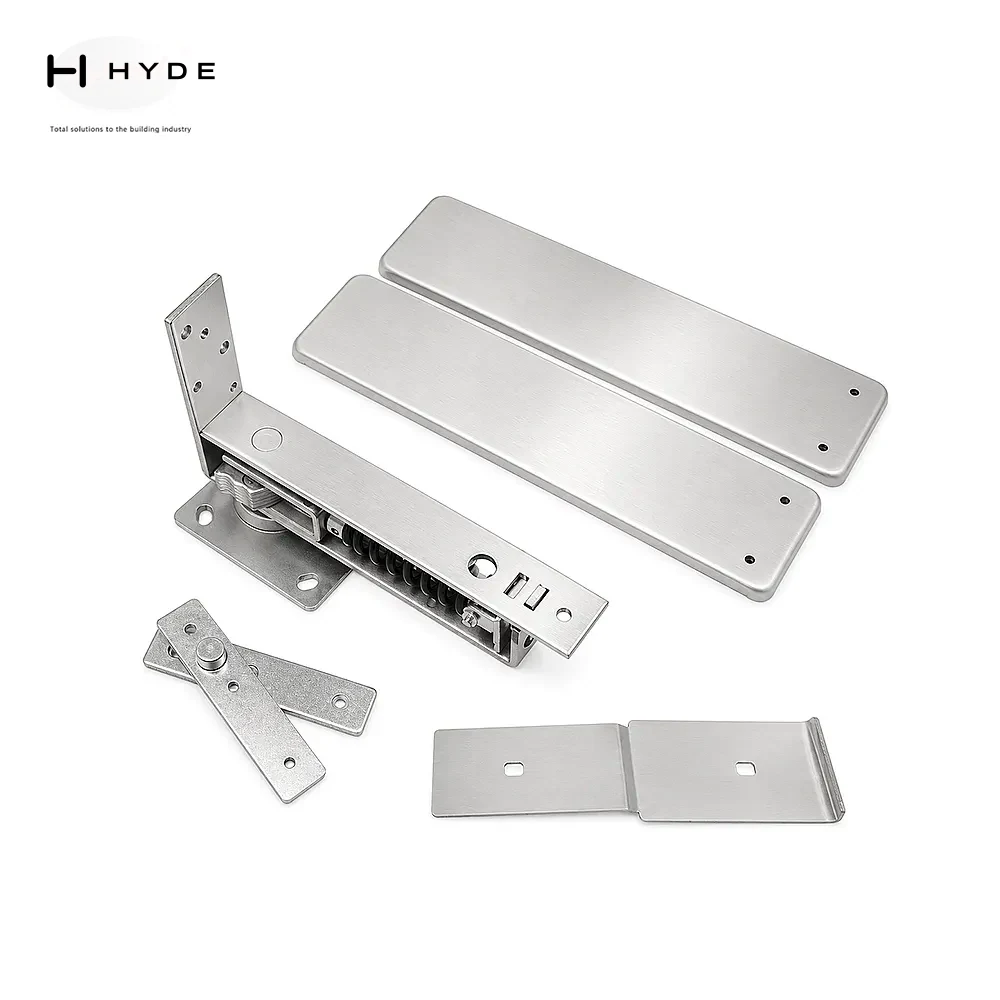
A double-action door swings both ways and comes back to the center line by itself. On a timber door two kinds of hardware do that: double-action spring hinges screwed to the door edge and the frame, or a floor spring with a top pivot, which carries the leaf on a spindle and controls its return hydraulically. The short answer is spring hinges for a light door where a quick, undamped return is acceptable, such as a café, bar or pantry door, and a floor spring when the door is heavy, wide or busy, or when people walk through it carrying things, because only the floor spring controls the closing speed.
In our catalog that means SSH031 on one side and the D-5061 and D-1032 floor springs on the other. Of these, only the floor springs publish a door weight. The Wooden Door Floor Hinge and F101 sit in the floor spring category too, but neither publishes a door weight, so neither can be chosen against a leaf from the website. What follows is how to choose, and what changes in the frame, the lock and the door once it swings both ways.
What double action changes before any hardware is chosen
A single-action door closes against a stop: a rebate or bead in the frame that it rests on, and that a latch can engage. A double-action door has nothing to close against. It passes through the frame line in both directions, so the frame has no stop, and the door is held at center only by the force that returns it. Three consequences follow, whichever hardware is chosen.
First, there is no latch in the ordinary sense. A latch needs a strike on a stop to hold against, and a door that swings both ways has neither. Every passage is a push, so the door usually carries push plates on both faces. If it must be secured out of hours, that is a separate bolt or lock decision, made with the frame and the floor in mind; a standard lever set cannot do it.
Second, people meet each other through it. A kitchen door with servers going out and coming back is a classic collision point, which is why these doors usually have a vision panel, and why a pair is often split into an in-door and an out-door. That is the architect's call. For the hardware it means one thing: take the leaf weight from the finished door, glazing included, not from the blank.
Third, the door overshoots. Released from 90°, a double-action leaf swings past center into the other side before it settles. How it settles is the real difference between the two kinds of hardware.
Double-action spring hinge: SSH031
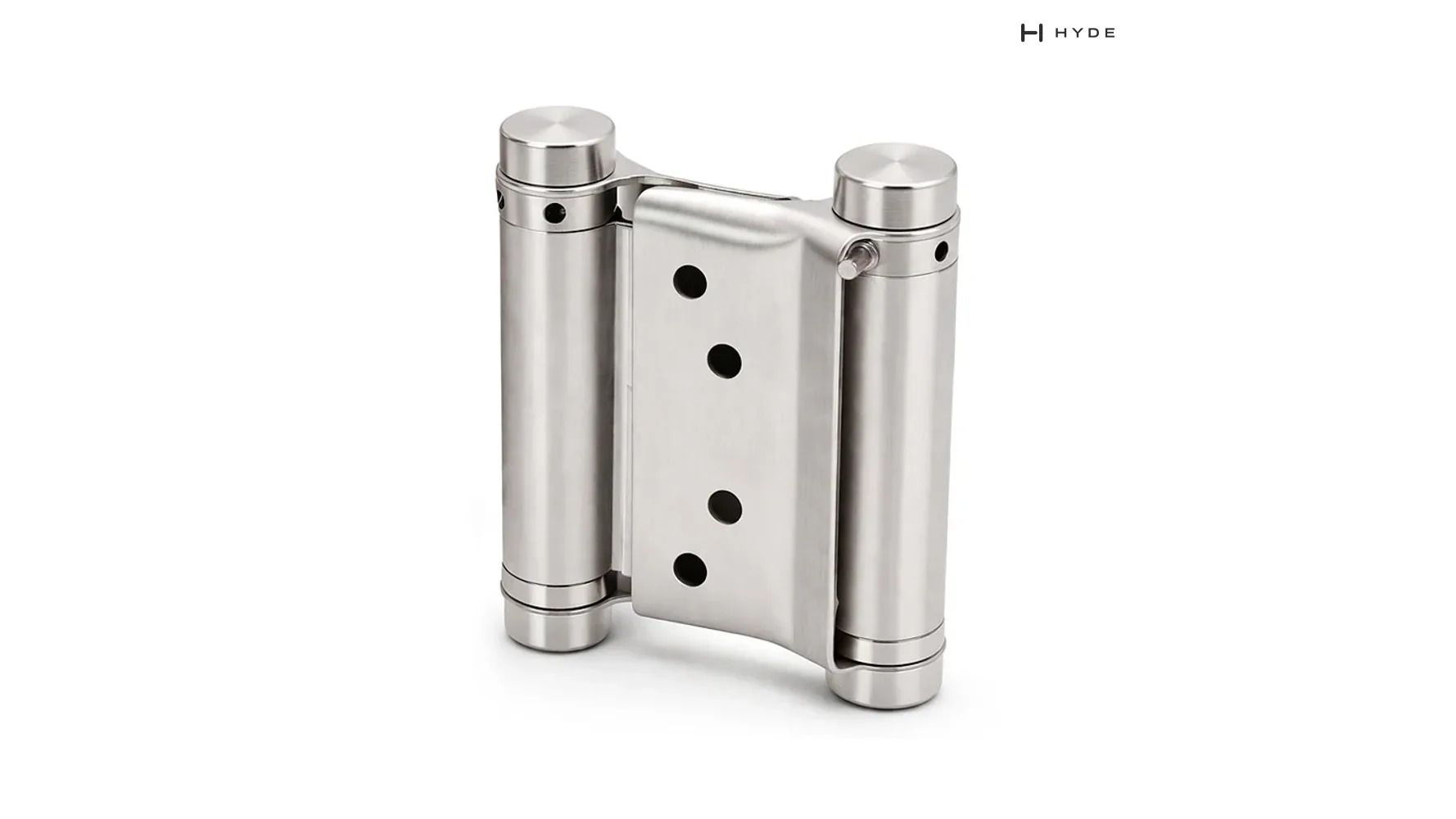
A double-action spring hinge has two spring barrels joined by a center plate. One leaf fixes to the door edge, the other to the frame, and whichever way the door is pushed, one barrel winds up and brings it back. SSH031 is a stainless steel hinge, 4” × 3”, with a published opening of 180° in total, 90° each way, adjustable spring tension, and no handing: the same part fits either side of the opening. The listed finishes are stainless steel, polished stainless steel, antique brass, antique copper and PVD, and the record names café, kitchen and swing doors as the application.
What a spring hinge does not have is hydraulic control. The spring returns the door and nothing slows it down. On a light leaf that is fine: the door swings past center a few times and stops. On a heavier leaf, or with the tension turned up so it closes at all, the door comes back fast and keeps flapping, and the person behind the server takes it on the tray. Turning the tension down to soften the return also means the door may stop short of center. That trade-off is built into the part; it is not a setting.
The other limit is published data. SSH031 lists no maximum door weight, no maximum door width and no number of hinges per door. So the decision cannot be made from the record alone: send us the leaf size, thickness and material, and we will confirm the hinge and how many the door needs, rather than leaving a third hinge to be decided on site.
Fitting is surface work. The barrels stand proud of the door edge, so the hinge side of the opening shows the hardware and has a wider gap than a door on ordinary butt hinges. In exchange there is no floor preparation, no recess and nothing to coordinate with the screed, which makes spring hinges the practical choice for converting an existing opening.
Floor spring: D-5061 and D-1032
A floor spring carries the door on a spindle at the bottom and a top pivot at the head, and returns it through a spring whose speed is governed by hydraulic valves. D-5061 and D-1032 are both listed as double action, for timber and metal doors, with a two-stage closing valve, a 90° hold-open and a maximum opening angle of 125°, in satin stainless or matt black. Unlike the hinge, each publishes per variant the door weight and width it is for:
Scroll sideways to compare columns. Select a column heading to sort; select it three times to restore source order.
| D-5061.50 | 50 kg (110 lb) | ≤700 mm | ≥40 mm | EN2 | Aluminum + steel |
|---|---|---|---|---|---|
| D-5061.80 | 80 kg (176 lb) | ≤900 mm | ≥40 mm | EN3 | Aluminum + steel |
| D-1032.60 | 60 kg (132 lb) | ≤800 mm | ≥42 mm | EN3 | 45# steel |
| D-1032.100 | 100 kg (220 lb) | ≤1100 mm | ≥42 mm | EN4 | 45# steel |
4 rows · Source order
The closing force column uses the power-size notation of EN 1154, the European standard for controlled door closing devices, in which a higher number means a stronger closing force for a wider, heavier door. Read it as a size, not as a test result. Pick the variant whose weight and width both cover your leaf with a margin. When a leaf falls between two variants, take the larger one: a floor spring that is short of power is the one that never quite reaches center.
The two-stage valve is what the hinge lacks. One stage controls the sweep from open, the other the last part of the travel into center, so a busy kitchen door can be set to come back steadily and settle instead of flapping. That is the reason to specify a floor spring for a restaurant, even where a pair of hinges could physically carry the leaf.
Two practical points before ordering. Neither record publishes the recess or installation drawing, so ask for it before the floor or the leaf is prepared, because a floor spring cannot be moved once it is set. And the floor spring needs a top pivot at the head of the door, on the same vertical axis as the spindle; it is a separate line on the order. When the two are out of line, the door binds as it swings and drifts off center when it closes.
The 90° hold-open is useful on a kitchen door during service. On a corridor door that forms part of a fire or smoke compartment it is a liability, because a door held open mechanically is an open door at the moment it matters, and fire-door practice does not accept it. If the door has a fire role, say so when you enquire, and confirm with us whether the hold-open can be left out.
Wooden Door Floor Hinge and F101: what is and is not published
The Wooden Door Floor Hinge is listed as a concealed floor spring for wooden doors, supplied with pivot brackets, cover plates and a top center. Its record publishes no door weight, no door width and no closing force, and it does not say whether it is single or double action; the full specification is still being confirmed with the factory. It is a part to ask about, not one to order from the page.
F101 is a floor spring with an iron body and 304 stainless steel outer plates, a 308 × 108 mm footprint and a 40.5 mm case depth, with adjustable latch and closing speed. It publishes no door weight and does not state double action either. Its dimensions help check the depth available in a floor, but neither of these two can be matched to a leaf from the published data, and we would rather say so than let a page imply a capacity nobody has stated.
Choosing between them
Scroll sideways to compare columns. Select a column heading to sort; select it three times to restore source order.
| Door weight published | No | Yes, 50 to 100 kg by variant |
|---|---|---|
| Closing speed control | Spring tension only | Two-stage hydraulic valve |
| Opening | 90° each way | 125° maximum |
| Hold-open | None listed | 90° |
| Visible hardware | Barrels on the hinge edge | Spindle connector and top pivot |
| Preparation | Screws to door and frame | Recess to a drawing (ask for it); top pivot at the head |
| Typical door | Light café, bar and pantry doors; conversions of existing openings | Restaurant kitchen, corridor and heavier timber doors |
7 rows · Source order
A rule that holds up: if the door is light, the traffic is occasional and some flapping is acceptable, SSH031 is the simpler order. If the door is heavy, the traffic is constant, people carry trays or push carts through it, or the closing has to be predictable, specify a floor spring and choose the variant by weight and width together. When a leaf is outside every published figure, it is outside, and we will tell you so rather than stretch a number.
To settle a double-action door in one reply, send the leaf height, width and thickness; the finished weight, or the material and core; whether it is timber or metal; the traffic it carries; whether it has a fire or smoke role; and whether it must lock. With those facts we can name the hinge or the floor spring variant, the top pivot that goes with it, and anything the published records do not yet answer.
Questions this answers
What is a double-action door hinge?
A double-action spring hinge has two spring barrels joined by a center plate, so the door can be pushed either way and the spring brings it back to center. SSH031 is a 4” × 3” stainless steel example, with 90° of opening each way, adjustable spring tension and no handing. It has no hydraulic control, so the door swings past center a few times before it settles.
Should a restaurant kitchen door use spring hinges or a floor spring?
A floor spring, in most cases. A busy kitchen door with people carrying trays needs a controlled return, and only a floor spring has hydraulic valves to give it; D-5061 and D-1032 list a two-stage closing valve. Spring hinges such as SSH031 suit light, occasionally used doors, where a quick return with some flapping is acceptable.
How much door weight can a double-action floor spring carry?
It depends on the variant, and both weight and width must fit. D-5061 is published for 50 kg or 80 kg doors (up to 700 mm or 900 mm wide), D-1032 for 60 kg or 100 kg doors (up to 800 mm or 1100 mm wide). The Wooden Door Floor Hinge and F101 publish no door weight, so ask us before choosing either.
Can a double-action door have a latch or a lock?
Not a normal latch, because a door that swings both ways has no stop in the frame for a latch to engage. These doors usually carry push plates on both faces. If the door must be secured out of hours, that needs a separate bolt or lock, planned together with the frame and the floor.
Related products
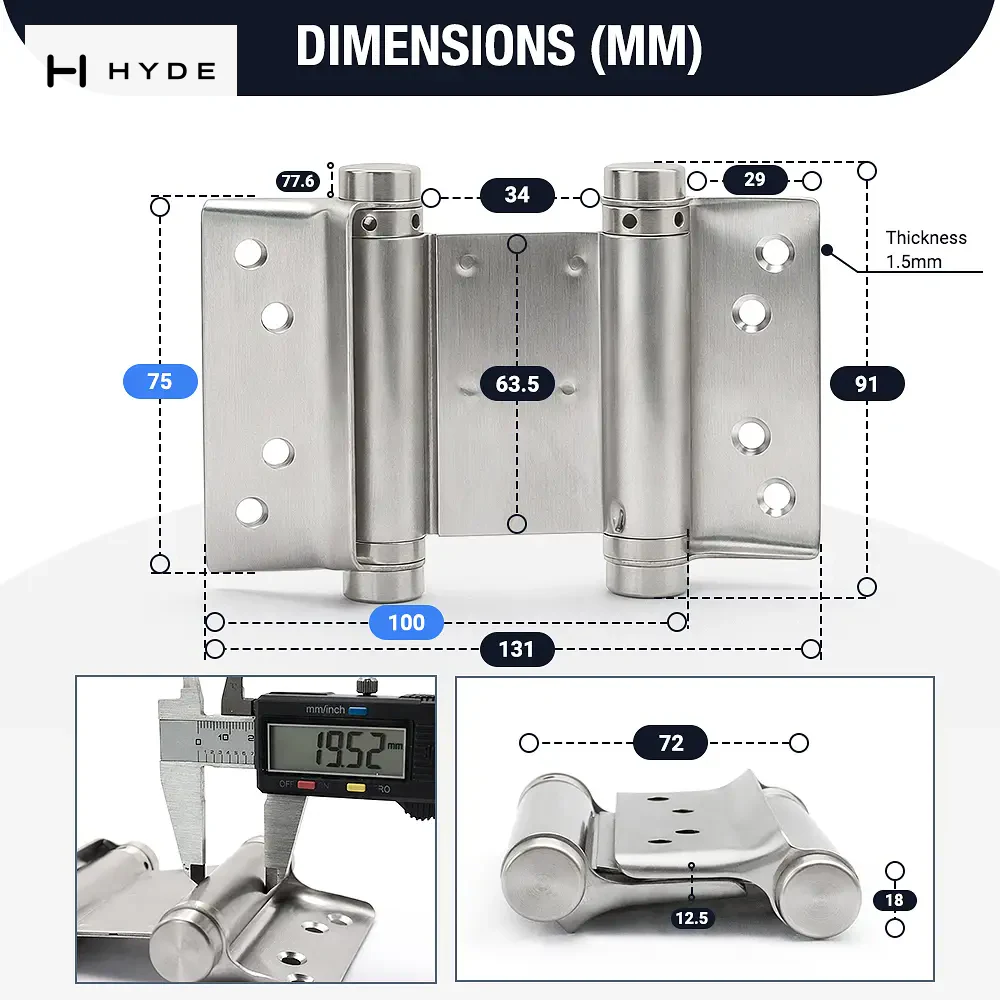
Size 4” × 3”
Brass and Steel Hinges
Model SSH031 · Video
Stainless Steel
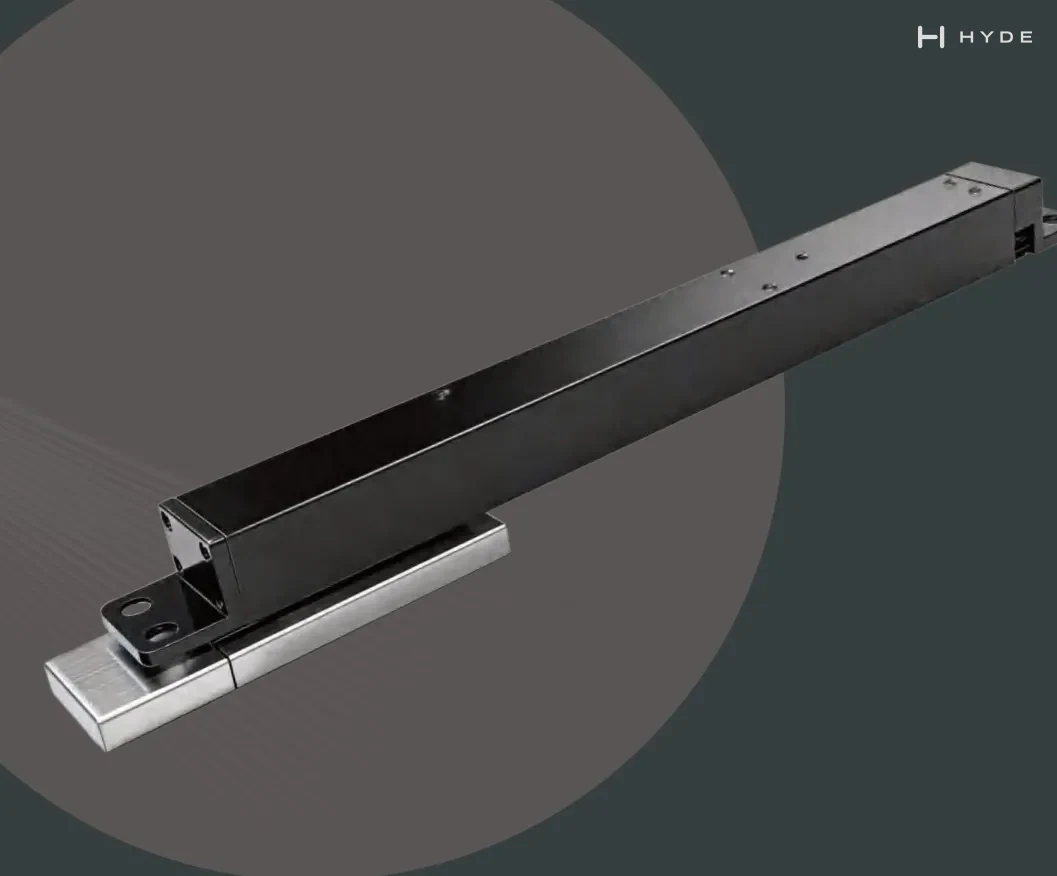
Floor Spring
Model D-5061
Aluminum + steel
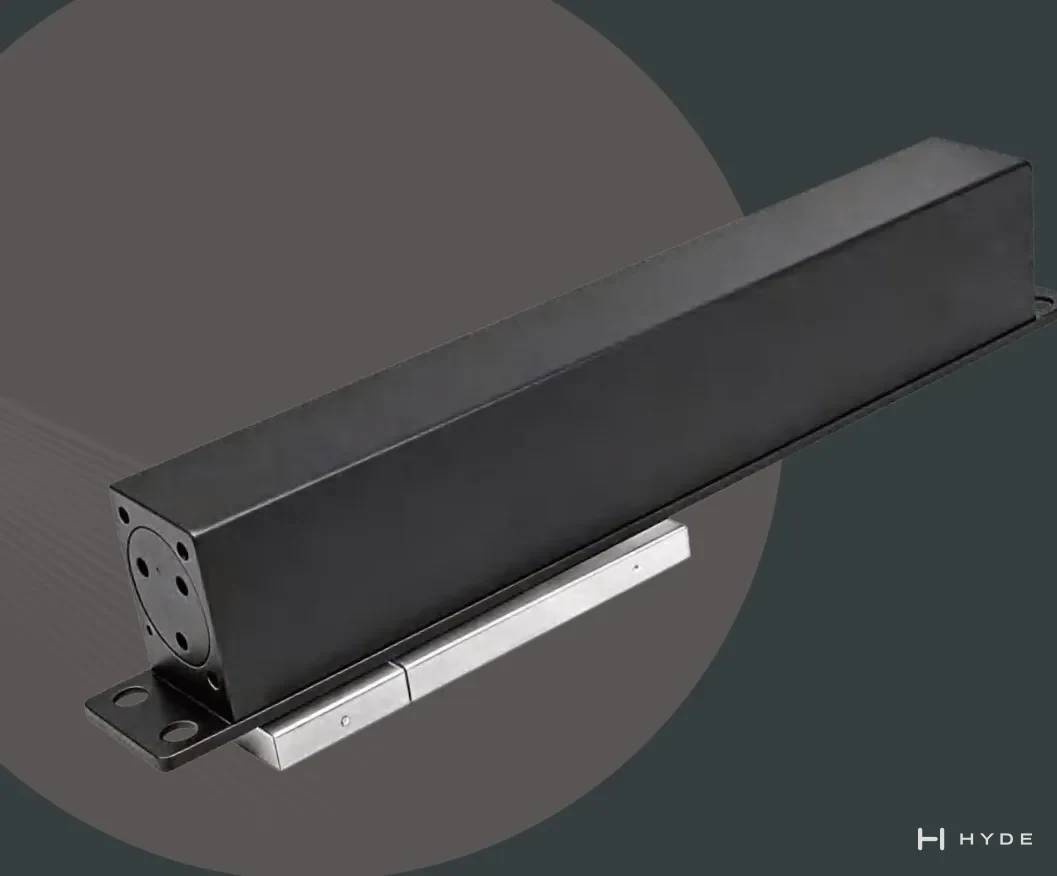
Floor Spring
Model D-1032
45# steel
About Canton Hyland — Canton Hyland manufactures panic exit devices, locks and architectural door hardware for commercial and institutional projects, supplying specifiers and distributors internationally.