
UL 305 Is a Listing, Not a Grade
EN 1125 is a standard you test against. ANSI/BHMA A156.3 is a standard that grades you 1, 2 or 3. UL 305 is neither — it is the basis for a listing, which is an ongoing arrangement with a certification body rather than a document you hold. Confusing the three is how a compliant-looking device fails a submittal.
Insight
Johnson LiuDigital Communications, Canton HylandMA Digital Media, Johns Hopkins University
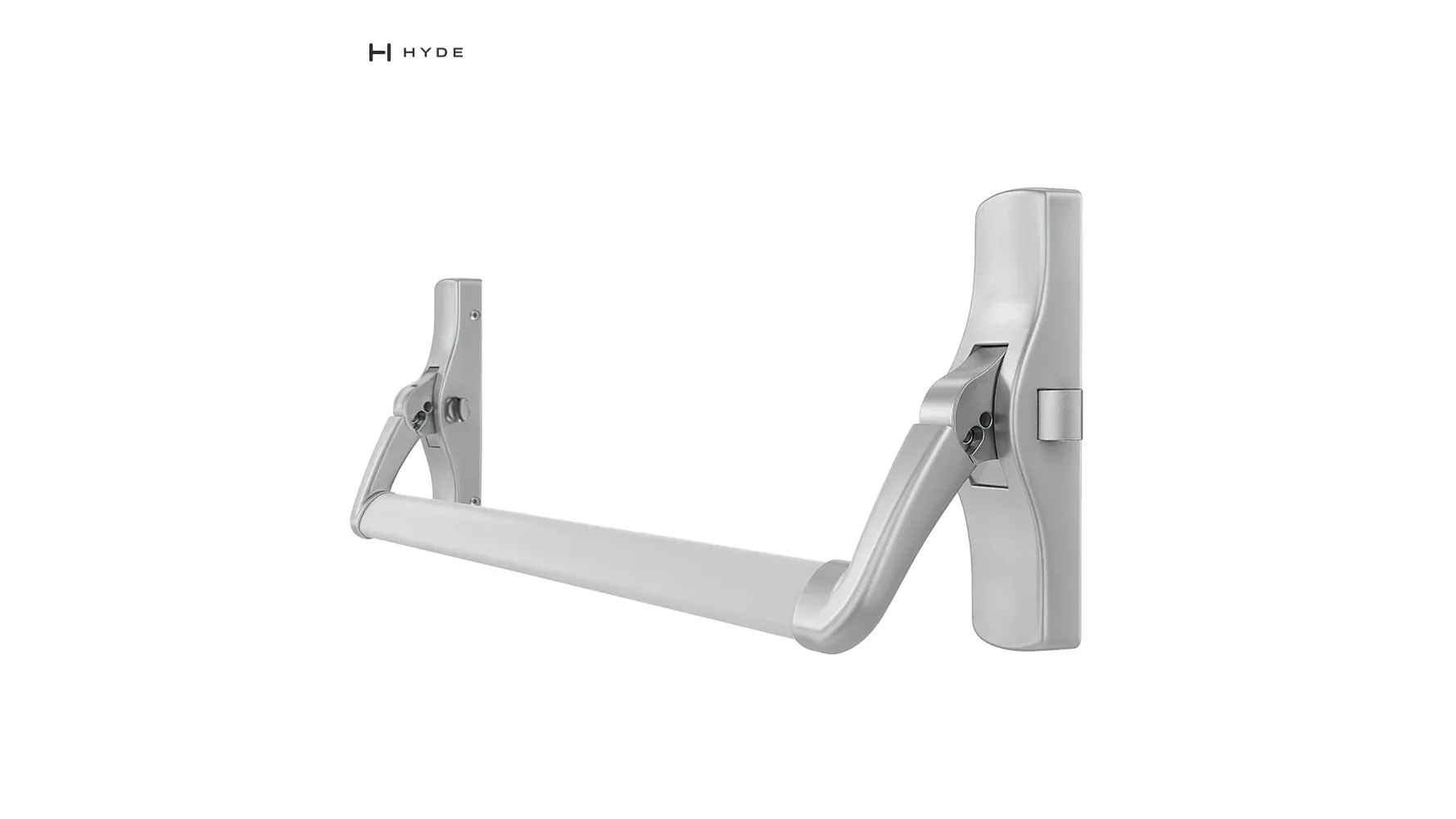
Three numbers turn up in panic-hardware enquiries and they are usually treated as interchangeable: EN 1125, ANSI/BHMA A156.3, and UL 305. They are not three grades of the same thing, and they are not even three of the same kind of thing. One is a performance standard, one is a grading standard, and one is the basis of a listing. Getting the category wrong is more expensive than getting the number wrong, because a device can satisfy one and be irrelevant to another.
EN 1125 is the European standard for panic exit devices operated by a horizontal bar, on escape routes used by the public. You demonstrate compliance by testing, and what you end up holding is a report against a specific model. Its companion EN 179 covers emergency exit devices operated by a lever or a pad, for buildings where the occupants know the way out. We have written about the difference between those two elsewhere on this site.
ANSI/BHMA A156.3 is the North American standard for exit devices, and it does something the European standard does not: it sorts products into Grade 1, Grade 2 and Grade 3 on a cycle-test basis. Grade 1 is tested to a higher cycle count than Grade 3. Both are graded exit devices; the grade is a durability classification, not a pass or a fail. This is the number a specifier means when they write "Grade 1" on a schedule.
UL 305 is the third kind. It is UL's standard for panic hardware, and the thing a manufacturer obtains against it is a listing — not a certificate in a drawer, but an ongoing arrangement in which the certification body inspects the factory periodically and the product carries a mark. That is the practical difference worth knowing: a test report is a photograph of one model on one date, and a listing is a continuing claim about production. They cost differently for that reason, and they lapse differently.
Which of them your project is under is decided by the building, not by the supplier. A door in a European member state under a public escape route is an EN 1125 conversation. A door in a North American jurisdiction where the authority enforces the model code and the specification is written by an architect is an A156.3 conversation, and if that specification also says "UL listed" it is a UL 305 conversation on top. Those are not alternatives, and a project can require two of them at once.
Now our own position, plainly, because this is where catalogues go quiet. Our EN 1125 evidence is a test report from Intertek Testing Services Shenzhen Ltd., Guangzhou Branch, reference 130722068GZU-001, issued 7 November 2013, and it covers one model: KD070/30-290. There is also a CE Certificate of Conformity to EN 1125:2008 from CELAB, Italy. Both issuers restrict redistribution, so we supply them against a named tender rather than as a download.
There is no ANSI/BHMA certification, and no UL listing appears among the credentials this factory holds. We state that rather than leaving it to be discovered, because a North American specification that says "UL listed" cannot be met by us today, and the honest moment to find that out is before the quotation rather than at the submittal. If your project requires a listing, tell us at enquiry stage; it changes what we can offer and it changes it before anybody has spent money.
A last note on the number itself, because it has cost us an enquiry already. Our own catalogue contains a panic exit device model 305, and a fire-door version of it. That is a model number in our own series and it has no relationship whatever to UL 305. If you are searching for one and find the other, the coincidence is exactly that. What our 305 does state is a fire rating, and a fire rating is a fourth axis again: it belongs to a tested door assembly — leaf, frame, hinges, closer and device — rather than to the device on its own.
About Canton Hyland — Canton Hyland manufactures panic exit devices, locks and architectural door hardware for commercial and institutional projects, supplying specifiers and distributors internationally.