
UL 305 Is a Listing, Not a Grade
EN 1125 is a standard you test against. ANSI/BHMA A156.3 is a standard that grades you 1, 2 or 3. UL 305 is neither, it is the basis for a listing, which is an ongoing arrangement with a certification body rather than a document you hold. Confusing the three is how a compliant-looking device fails a submittal.
Insight
Johnson LiuDigital Communications, Canton HylandMA Digital Media, Johns Hopkins University
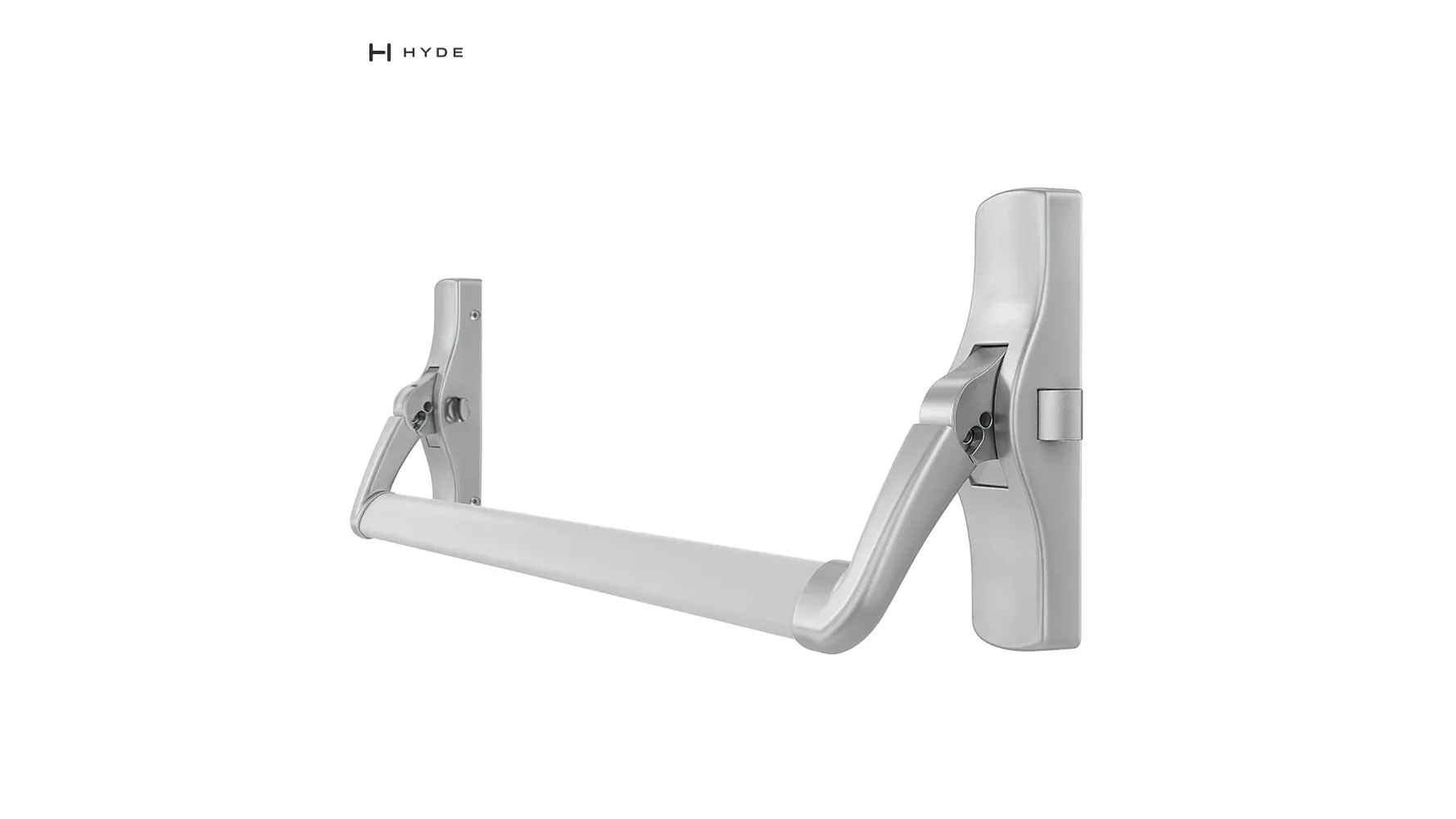
Three numbers turn up in panic-hardware inquiries and they are usually treated as interchangeable: EN 1125, ANSI/BHMA A156.3, and UL 305. They are not three grades of the same thing, and they are not even three of the same kind of thing. One is a performance standard, one is a grading standard, and one is the basis of a listing. Getting the category wrong is more expensive than getting the number wrong, because a device can satisfy one and be irrelevant to another.
EN 1125 is the European standard for panic exit devices operated by a horizontal bar, on escape routes used by the public. You demonstrate compliance by testing, and what you end up holding is a report against a specific model. Its companion EN 179 covers emergency exit devices operated by a lever or a pad, for buildings where the occupants know the way out. We have written about the difference between those two elsewhere on this site.
ANSI/BHMA A156.3 is the North American standard for exit devices, and it does something the European standard does not: it sorts products into Grade 1, Grade 2 and Grade 3 on a cycle-test basis. Grade 1 is tested to a higher cycle count than Grade 3. Both are graded exit devices; the grade is a durability classification, not a pass or a fail. This is the number a specifier means when they write "Grade 1" on a schedule.
UL 305 is the third kind. It is UL's standard for panic hardware, and the thing a manufacturer obtains against it is a listing, not a certificate in a drawer, but an ongoing arrangement in which the certification body inspects the factory periodically and the product carries a mark. That is the practical difference worth knowing: a test report is a photograph of one model on one date, and a listing is a continuing claim about production. They cost differently for that reason, and they lapse differently.
Which of them your project is under is decided by the building, not by the supplier. A door in a European member state under a public escape route is an EN 1125 conversation. A door in a North American jurisdiction where the authority enforces the model code and the specification is written by an architect is an A156.3 conversation, and if that specification also says "UL listed" it is a UL 305 conversation on top. Those are not alternatives, and a project can require two of them at once.
Now our own position, plainly, because this is where catalogs go quiet. Our EN 1125 evidence is a test report from Intertek Testing Services Shenzhen Ltd., Guangzhou Branch, reference 130722068GZU-001, issued 7 November 2013, and it covers one model: KD070/30-290. There is also a CE Certificate of Conformity to EN 1125:2008 from CELAB, Italy. Both issuers restrict redistribution, so we supply them against a named tender rather than as a download.
There is no ANSI/BHMA certification, and no UL listing appears among the credentials this factory holds. We state that rather than leaving it to be discovered, because a North American specification that says "UL listed" cannot be met by us today, and the honest moment to find that out is before the quotation rather than at the submittal. If your project requires a listing, tell us at inquiry stage; it changes what we can offer and it changes it before anybody has spent money.
A last note on the number itself, because it has cost us an inquiry already. Our own catalog contains a panic exit device model 305, and a fire-door version of it. That is a model number in our own series and it has no relationship whatever to UL 305. If you are searching for one and find the other, the coincidence is exactly that. What our 305 does state is a fire rating, and a fire rating is a fourth axis again: it belongs to a tested door assembly (leaf, frame, hinges, closer and device) rather than to the device on its own.
Checking any supplier's claim in five minutes
Everything above can be verified without taking anyone's word for it, including ours, and a buyer who does the checks below before a quotation will save more money than any negotiation on price.
A UL listing: search the manufacturer's name in UL Product iQ, UL's public certification directory. A genuine listing appears there under the company that holds it, with a file number and the product category it covers. If a supplier claims a listing and you cannot find it, ask for the file number; if they cannot give you one, you have your answer. Note also whose name is on the listing: a device listed to a brand owner and made by a different factory is legitimate, but the listing belongs to the name in the directory, not to whoever is quoting you.
An ANSI/BHMA grade: BHMA publishes a directory of certified products. A grade claim that does not appear there is a claim about a test the supplier says they passed, not a certification, and those are different things for a specifier who has to defend a submittal.
An EN 1125 claim: ask for the report or certificate and read its scope: the issuing body, the reference, the date, the edition of the standard, and the exact model covered. For a CE-marked device, the marking should point to the body and the document behind it. Our own EN 1125 evidence is described above in exactly those terms (issuer, reference, date and the single model covered) because that is the standard of answer a buyer should expect from anyone.
Fire exit hardware: the listing within the listing
In North American practice, a panic device on a fire-rated door is a further case again. It has to be panic hardware and it has to be suitable for the fire door, which in the UL system means hardware tested for fire door use as well as for panic operation, commonly described as fire exit hardware. A device listed only as panic hardware is not automatically acceptable on a rated opening, and a specification that says "UL listed fire exit hardware" is asking for both.
This is also where fire claims on product pages deserve the most scepticism, ours included. A duration such as "1.5 hours" or "2.5 hours" means something only as the rating of a tested door assembly, identified in a report or a listing. Standing alone next to a device, it describes an expectation, not evidence. Ask what assembly was tested, by whom, and against which standard, and if the answer is a figure with no document, treat it as a figure with no document.
If your specification says "UL listed"
The first thing to establish is which doors the requirement actually covers. On many projects the listed requirement applies to particular openings (rated doors, escape routes, doors named in the fire strategy) and not to every door that carries a lever or a bar. A hardware schedule that marks the requirement opening by opening often turns out to need listed devices on a fraction of the doors rather than on all of them.
For the openings that do require a listing, the requirement is not negotiable with us, and it would be wrong to pretend otherwise. Our 307 and 311 have been submitted for testing, and until certificate numbers exist we will not imply a listing, a grade or a UL-recognised fire rating for them. For the openings that do not require one (back-of-house doors, stores, doors outside the regulated route) the conversation is an ordinary one about the leaf, the length and the trim, and we can have it today.
What we will not do is suggest a substitution request to get round a written requirement. An architect who specified a listing did so for a reason, and a supplier who quietly supplies an unlisted device against that specification has transferred the risk to whoever signs the door off. Better to know at inquiry, when the answer changes what you order, than at inspection, when it changes what you remove.
Why a listing costs more than a report
Buyers sometimes ask why a listed device is priced above an otherwise similar one with a test report. The answer is in the definition above: a report is a single test of a single model on a single date, while a listing is a continuing arrangement, with the certification body inspecting production periodically and the manufacturer maintaining the conditions of the listing between visits. That ongoing cost is real, it is carried by every device made under the listing, and it is what makes the listing mean something about the device in your particular carton rather than about one sample years ago.
At goods-in: check the device, not the paperwork
The directory search proves a listing exists. It does not prove the device in the carton is the listed one. A listed product carries the certification mark on the product or its label, and an inspector will look for it on the door, not in the submittal folder. So the last check happens when the delivery arrives: open one carton from each batch, find the mark or label on the device, photograph it, and compare it with the listing you looked up: company, product and category. A mark that does not match a directory entry, or a device with no mark at all where a listing was ordered, is a problem to raise with the supplier that day, while the goods are still in their packaging and still returnable. It takes ten minutes per delivery, and it is the only check in this article that looks at what was actually shipped.
Questions this answers
What is the difference between UL 305, EN 1125 and ANSI A156.3?
They are not three grades of one thing. EN 1125 is the European performance standard for panic exit devices operated by a horizontal bar, demonstrated by testing against a specific model. ANSI/BHMA A156.3 grades products 1, 2 or 3 on a cycle-test basis, which is a durability classification rather than a pass or fail. UL 305 is the basis of a listing, an ongoing arrangement in which the certification body inspects the factory and the product carries a mark.
Is a test report the same as a listing?
No. A test report is a photograph of one model on one date. A listing is a continuing claim about production, maintained by periodic factory inspection. They cost differently for that reason and they lapse differently.
Does Canton Hyland hold a UL listing?
No UL listing appears among this factory's credentials, and there is no ANSI/BHMA certification either. What we hold is an EN 1125 test report from Intertek Testing Services Shenzhen Ltd., Guangzhou Branch, reference 130722068GZU-001, covering model KD070/30-290, and a CE Certificate of Conformity to EN 1125:2008 from CELAB, Italy.
How can I check whether an exit device really has a UL listing?
Search the manufacturer's name in UL Product iQ, UL's public certification directory. A genuine listing shows the company holding it, a file number and the product category covered. If you cannot find it, ask the supplier for the file number. Check whose name is on the listing: it belongs to the company in the directory, which may be a brand owner rather than the factory quoting you. For ANSI/BHMA grades, check BHMA's directory of certified products.
Is a UL-listed panic device automatically acceptable on a fire door?
Not automatically. In North American practice a device on a fire-rated door must be both panic hardware and suitable for fire door use (commonly called fire exit hardware), so a specification saying "UL listed fire exit hardware" is asking for both. Fire durations like "1.5 hours" mean something only as the rating of a tested door assembly identified in a report or listing; standing alone next to a device, they are an expectation rather than evidence.
What if my specification requires a UL listing and the supplier does not have one?
First check which openings the requirement covers, often rated doors and escape routes rather than every door. For those openings the requirement is not negotiable: we do not hold a UL listing, our 307 and 311 have been submitted for testing, and we will not imply otherwise until certificate numbers exist. For doors outside the requirement, the choice is an ordinary one about leaf, length and trim. A substitution request to get round a written requirement only moves the risk to whoever signs the door off.
Canton Hyland 소개 — Canton Hyland는 상업 시설과 공공 프로젝트용 패닉 엑시트 디바이스, 락, 건축용 도어 철물을 생산하며, 세계 각국의 설계 사무소와 유통사에 공급합니다.