
Durability Numbers on Institutional Door Hardware: How to Read Cycle Tests and Grades
A durability figure on a lock, lever, exit device or closer can only be compared when it names the standard and the grade it earned there. This article explains what one cycle is, how the ANSI/BHMA A156 grades and the EN 12209, EN 1906, EN 1125, EN 179 and EN 1154 classes work, why a bare cycle count cannot be ranked, and which openings in schools, hospitals and offices need which level.

Johnson LiuDigital Communications, Canton HylandMA Digital Media, Johns Hopkins University
A durability number on door hardware can only be compared when it names the standard it was earned under and the grade or class it earned there. "Grade 1 under ANSI/BHMA A156.2" and "durability grade 7 under EN 1906" are test results, each with a defined cycle, load and pass criterion behind it. "200,000 cycles" on its own is a count somebody reported, and it cannot be ranked against either.
For schools, hospitals and offices the working rule follows from that. Decide the level opening by opening, from traffic and from how much care the users take. Write the standard and the grade into the door schedule, not a cycle count. Then ask every supplier for the report behind the claim: the standard, the laboratory, the date, the sample and the pass criteria. A supplier who offers only a number has told you how many times something moved, not whether it passed.
What counts as one cycle
For a lock or latch, one cycle is one complete operation: the knob or lever turns far enough to withdraw the latch fully, then returns, and the latch springs back out. For a door closer it is one opening to a set angle followed by one controlled close. For an exit device it is one press of the bar or pad that retracts the latch, followed by release. Where a standard also tests the key, key operations are counted separately.
The count hides the conditions. A rig can cycle a lock with or without a load pressing the latch against the strike, quickly or slowly, turning the handle to its stop or only until the latch clears. Each standard fixes those conditions, and fixes what must still be true at the end: the latch still retracts, the lever still returns to horizontal, play and operating torque stay within limits, nothing has cracked. Change any one of them and the same count describes a different test.
The ANSI/BHMA A156 grades
ANSI/BHMA writes a separate standard for each product family in its A156 series and grades most of them 1, 2 or 3, with Grade 1 the most demanding. A156.2 covers bored and preassembled locks, which is the cylindrical lock family. A156.13 covers mortise locks, A156.3 exit devices, A156.4 door closers and A156.1 butt hinges.
Scroll sideways to compare columns. Select a column heading to sort; select it three times to restore source order.
| A156.2 | Bored (cylindrical) locks and latches | 1,000,000 |
|---|---|---|
| A156.13 | Mortise locks | 1,000,000 |
| A156.3 | Exit devices | 500,000 |
| A156.4 | Door closers | 2,000,000 |
| A156.1 | Butt hinges | 2,500,000 |
5 rows · Source order
Those figures come from a door-hardware manufacturer's published summary of the standards, and the standards are revised, so confirm them against the edition your specification cites. Grade 2 and Grade 3 call for lower counts in each family. Published summaries do not all agree on those lower figures, so take them from the standard itself rather than from a chart.
Two things are easy to miss. A Grade 1 in one standard is not a Grade 1 in another: a Grade 1 closer and a Grade 1 lock are cycled to different counts on different rigs. And the cycle test is only one test in a grade. A156.2 also sets dimensional, operational, strength and security tests, and a lock that completed the cycle count without passing the rest has not earned the grade.
The European classifications
European standards classify rather than grade. Each product carries a code of several digits, one of which is durability, and that digit only means something next to the standard it came from.
Scroll sideways to compare columns. Select a column heading to sort; select it three times to restore source order.
| EN 12209 | Mechanical locks, latches and strike plates | A lettered grade; each letter stands for a cycle count set in the standard |
|---|---|---|
| EN 1906 | Lever handles and knobs | Grade 6 is 100,000 cycles, grade 7 is 200,000 (2012 edition; earlier editions define the grades differently) |
| EN 1125 | Panic exit devices: push bar or touch bar | Grade 6 is 100,000 cycles, grade 7 is 200,000 |
| EN 179 | Emergency exit devices: lever or push pad | Same structure as EN 1125 |
| EN 1154 | Door closers | One grade, 8, which is 500,000 cycles |
5 rows · Source order
For institutional work the first digit matters as much as the durability digit. EN 12209 and EN 1906 both open with a category of use, which ranks how often the door is used and how much care its users take. The top category is for doors used by the public, with little incentive to take care and a real chance of misuse. A handle with a high durability grade and a low category of use is a handle that lasts on a careful door.
On closers the durability digit does not separate one product from another, because every EN 1154 closer carries the same grade; the choice is between power sizes and categories of use. On exit devices, grade 6 against grade 7 is the decision to make, and a busy school or hospital route is where grade 7 earns its place. Do not convert a European digit into an American grade or back: the products, rigs and pass criteria differ, even where the counts happen to match.
Why a bare "200,000 cycles" cannot be ranked
A figure with no standard behind it leaves every question above unanswered: what was cycled, the whole lockset or the handle alone; on what rig; under what load on the latch; at what rate; and what still had to work when the count was reached. Nor does it say whether strength or security tests were run at all. That cuts both ways. A bare figure that equals a grade's requirement does not place the product in that grade, and a bare figure below one does not prove it would fail. The accurate reading is: manufacturer's stated figure, test conditions not given.
What to ask a supplier
Scroll sideways to compare columns. Select a column heading to sort; select it three times to restore source order.
| Which standard, which edition, which grade or class? | A count without a standard cannot be compared with anything |
|---|---|
| Independent laboratory or the factory's own rig? | Both can be genuine, but most project reviewers expect a report from an accredited laboratory |
| Report number and date | You can check it, and see whether the standard has been revised since |
| Which sample: model, function, finish | A passage latch and a keyed classroom lock are different mechanisms; a report on one does not cover the other |
| Pass criteria and post-test checks | What had to still work at the end is what the count means |
| The full test series, or cycles only? | A grade needs every test in the standard, not only the cycle test |
6 rows · Source order
An answer of "not tested to a standard" is usable. It tells you to put that product where no grade is specified, or to have it tested before you specify it. What is not usable is a number offered as though it answered the question. Checking the certificate itself, its scope and its register entry, is a separate step, covered in our article on validating hardware certificates.
Which openings need which level
Scroll sideways to compare columns. Select a column heading to sort; select it three times to restore source order.
| Main entrances (school, hospital, office) | The highest traffic in the building | Top grade on lock, closer and hinges |
|---|---|---|
| School classrooms and corridors | Very frequent use, little care, deliberate abuse | Top grade lock or top EN category of use; classroom or storeroom function as scheduled |
| Hospital wards, treatment rooms, corridors | Frequent use, beds and carts striking the door, frequent cleaning | Top grade lock and closer; corrosion class as well as durability |
| Public escape routes | Panic among people who do not know the building | EN 1125 or A156.3 device; durability grade 7 on busy routes |
| Office internal doors, meeting rooms | Moderate use by careful occupants | A middle grade is often enough |
| Storerooms, plant rooms, cleaners' cupboards | Infrequent use; security matters more | Durability is secondary; function and keying come first |
| Public washrooms and cubicles | Frequent use, misuse, moisture | Top category of use; corrosion class |
7 rows · Source order
One rule overrides the table. Many accessibility codes require door hardware that can be operated without tight grasping or twisting of the wrist, which rules out knobs on the doors those codes cover. Check the code before choosing trim.
Where our heavy-duty cylindrical locks sit
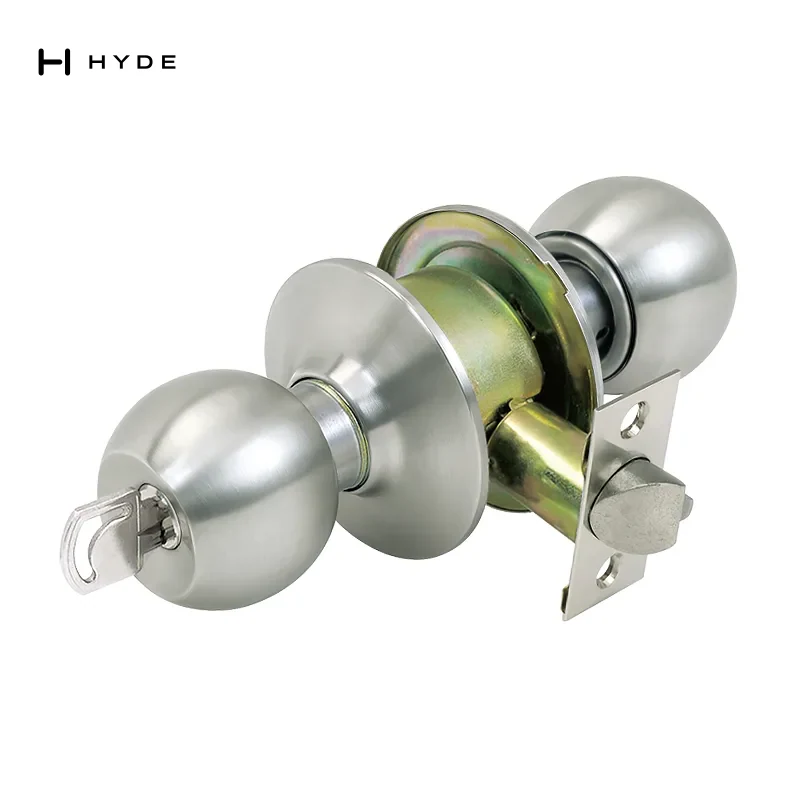
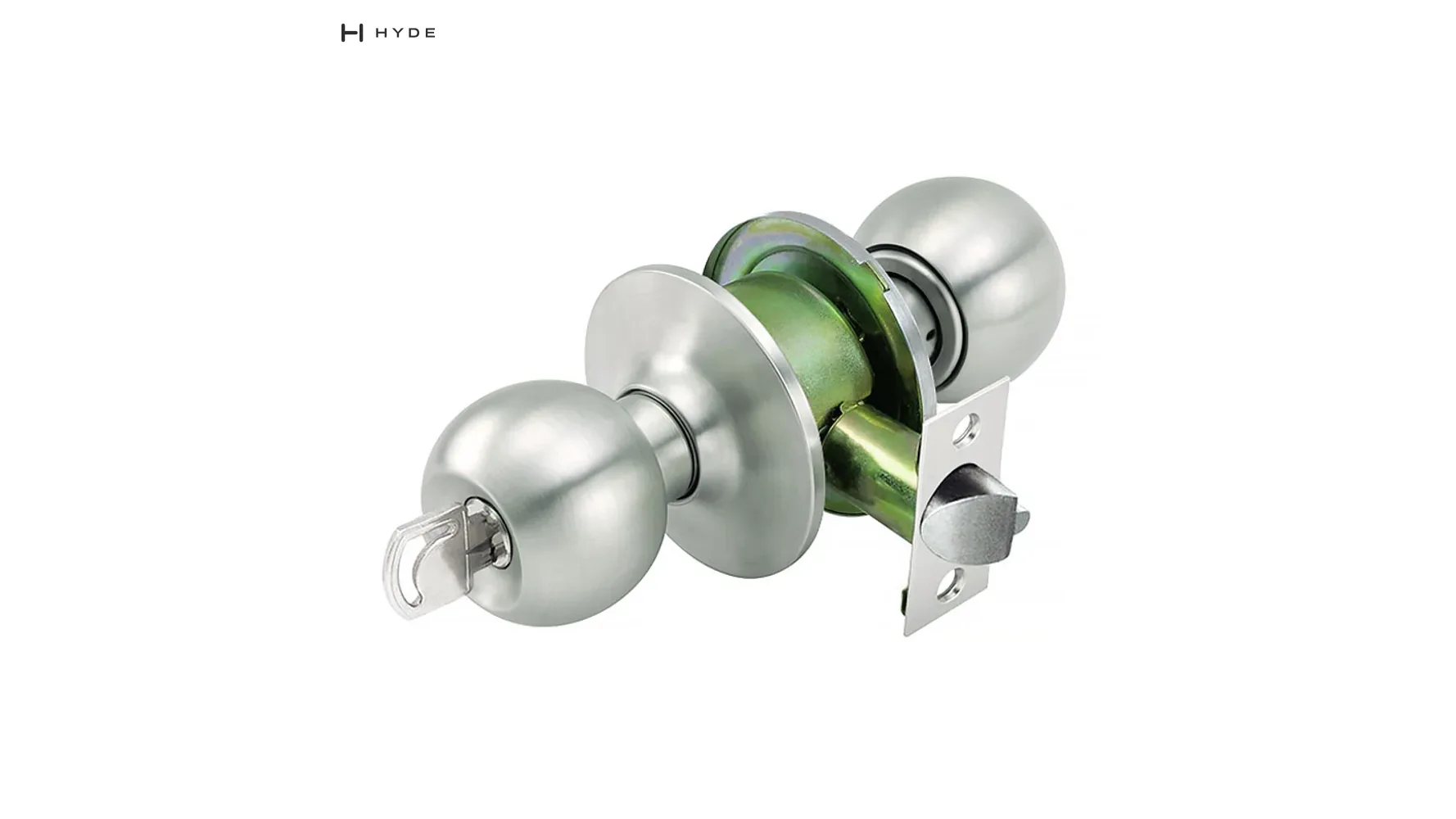
The 5870 SSET and 5831 SSET are heavy-duty cylindrical locks in stainless steel with a satin stainless finish (US32D), entrance function keyed outside, a solid steel chassis and latch case, and a deadlocking latch on keyed functions; the 5831 SSET adjusts to a 60, 70, 80 or 90 mm backset and fits doors 35–50 mm thick. The 5807 SSCR and 5807 SSR carry the classroom and storeroom functions in stainless steel 304/201, for doors 35–45 mm thick. All four are knob locks, and they appear here as examples of the hardware type, not as answers to the grading question.
We do not publish a BHMA grade or an EN classification for any of them, and nothing on this page should be read as one. Where a product page carries a cycle-life figure, it does not name a standard, rig, load or pass criterion, so apply the questions above to it as you would to any supplier's number, and ask us before writing it into a submittal.
Questions this answers
What does ANSI/BHMA Grade 1 mean for a cylindrical lock?
That the lock passed the full Grade 1 test series in ANSI/BHMA A156.2, the standard for bored and preassembled locks: dimensional, operational, strength and security tests as well as a cycle test, which manufacturer summaries give as 1,000,000 cycles for Grade 1. Grade 1 in another A156 standard, such as A156.4 for closers, is a different test with a different count.
What counts as one cycle in a door hardware cycle test?
For a lock, one full operation: the knob or lever turns far enough to withdraw the latch completely and returns, and the latch springs back out. For a closer, one opening to a set angle and one controlled close. For an exit device, one press that retracts the latch, then release. The standard also fixes the load, the rate and what must still work at the end.
Is 200,000 cycles the same as a BHMA or EN grade?
No. A cycle count with no named standard has no defined rig, load or pass criteria, and a grade also requires tests other than cycling. A bare figure equal to a grade's requirement does not place the product in that grade. Read it as a manufacturer's stated figure and ask which standard, which laboratory and which sample.
What durability level do school and hospital doors need?
Main entrances, classrooms, corridors and wards take the top level: ANSI/BHMA Grade 1, or the top category of use in EN 12209 and EN 1906. Busy public escape routes take an EN 1125 device with durability grade 7. Office internal doors with careful users can often take a middle grade; storerooms are chosen for function and keying first.
What should I ask a supplier to prove a durability claim?
The standard and its edition, the grade or class claimed, whether the test was run by an independent laboratory or on the factory's own rig, the report number and date, the sample tested (model, function and finish), the pass criteria, and whether the full test series was run or only the cycle test.
Related products
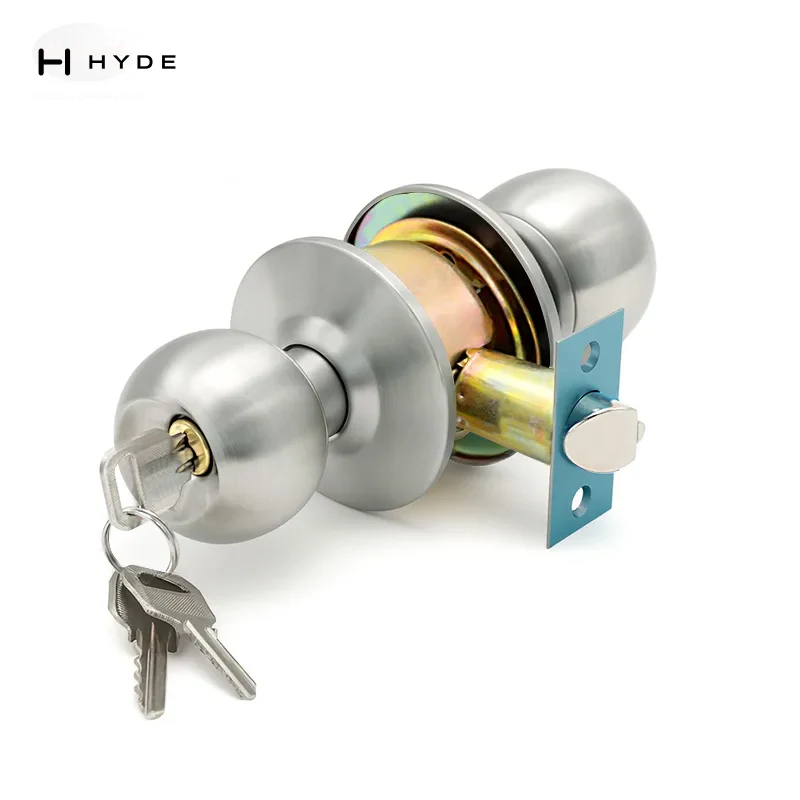
Heavy Duty Cylindrical Lock
Model 5870 SSET · Video
Stainless Steel
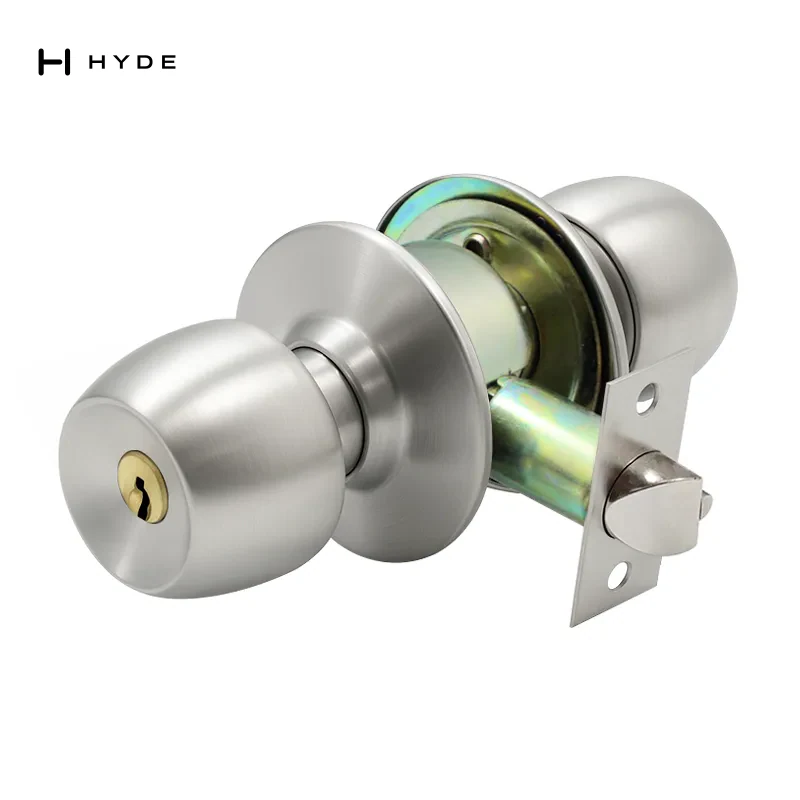
Backset 60 / 70 / 80 / 90 mm (Adjustable)
Heavy Duty Cylindrical Lock
Model 5831 SSET
Stainless Steel
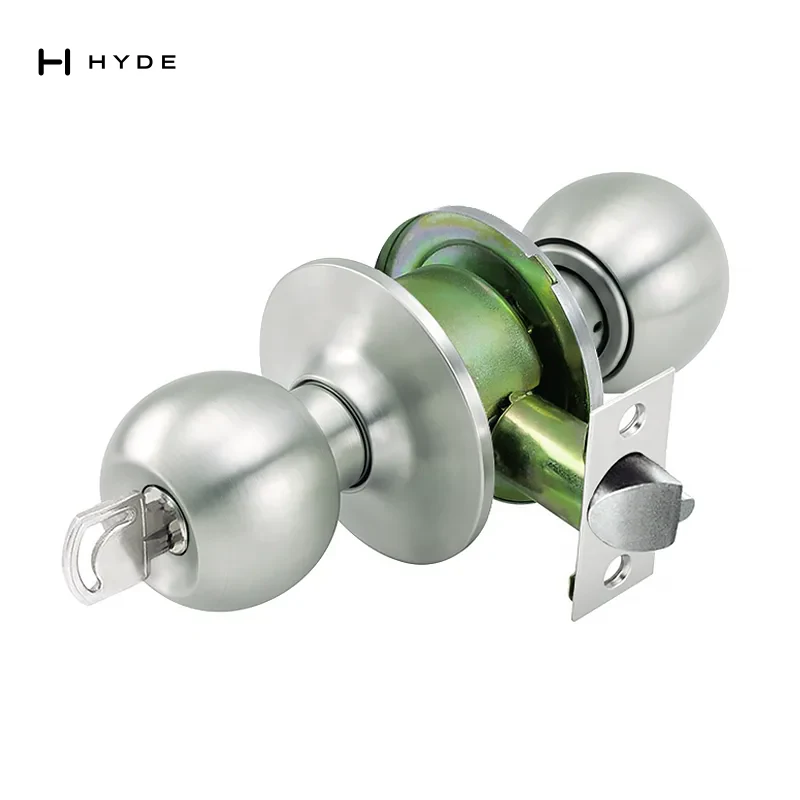
Door thickness 35–45mm
Commercial Lock
Model 5807 SSCR
Stainless Steel 304/201
About Canton Hyland — Canton Hyland manufactures panic exit devices, locks and architectural door hardware for commercial and institutional projects, supplying specifiers and distributors internationally.