
Fire Rated Door Knobs and Levers: The Rating Is in the Latch, Not the Knob
No knob or lever is fire rated because of its shape. The rating belongs to the tested door assembly and to the listed latching lockset, meaning latch, chassis, strike and trim together. Here is what UL 10C, NFPA 80, EN 12209 and EN 1906 actually rate, why knob versus lever is an accessibility choice, and what to ask a supplier before ordering.

Johnson LiuDigital Communications, Canton HylandMA Digital Media, Johns Hopkins University
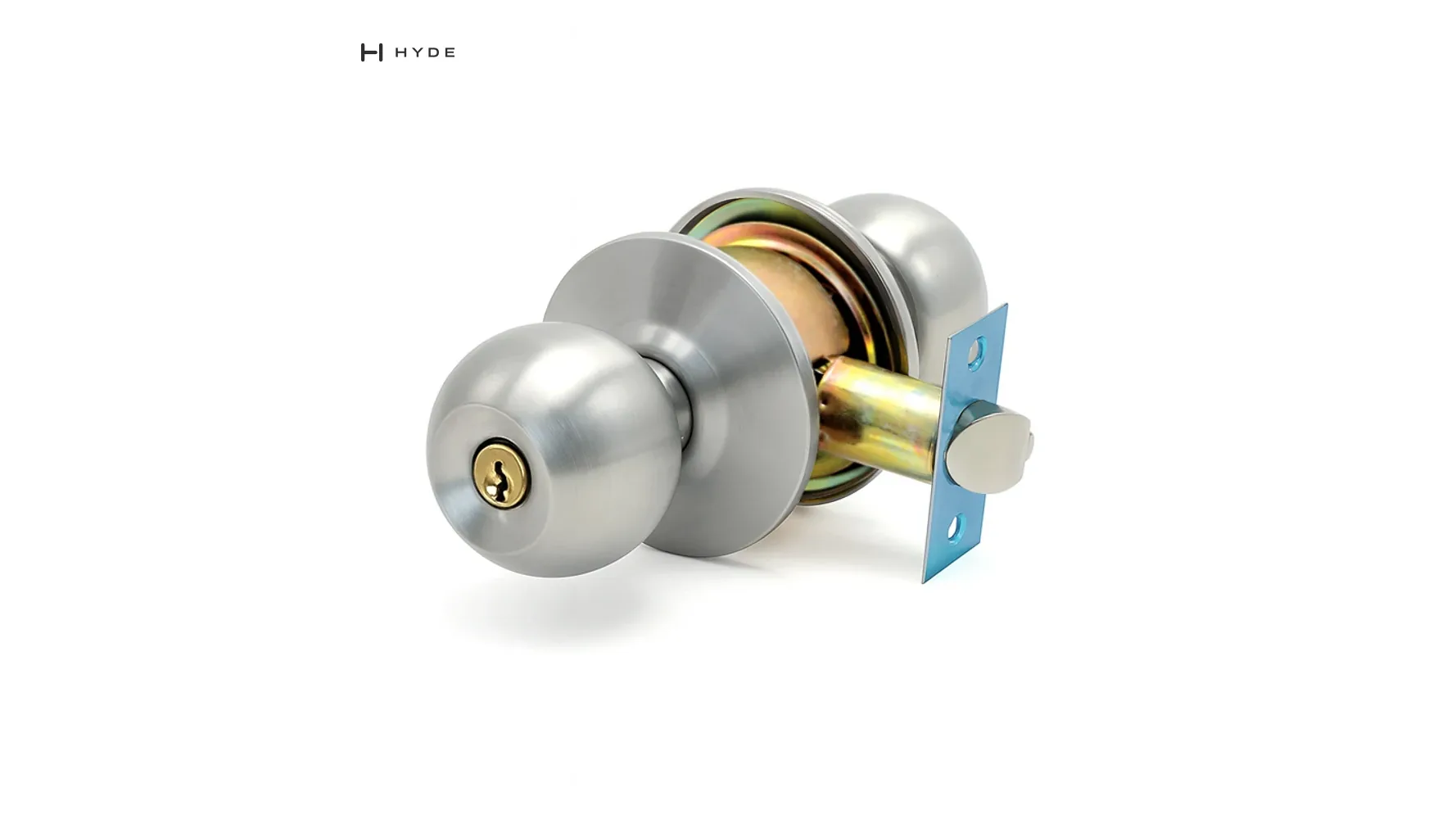
No door knob is fire rated because of its shape. When a specification asks for a "fire rated knob" or a "fire rated lever", what it actually needs is a lockset whose latching hardware has been tested on a fire door assembly, and listed or classified for a stated type of door and rating. The knob or lever is only the part of that lockset you hold. The rating belongs to the door assembly, and to the latch, chassis and strike that keep the door shut while the fire burns.
So the short answer is this. Knob locksets that may be used on fire doors exist, and so do lever locksets, but you buy them by their listing, not by their trim. Ask for the listing or classification number, read its scope, and check that your door falls inside it. If a supplier cannot give you a number, the product is not fire rated for your purposes, however solid it looks.
Why the knob is not the rated part
A fire door has one job in a fire: it stays shut. The leaf can bow, the frame can move, and the pressure in the burning room can push on the door, and the opening still has to hold. That is why every system asks for positive latching: a spring latch bolt that engages the strike by itself every time the door closes, without anyone turning a key or throwing a bolt.
The knob contributes very little to that. Furnace temperatures in a fire test are far above the melting point of zinc die-cast trim, and what decides the result is whether the door stays latched and the opening stays closed. The parts that carry that load are the latch bolt and its throw, the latch case, the chassis that keeps the latch extended, the strike, and the screws that fix all of them. This is also why a lockset is listed as a lockset. The trim, latch, chassis and strike went into the furnace together, and the listing covers that combination, often with a stated choice of knob or lever designs. Swap the latch and the listing no longer describes what is on the door, even if the knob has not changed.
Latch throw, latch type and the deadbolt question
Latch throw is the distance the latch bolt projects beyond the lock face. Listings state the throw they require, and a pair of doors often needs a longer throw than a single door, because the gap at the meeting edge can open as the leaves deflect. The figure comes from the listing of the door and the lock, so take it from the documents for your opening.
Latch type matters as much. Many tubular and cylindrical locks are offered with either a faceplate latch or a round drive-in latch; the drive-in version is quicker to fit because it needs only a bored hole in the door edge. Manufacturers that list such locks for fire doors commonly list the faceplate version, and some mark the drive-in version as not for fire door use. Same knob, same chassis, different status, decided entirely by a part hidden in the door edge.
A deadbolt cannot do the job alone. It holds only when someone throws it, so it is not self-latching, and a fire door secured only by a deadbolt is unlatched the moment the last person leaves without locking it. Where the codes for that door allow it, a deadbolt suitable for the door can be added to a latching lockset, but it never replaces the spring latch. The same reasoning rules out a dummy trim, a knob or lever with no latch at all, as the only hardware on a fire door: it lets you pull the door, and nothing holds it shut.
United States: UL 10C, NFPA 80 and the listing
In the United States, fire door assemblies are tested to UL 10C, a positive-pressure fire test followed by a hose stream test, or to NFPA 252. Hardware for those doors is listed by a testing laboratory for fire door use, and the listing states what it covers, typically the door constructions, the maximum rating and the leaf sizes the lock was evaluated on.
NFPA 80 governs how the assembly is installed and maintained. Fire doors must self-close and positively latch, the hardware on them must be suitable for fire door use, and field changes outside what the standard permits take the door outside its label. A knob lockset on a US fire door is acceptable because its listing says so, not because it is heavy, made of steel or looks commercial. A BHMA grade is not a fire rating either. A grade describes cycle testing, strength and finish; whether a lock may go on a fire door is a separate listing. A lock can carry one and not the other.
Europe: EN 1634-1, EN 12209 and EN 1906
In Europe the doorset is tested to EN 1634-1, and the result classifies the whole assembly. The hardware standards then record, as one digit of a longer classification code, whether a product is suitable for fire or smoke doors. EN 12209 covers mechanical locks, latches and strike plates. EN 1906 covers lever handles and knob furniture. In both, the fourth digit is the fire digit: 0 means not approved for fire or smoke door use, and 1 means suitable, on the strength of a fire test of a doorset to EN 1634-1. So the European system classifies the knob or lever furniture as well as the lock, but the logic is the same. A 1 in the fourth digit says the product was in a fire-tested doorset. It does not say it suits your doorset. The door construction, the rating period, the other hardware and the permitted variations decide that, and they are in the test or classification report, not in the digit.
Scroll sideways to compare columns. Select a column heading to sort; select it three times to restore source order.
| Test of the door assembly | UL 10C or NFPA 252 | EN 1634-1 |
|---|---|---|
| Where the lock's fire suitability is shown | Laboratory listing for fire door use | Fourth digit of the EN 12209 code |
| Where the knob or lever is covered | Within the lockset's listing | Fourth digit of the EN 1906 code |
| Installation and upkeep | NFPA 80 | National rules, which vary |
| Document to ask for | Listing or file number, and its scope | Both classification codes, and the fire test or classification report |
5 rows · Source order
Knob or lever: an accessibility question, not a fire one
Once the listing has settled the fire question, the choice between knob and lever is about the people who use the door. US accessibility rules require operable parts that work with one hand without tight grasping, pinching or twisting of the wrist. A round knob fails that test and a lever passes it. The usual mounting range for door hardware under those rules is 34 to 48 inches (864 to 1219 mm) above the finished floor. German accessibility guidance, DIN 18040, likewise advises against knobs. That is why fire doors in corridors, stairs and public areas usually carry levers: those doors are nearly always on accessible routes as well. A knob lockset may still be listed for a fire door, and on a private room door it may be acceptable. On a door the public uses, the accessibility rule usually rules the knob out before fire ever comes into it.
What to ask a supplier before you order
First, the certificate or listing number. In the US, the laboratory listing or file number for fire door use. In Europe, the full EN 12209 and EN 1906 classification codes and the number of the fire test or classification report behind the fourth digit. A brochure line saying "suitable for fire doors" is not a number. Second, the scope. Which rating periods, door constructions and leaf sizes, single doors or pairs, and which latch, strike and trim options sit inside it. Check the exact latch you are ordering, faceplate or drive-in, against that list. Third, the door types. A lock listed on hollow metal doors is not thereby listed on timber doors, and a classification earned on one doorset construction is not automatically valid on another. Match the scope to your door schedule line by line.
What not to do
Do not hold a fire door open with anything that will not release it in a fire. Wedges, hooks and floor stops turn a fire door into an open hole. Where a door has to stand open in daily use, the accepted route is a hold-open device released by the fire alarm or a smoke detector: an electrically powered device to EN 1155 in Europe, a listed device connected to the alarm in the US. The same applies to the latch itself. Tape over the bolt, a latch left held back, or a strike filed open until the bolt no longer catches all leave a closed door that is not latched.
Do not mix parts. A lever from one maker on another maker's chassis, a replacement latch that happens to fit the bore, a strike borrowed from a different lock, longer screws, or a new trim ordered later from a different supplier: each may fit perfectly, and each takes the lockset outside the combination its listing describes. If a part has to change on a fire door, the replacement comes from the same listed product, or from another product whose listing covers that door.
Where our knob and lever locks stand
We make knob and lever locksets of the types discussed here. The 5870 SSET is a heavy-duty cylindrical knob lock in satin stainless steel, with an entrance function and a deadlocking latch on keyed functions. The 607 SSET is a tubular knob lock with a 60/70mm adjustable backset, a published 12mm (1/2") latch throw and an optional 1" round drive-in latch. The 808 SNET is a zinc alloy lever lockset on a 60/70mm adjustable tubular latch, published for residential use. Those figures are dimensions, not ratings.
None of these carries a fire listing or an EN 12209 or EN 1906 fire classification, and we do not describe them as fire rated. That matches what we publish about the rest of our hardware, including the 307 and 311 exit devices, which do not hold fire certificates today. Where one of our product records names fire doors in its application field, that describes an intended use, not a test result. A buyer who needs fire-rated knobs or levers should obtain the certificate or listing number, and its scope, before ordering, from us or from anyone else.
Questions this answers
Are door knobs fire rated?
A knob is not rated on its own. Knob locksets can be listed or classified for fire doors, and when they are, the rating covers the whole lockset, meaning latch, chassis, strike and trim, on a stated type of door. Ask for the listing or classification number and check its scope against your door.
Can you use a knob lock on a fire door?
Yes, if that lockset is listed or classified for fire door use and your door falls inside its scope. It must positively latch, so a deadbolt alone or a dummy trim with no latch does not qualify. On doors along accessible routes a lever is usually required, for accessibility reasons rather than fire reasons.
What makes a door lock fire rated?
A fire test of a door assembly with that lockset fitted, to UL 10C or NFPA 252 in the US or EN 1634-1 in Europe, and a listing or classification that records the result. In Europe the fourth digit of the EN 12209 code for the lock and of the EN 1906 code for the knob or lever shows fire suitability: 0 for not approved, 1 for suitable.
Can a fire door be held open?
Only by a hold-open device that releases it automatically on a fire alarm or smoke detector signal, such as an EN 1155 device in Europe or a listed device connected to the alarm in the US. Wedges, hooks and floor stops are not acceptable.
Are HYDE knob locks fire rated?
No. Our knob and lever locksets, including the 5870 SSET, 607 SSET and 808 SNET, carry no fire listing and no fire classification. If you need fire-rated hardware, obtain the certificate or listing number and its scope before ordering.
Related products
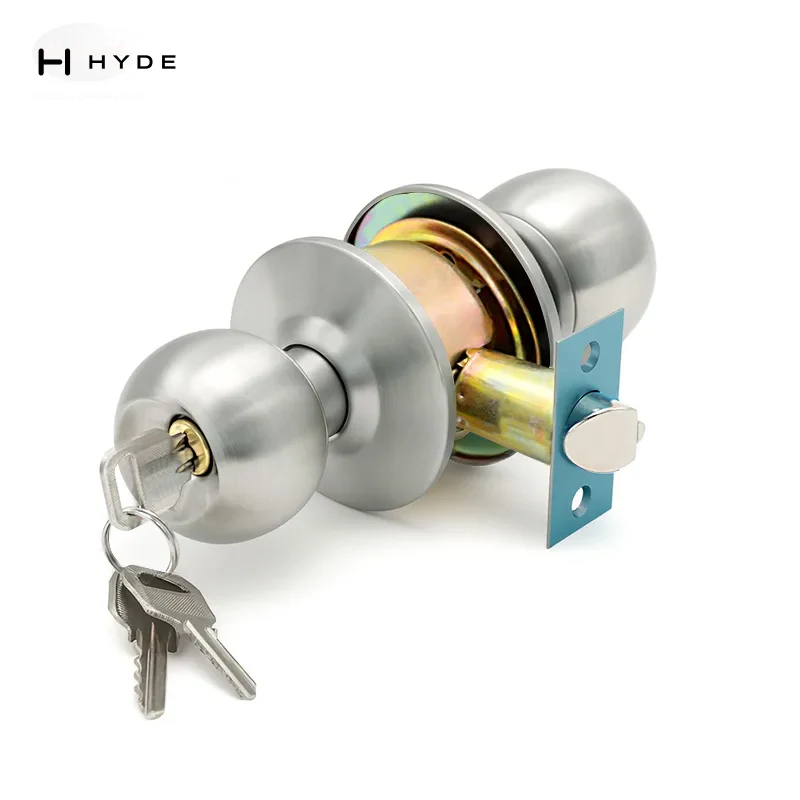
Heavy Duty Cylindrical Lock
Model 5870 SSET · Video
Stainless Steel
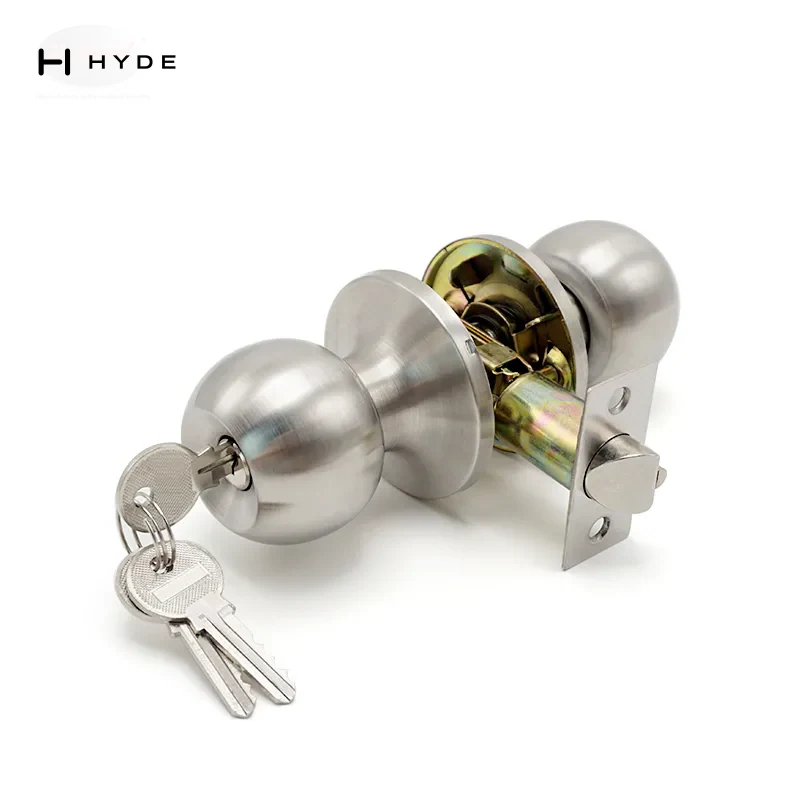
Backset 60mm / 70mm adjustable
Tubular Lock
Model 607 SSET · Video
Stainless steel/Brass/Solid steel
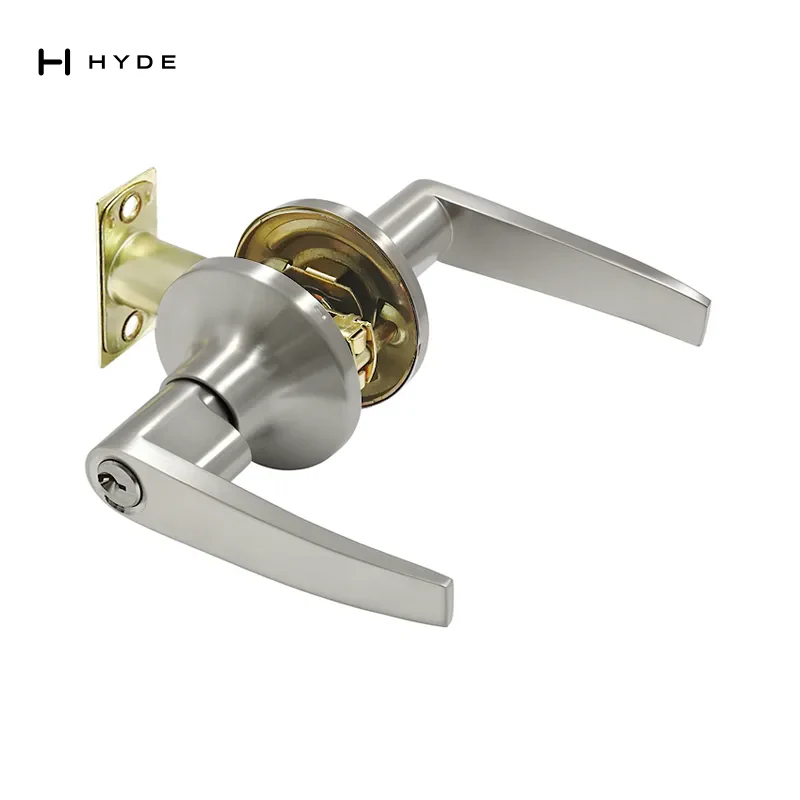
Backset 60/70mm
Lever Handle
Model 808 SNET · Video
Zinc Alloy
About Canton Hyland — Canton Hyland manufactures panic exit devices, locks and architectural door hardware for commercial and institutional projects, supplying specifiers and distributors internationally.