
Entrance, Privacy, Passage: Choosing Between Twelve Cylindrical Locks
587, 607, 5807, 5870, 592, 598, 575, 578, 9210, 595, 609 and 5831 look like twelve choices and are mostly one choice made twelve times. Nearly all of them take a 60/70mm adjustable backset and a 35–45mm door, so the decision is function first, chassis second — and one of the twelve goes to a 90mm backset when the others stop at 70.
Insight
Johnson LiuDigital Communications, Canton HylandMA Digital Media, Johns Hopkins University
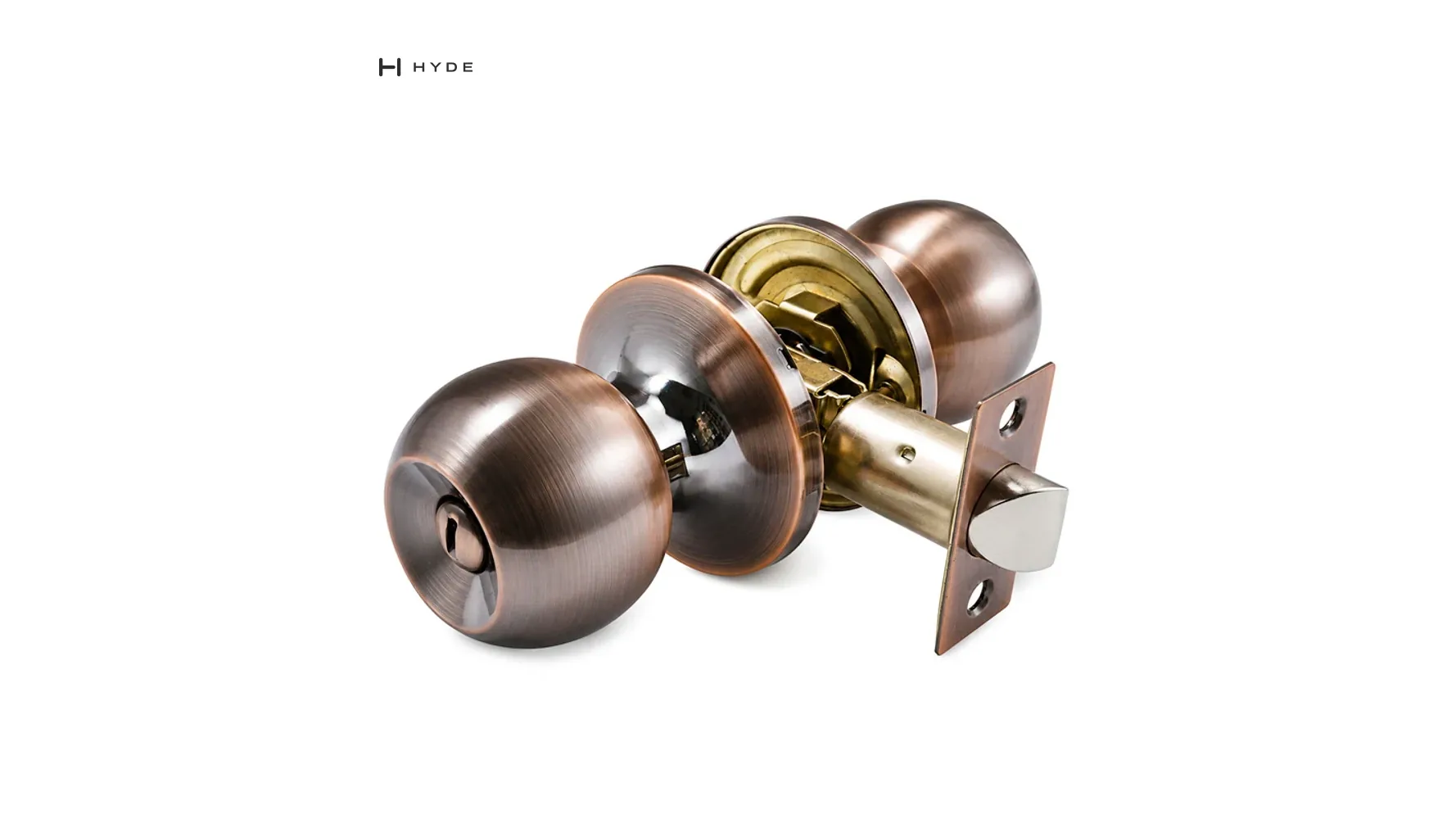
A cylindrical lock — a knob or lever set that fits two bored holes rather than a mortised pocket — is the commonest lock in the world, and choosing one from a catalogue is harder than it should be because the model numbers do not tell you what differs. This piece takes the twelve numbers in our own selected range and says plainly which decisions actually separate them.
The first thing to know is how much they have in common. Across 587, 607, 592, 598, 575, 595 and 609 the backset is stated as 60mm or 70mm adjustable and the door thickness as 35mm to 45mm adjustable. That is not laziness in the data; it is the point of a bored lock. One part covers the two backsets the world installs, and the same part covers most residential and light commercial door thicknesses, so a specification error on either of those two rows is recoverable on site rather than in a container.
So the real first decision is function, and there are three that cover most doors. Entrance is keyed on the outside and always free on the inside. Privacy is the bathroom and bedroom function: a turn button inside, no key, and a small emergency release outside. Passage is not a lock at all — it latches the door and has no locking function in either direction, which is what you want on a corridor door that has to stay closed against smoke but must never trap anybody.
Then there is a fourth group that most catalogues bury, and it is the one an institutional project needs. The 5807 is published with functions named COMMUNICATION LOCK, CLASSROOM LOCK and EXIT LATCH. A classroom function keys from the corridor side only, so a teacher can lock the door from inside the room without a key being required to leave it. If your specification names a school, a clinic or a hall of residence, look at the 5807 first, because the other eleven in this range are specified around the entrance-privacy-passage set.
The chassis is the second decision and it is mostly a decision about the building's traffic. Most of these are stainless steel; the 5870 is published in one variant as iron plus stainless steel and in another as Stainless Steel 304/201; the 592 and 595 are published as brass or stainless steel, which means the base metal is a choice the buyer has not made yet. That last point matters more than it reads — a finish specification written in BHMA numbers cannot be answered until the base metal is settled, for the reason set out in our article on finish codes.
The 5831 is the outlier and it is the reason a range this size exists at all. Its backset is published as 60, 70, 80 or 90mm adjustable and its door thickness as 35 to 50mm, where the rest of the range stops at 70mm and 45mm. That is a lock for a thicker leaf and a deeper stile — a security door, a heavier timber door, a door where the ironmonger has already discovered that a 70mm backset puts the knob too close to the edge. If a survey comes back with a backset over 70, this is the number to quote.
The 5870 sits between the two: 60mm/70mm on some variants, 70mm only on others, and a door thickness published as 35–50mm rather than 35–45mm on one variant. If you are standardising a project on one part number, that difference between variants is worth confirming against the specific finish code you are ordering, because it is not constant across the model.
One honest gap. The 9210 is in this selected range and carries four published variants, and it has no specification rows at all — no backset, no door thickness, no function. We are not going to fill those in by analogy with its neighbours, because a backset copied from a similar-looking lock is exactly the kind of plausible number this site refuses to publish. If the 9210 is the one you want, ask us and we will measure it against the drawing.
For a quotation, three rows settle it: the function on each door, the backset your survey found, and the leaf thickness. Finish comes after those three and never before, because the finish never changes what fits and the first three always do. Send a door schedule if you have one; we will answer it line by line rather than sending a catalogue back.
About Canton Hyland — Canton Hyland manufactures panic exit devices, locks and architectural door hardware for commercial and institutional projects, supplying specifiers and distributors internationally.