
Exit Device Comparison 2026: Every Push Bar in the Range by Length, Latching and Door
46 records sit in our panic exit device family, and only 27 of them are exit devices. Here they are in three tables (single doors, pairs, special purposes) built from their specification rows, with the missing rows and the conflicting ones named.
Johnson LiuDigital Communications, Canton HylandMA Digital Media, Johns Hopkins University
Products mentioned
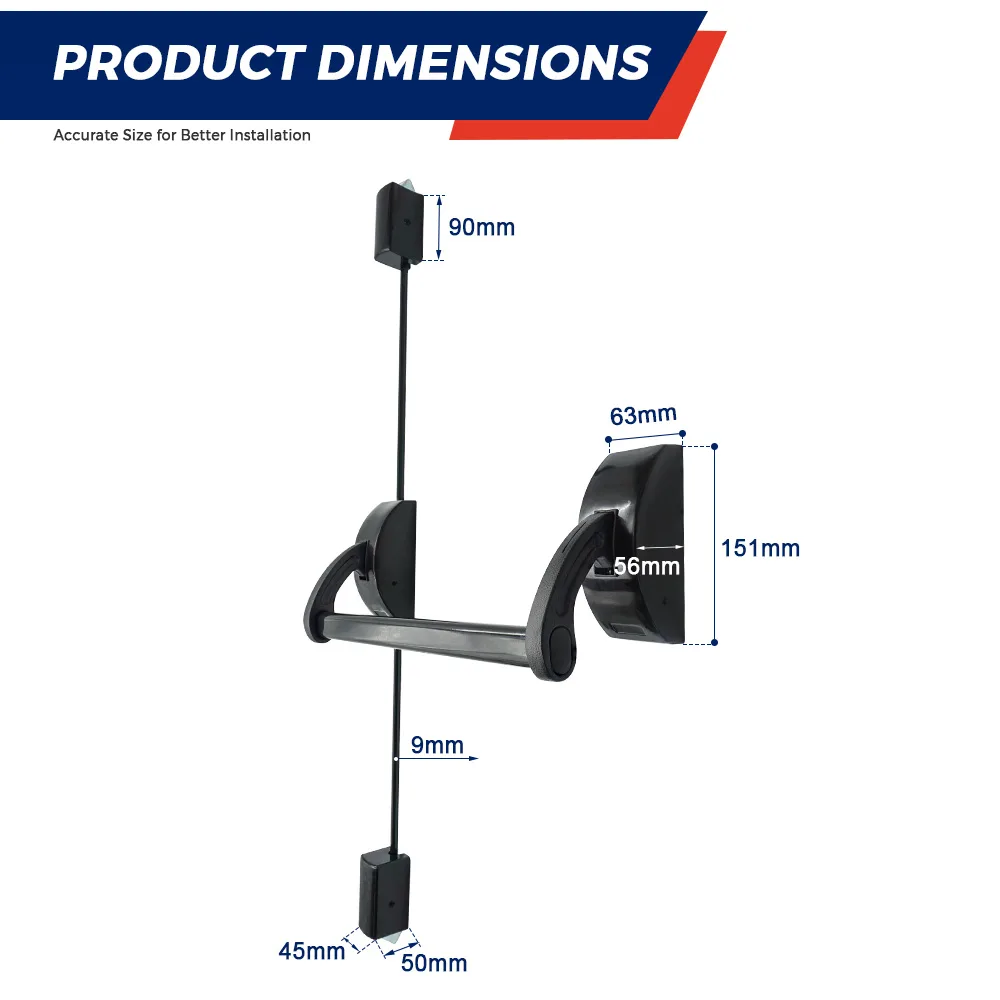
A search for panic bars on a supplier's site usually returns a wall of near-identical photographs: a red or silver bar, a grey housing, a model number. The differences that decide whether a device fits the door are in the specification rows, and on most sites they are spread across dozens of pages. This guide puts every exit device in our catalogue on one page, as of 23 September 2026, so the comparison can be made in a few minutes rather than an afternoon.
First, what the family actually contains. There are 46 published records in our panic exit device family, and 27 of them are exit devices. The other 19 are the parts that go with them: 16 outside trims (the lever or handle on the pull side of the door), one lock case for the 307, and two door coordinators for pairs. Trims have their own guide on this site, and coordinators their own article; this page is about the devices.
HOW TO READ THE TABLES
Every cell comes from a specification row on the product page. Where a device publishes a row, the table shows it in the words the record uses; where it does not, the cell says not published. Lengths are the published bar lengths, in millimetres with inches alongside. Material is the material row as published, which is not always the same as the one-line material field at the top of the page; where the two disagree, this guide says so rather than choosing one.
Of the 27 devices, 13 publish a length. That is the single most important row for a push bar, because the bar has to suit the leaf it is fitted to, and it is the row buyers most often send us without. Our article on push bar length explains how to measure the leaf so the length question has an answer.
SINGLE DOORS: DEVICES WITH A PUBLISHED LENGTH
These are the rim-type push bars for a single leaf that publish their length. A rim device latches into a strike on the frame at the lock edge, one point, and is the ordinary choice for a single escape door.
Scroll sideways to compare columns. Select a column heading to sort; select it three times to restore source order.
| 300 | 900mm (35-7/16") | adjustable | iron with ABS | red finish; the record states a 1.5 hour fire rating |
|---|---|---|---|---|
| 302 | 1040mm (40-15/16") | adjustable | stainless steel and iron | reversible for left or right hand |
| 303 | 900mm (35-7/16") | fixed | steel or stainless steel, iron inner | satin nickel, chrome, antique brass, polished brass |
| 305 | 1040mm (40-15/16") | fixed | iron and aluminium | spray painted; listed under fire doors |
| 307 | 1000mm (39-3/8") | fixed | ABS with aluminium push bar | pairs with the 072 lock case; the record states 2.5 hours; reversible |
| 308 | 1050mm (41-5/16") | fixed | 304 stainless steel | plate 165 × 55mm, projection 99mm |
| 310 | 900mm (35-7/16") | fixed | iron | red or black; the record states a 1.5 hour fire rating |
| 311 | 900mm (35-7/16") | fixed | ABS with aluminium | sold as a set with lock body, brass cylinder and stainless handle; cylinder centres 72 and 92mm |
| 330 | made to length | to order | iron with iron tube | red or black |
9 rows · Source order
Two groupings are worth pointing out. The 307 and the 311 are not rim devices in the ordinary sense: each works with a mortise lock body in the door, the 307 with our 072 case (65mm backset, 72mm centre distance, two euro cylinder apertures) and the 311 as a complete set. Choose one of those where the door already has, or needs, a mortise lock and a keyed cylinder on the outside. And the 308 is the one single-door device in stainless steel that publishes its projection, 99mm, which is the figure to check against a door that opens into a narrow corridor.
Where a project has many door widths, the adjustable 300 and 302 are usually the economical answer: one part number cut or set to each leaf, rather than a different fixed length per opening. Only devices published as adjustable, or made to length like the 330, should be shortened; a fixed-length device cut on site is no longer the device that was supplied.
PAIRS OF DOORS AND MULTI-POINT LATCHING
A pair of doors is where exit devices differ most, and where a wrong choice is most expensive. A rim device on each leaf only works where there is a centre mullion for the strikes. Without one, the inactive leaf has to be held at the top and the bottom, which is what vertical-rod and multi-point devices do.
Scroll sideways to compare columns. Select a column heading to sort; select it three times to restore source order.
| 309-D | pair | active and inactive leaf | 1110mm (43-11/16") | aluminium alloy and iron; powder coated |
|---|---|---|---|---|
| 316-D | pair | top and bottom latching | not published | flame-retardant ABS housing, aluminium alloy body, iron push bar, thickened iron latch; surface mounted; reversible; outside lever optional |
| 320 | pair | two-point locking | made to length | iron; red or black |
| 306-D | pair | not published | not published | no other rows |
| 308-D | pair | not published | not published | no rows yet |
5 rows · Source order
The 316-D is the pair set that publishes the most, and it states its latching in words: top and bottom. The 309-D states that it works the active and inactive leaf and publishes the longest bar in the range. On any pair, the device is only half the answer: the leaves also have to close in the right order, which is the coordinator's job, and our article on door coordinators for double fire doors covers that. The two coordinators in this family, the DC01 and the DSL02, are there for exactly that reason.
Two records in this table publish almost nothing. We are not going to give the 306-D or the 308-D the rows of their neighbours: ask, and we will confirm their latching and length against the drawing before you specify them.
SPECIAL PURPOSES
Four devices are built for one situation each, and each is the right answer only there.
Scroll sideways to compare columns. Select a column heading to sort; select it three times to restore source order.
| 314 | alarmed exit door | 650, 800 or 1000mm (25-5/8", 31-1/2" or 39-3/8"), customizable; built-in alarm; key access from outside; external lever or dogging as options; surface mounted |
|---|---|---|
| 315 | pry latch, push-to-open emergency exit | 800 or 1000mm; iron, painted; commercial emergency exit doors |
| 317 | cold room and freezer doors | releases from inside with no key; outside handle optional; iron; installed inside the door |
| 306 PS | passage push bar | no latch bolt; fitted with a separate lock case, supplied to suit |
4 rows · Source order
The 314 is the device for a door that must be escapable but should not be used casually, a fire exit from a shop floor for example: pushing the bar opens the door and sounds the alarm. The 317 answers a safety question that ordinary hardware does not: a person shut inside a cold store must be able to get out without a key, from the inside, in the cold. The 315 is a pry latch, a push-to-open latch for commercial exits; the catalogue lists it in this family, but check it against the standard your door has to meet before treating it as a panic device.
RECORDS THAT DO NOT PUBLISH ENOUGH TO COMPARE
Nine devices have a photograph and a page but too few rows to place in a table: the 036, 301, 306-S, 308-S, 309-S, 312, 313, 316-S and SH01. Some publish a material and nothing else; the 312 and the SH01 publish no rows at all. The 316-S shares its construction rows with the 316-D (flame-retardant ABS housing, aluminium alloy body, iron push bar, surface mounted, reversible) but not its length. If one of these is the device you want, tell us the leaf and we will confirm the rows before quoting.
Two records also contradict themselves, and it is better to say so than to let a buyer find out. The 305 lists steel or stainless steel in its material field and iron and aluminium in its specification row. The 309-D does the same: steel or stainless steel in one place, aluminium alloy and iron in the other. Until the factory confirms, treat the specification row as the working answer and ask before ordering either for a corrosive location.
FIRE RATINGS ON THESE PAGES
Three records carry a fire duration: 1.5 hours on the 300 and the 310, and 2.5 hours on the 307. Read those as the record states them, not as evidence. A fire duration means something only as the rating of a tested door assembly, identified in a report or a listing, and none of these three publishes one. We do not hold a UL listing; the 307 and 311 have been submitted for testing, and until certificate numbers exist we will not imply a listing or a rating for them. Our article on UL 305 explains what a listing is and how to check one.
CHOOSING, IN FOUR QUESTIONS
Is it one leaf or a pair? A pair without a centre mullion needs top and bottom latching and a coordinator, which narrows the choice to the second table. How wide is the leaf? That decides the length, and whether an adjustable device or a made-to-length one is the economical answer. Does the outside need a key or a lever? Then choose a device that works with the trim you need, or a set like the 311 that includes it. And does the door face something other than an ordinary corridor, a cold store, an alarmed exit, a coastal entrance? Then the special-purpose table, or the stainless 308, is the place to start.
Send those four answers with the leaf size and the door thickness, and the first reply can name a device and a trim. Send a photograph of a red bar, and the first reply will be these four questions.
Questions this answers
What lengths do your panic exit devices come in?
Published lengths run from 650 to 1110mm. Single-door devices are 900mm (300, 303, 310, 311), 1000mm (307), 1040mm (302, 305) and 1050mm (308); the 309-D pair set is 1110mm; the alarmed 314 is 650, 800 or 1000mm; the 315 pry latch is 800 or 1000mm. The 300 and 302 are adjustable, and the 320 and 330 are made to the length requested. Of 27 devices, 13 publish a length.
Which panic bar should I use on a pair of doors without a centre mullion?
A device that latches the inactive leaf at the top and bottom, plus a coordinator so the leaves close in order. In our range, the 316-D publishes top and bottom latching, the 309-D works the active and inactive leaf with a 1110mm bar, and the 320 is a two-point locking device made to length. The DC01 and DSL02 coordinators sit in the same family.
Which of your exit devices work with a mortise lock?
The 307 works with our 072 lock case (65mm backset, 72mm centre distance, two euro cylinder apertures), and the 311 is sold as a set with its own lock body, brass cylinder and stainless handle, with cylinder centres of 72 and 92mm. Choose one of those where the door needs a keyed cylinder on the outside.
Do you have an alarmed exit device or one for cold rooms?
Yes. The 314 has a built-in alarm, key access from outside and an optional external lever or dogging function, in 650, 800 or 1000mm. The 317 is an inside-release push bar for cold storage and freezer doors: no key is needed from the inside, and an outside handle is optional.
Are the fire ratings on your exit device pages certified?
No. The 300 and 310 records state 1.5 hours and the 307 states 2.5 hours, but a fire duration means something only as the rating of a tested door assembly named in a report or listing, and none of these publishes one. We do not hold a UL listing; the 307 and 311 have been submitted for testing, and we will not imply a rating until certificate numbers exist.
Why do some of your exit devices show almost no specifications?
Nine devices (036, 301, 306-S, 308-S, 309-S, 312, 313, 316-S and SH01) publish too few rows to compare, and the 312 and SH01 publish none. We do not copy rows from similar models. Tell us the leaf size and door thickness and we will confirm the device's rows against the drawing before quoting.
About Canton Hyland — Canton Hyland manufactures panic exit devices, locks and architectural door hardware for commercial and institutional projects, supplying specifiers and distributors internationally.