
Cylindrical and Tubular Lock Comparison 2026: Four Families, Every Series, and What Heavy Duty Actually Changes
59 knob and lever locks for bored doors, in four families: tubular, light-duty cylindrical, heavy-duty cylindrical and commercial. Side by side from their specification rows, with the one row that does not separate them, and the rows that do.
Johnson LiuDigital Communications, Canton HylandMA Digital Media, Johns Hopkins University
Products mentioned
- 575 SSET — Tubular Lock
- 592 PBET — Tubular Lock
- 607 SSET — Tubular Lock
- 578 SSET — Light Duty Cylindrical Lock
- 587 SSBK — Light Duty Cylindrical Lock
- 5831 SSET — Heavy Duty Cylindrical Lock
- 5870 ACET — Heavy Duty Cylindrical Lock
- 5874 ACET — Heavy Duty Cylindrical Lock
- 5807 SSCR — Commercial Lock
- 5807 SSR — Commercial Lock
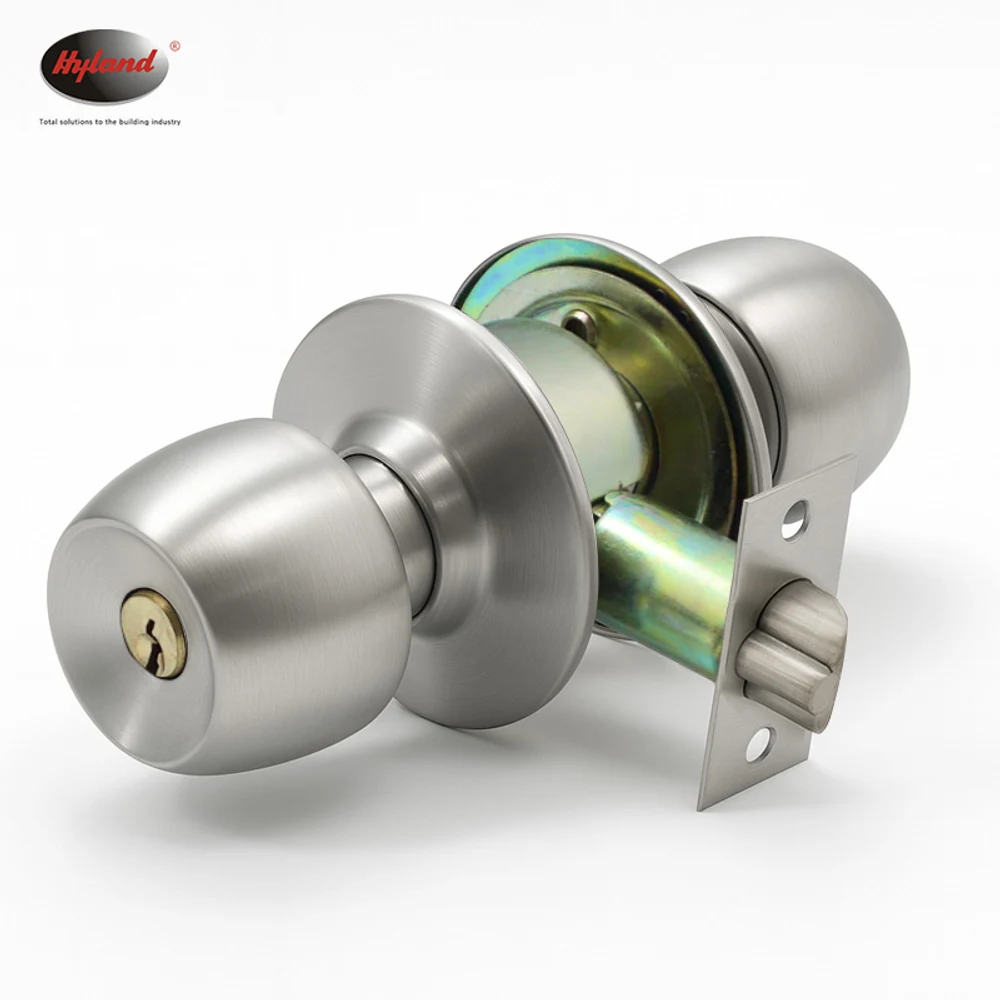
A lock for a bored door (a round hole through the face of the door and a smaller one into its edge) is the most common lock in the world and the easiest one to compare badly. Photographs look alike, prices differ by a factor of three, and the words on the labels (tubular, cylindrical, light duty, heavy duty, commercial) are used differently by every supplier. This guide lays out all the bored-door locks in our catalogue side by side, as of 23 September 2026, and says which rows actually separate them.
The family has 59 published records: 26 tubular locks, 11 light-duty cylindrical locks, 17 heavy-duty cylindrical locks and 5 commercial locks with the institutional functions. Every table below is built from the specification rows on those product pages. Where a family does not publish a row, the cell says not published, and nothing has been filled in from a neighbouring model.
THE ROW THAT DOES NOT SEPARATE THEM
Start with the number buyers usually reach for first. 43 of the 59 records publish a cycle life, and every one of them says 200,000 cycles, whether the page calls the lock tubular, light duty or heavy duty. So in our range the label is not a statement about cycle testing, and a buyer who chooses heavy duty expecting a higher cycle figure will not find one on these pages. Nor is either label an ANSI/BHMA grade: we do not hold BHMA certification, and 200,000 cycles is our published expectation, not a graded result. Our guide to cycle testing and durability grades explains what a grade would require.
What the labels do change, on the evidence of the rows, is the door the lock is published for and the metal of the trim. That is the comparison below.
THE FOUR FAMILIES, SIDE BY SIDE
Scroll sideways to compare columns. Select a column heading to sort; select it three times to restore source order.
| Tubular | 26 | 60mm / 70mm (2-3/8" / 2-3/4") adjustable, on all 26 | 35 to 45mm (1-3/8" to 1-3/4"), on all 26 | wrought stainless steel or brass | entrance 16, privacy 6, passage 2 |
|---|---|---|---|---|---|
| Light-duty cylindrical | 11 | not published | not published | wrought stainless steel or brass | entrance 6, privacy 4, passage 1 |
| Heavy-duty cylindrical | 17, of which 6 publish rows | 60/70mm on the 5870 ACET and 5874 ACET; 60, 70, 80 or 90mm adjustable on the 5831 SSET | 35 to 50mm (1-3/8" to 1-15/16") where published | zinc die-cast, electroplated, or solid brass | entrance 5 |
| Commercial | 5 | not published | 35 to 45mm | not published | classroom, storeroom, communication, exit latch, entrance and communication |
4 rows · Source order
Three readings follow. First, if the door is thicker than 45mm, the choice narrows at once to the heavy-duty locks that publish 35 to 50mm (the 5831 SSET, 5870 ACET and 5874 ACET), because every tubular lock stops at 45mm. Second, if the backset is anything other than 60 or 70mm, the 5831 SSET is the only lock in the family published for it, adjustable to 80 or 90mm. Third, if the room needs a classroom, storeroom or communicating function, only the commercial five offer one; the other families publish entrance, privacy and passage.
The trim row is worth reading carefully, because it runs against intuition. The tubular and light-duty locks publish wrought stainless steel or brass trim; the heavy-duty locks publish zinc die-cast trim, electroplated, or solid brass. Heavy duty here describes the chassis and the door range, not the metal of the lever or knob you touch. On an exterior or coastal door, where the trim metal matters more than the chassis, ask which trim is supplied before choosing by the label.
TUBULAR LOCKS, BY SERIES
All 26 tubular records share the same core rows: 60/70mm adjustable backset, 35 to 45mm door, 200,000 cycles, a solid steel chassis and latch case, zinc plated, and a 57mm curved-lip strike as standard with a 70mm lip available on request. The series differ in finish and function; the 26th record, titled Tubular Knob Lock, shares the core rows but publishes no function or finish.
Scroll sideways to compare columns. Select a column heading to sort; select it three times to restore source order.
| 575 | 4 | entrance | antique brass, antique copper, satin stainless steel; the 575 CPET row lists the whole range |
|---|---|---|---|
| 592 | 5 | entrance, privacy, passage | satin brass, polished brass, satin stainless steel |
| 595 | 2 | entrance, privacy | antique copper |
| 598 | 5 | entrance, privacy | antique copper, satin nickel, satin stainless steel |
| 607 | 7 | entrance, privacy, passage | antique copper, polished brass, polished and satin stainless steel |
| 609 | 2 | entrance | polished brass, satin stainless steel |
6 rows · Source order
The 575 is the series that publishes its latch in full: a 12mm throw, deadlocking on the keyed functions. The 607 is the widest set, with all three functions and the polished stainless finish (US32) that no other tubular series lists. Seven 607 records carry a latch row that repeats the backset (Adjustable 60 to 70mm) rather than describing the latch; we are correcting it, and until then take the 575 figures as the ones we can confirm for the latch.
CYLINDRICAL LOCKS, LIGHT AND HEAVY DUTY
The light-duty cylindrical locks are the 578 series (four variants) and the 587 series (seven). They publish the cylinder in detail (a 5-pin tumbler with a brass plug and two nickel-plated brass keys on the 578; solid brass, or zinc and brass, on the 587) and that they can be keyed alike to our deadbolts or master keyed. They do not publish a backset or a door thickness. Ask for both before ordering: they are the two rows that decide whether the lock fits the door at all.
The heavy-duty family is where the gaps are largest. Of its 17 records, 6 publish specification rows: the 5831 SSET, the 5870 ACET and 5870 SSET, the 5871 SSET, the 5874 ACET and the record titled Cylindrical Knob Lock. The other 11 (the four 5831 90mm colour variants, the four 9210 variants, the 5870 SNET, the S578 and the 587 SSPT) have a photograph and nothing else. The four 5831 90mm variants presumably share the 5831 SSET's 90mm backset, as their name suggests, but a name is not a specification; we will confirm them against the drawing on request.
Among the six that publish, the 5870 ACET and 5874 ACET add two useful rows: a 65 to 75mm rosette diameter, which is the figure that decides whether a new lock covers the marks of an old one on a replacement, and a wider list of key metals (iron, nickel-plated brass, solid brass, brushed nickel).
COMMERCIAL LOCKS AND THEIR FUNCTIONS
Scroll sideways to compare columns. Select a column heading to sort; select it three times to restore source order.
| 5807 SSCR | classroom | 35 to 45mm | stainless steel 304/201 |
|---|---|---|---|
| 5807 SSR | storeroom | 35 to 45mm | stainless steel 304/201 |
| 5807 SSCL | communication | 35 to 45mm | stainless steel 304/201 |
| 5807 SSEL | exit latch | 35 to 45mm | stainless steel 304/201 |
| 5870 SSCC | entrance and communication | 35 to 45mm | stainless steel 304/201 |
5 rows · Source order
These are the functions a school, an office or a hotel schedule asks for by name. A classroom lock lets a teacher lock the outside lever with a key from the corridor side while the inside always opens; a storeroom lock keeps the outside lever rigid, so the door is always locked from outside; a communicating lock sits between two rooms that each need to lock their own side. Our lock function decision guide sets out which rooms take which function, and the three function errors that are life-safety problems rather than inconveniences.
The material row on all five says stainless steel 304/201, which names two grades rather than one. The difference matters: 201 is cheaper and can mark and stain where 304 does not. Ask which grade is supplied for the variant you are ordering, especially for a washroom or an entrance exposed to weather. Our guide to stainless grade selection covers where each belongs.
READING THE MODEL CODES
Across the family, the last letters of the model number name the function, and they are consistent: ET is entrance (keyed outside), BK is privacy (a turn button inside, the bathroom function), PS is passage (no lock). The commercial locks use CR for classroom, R for storeroom, CL for communication, EL for exit latch and CC for entrance and communication. The letters before them usually name the finish, SS for satin stainless steel, PB for polished brass, AC for antique copper, SN for satin nickel, but not always: the 587 MB variants publish a finish row listing several finishes, and the 575 CPET lists every finish in the range. Read the finish row, not the letters, and name the finish in words on the order.
CHOOSING, IN THREE QUESTIONS
How thick is the door, and what is the backset? Over 45mm, or any backset other than 60 or 70mm, points to the heavy-duty locks that publish those rows. What does the room need? Entrance, privacy and passage are available in every family; classroom, storeroom and communicating functions only in the commercial five. Where is the door? An exterior or coastal door is chosen by the trim metal and the stainless grade, not by the words light or heavy duty.
Send the door thickness, the backset, the function for each door and the finish in words, and the first reply can name a series and a variant. Send a photograph and the word heavy duty, and the first reply will ask for those four things.
Questions this answers
What is the difference between your light-duty and heavy-duty cylindrical locks?
Not the cycle life: every record in the family that publishes one says 200,000 cycles. The differences in the published rows are the door and the trim. Heavy-duty locks that publish their rows take 35 to 50mm doors, and the 5831 SSET adjusts to a 60, 70, 80 or 90mm backset; their trim is zinc die-cast, electroplated, or solid brass. Light-duty locks publish wrought stainless steel or brass trim and do not publish a backset or door thickness, so ask for both.
Which of your locks fit a door thicker than 45mm?
The heavy-duty cylindrical locks that publish a door range: the 5831 SSET, 5870 ACET and 5874 ACET, each published for 35 to 50mm doors. Every tubular lock in the range is published for 35 to 45mm, as are the five commercial locks.
Do you have a lock with a 90mm backset?
Yes, the 5831 SSET heavy-duty cylindrical lock is published with an adjustable 60, 70, 80 or 90mm backset and a 35 to 50mm door. The four 5831 90mm colour variants are named for the same backset but do not yet publish rows; we confirm them against the drawing on request. All tubular locks are 60/70mm adjustable.
Which locks have classroom or storeroom functions?
The commercial 5807 series: 5807 SSCR is classroom, 5807 SSR storeroom, 5807 SSCL communication and 5807 SSEL exit latch, and the 5870 SSCC is entrance and communication. All are published for 35 to 45mm doors in stainless steel 304/201; ask which grade is supplied. The other families publish entrance, privacy and passage only.
What do ET, BK and PS mean in your lock model numbers?
They name the function: ET is entrance (keyed outside), BK is privacy (turn button inside, the bathroom function) and PS is passage (no lock). The commercial locks use CR classroom, R storeroom, CL communication, EL exit latch and CC entrance and communication. Letters before them usually name the finish, but not always, so read the finish row and name the finish in words on the order.
Are your cylindrical locks ANSI Grade 1 or Grade 2?
No grade is claimed. We do not hold ANSI/BHMA certification, and the 200,000 cycles on these pages is our published expectation, not a graded test result. If a specification requires a BHMA grade, that requirement cannot be met by these locks until a certificate exists.
About Canton Hyland — Canton Hyland manufactures panic exit devices, locks and architectural door hardware for commercial and institutional projects, supplying specifiers and distributors internationally.