
EN to ANSI/BHMA Cross-Reference 2026: What Maps, What Does Not, and Why
Specifiers ask for a conversion table between EN and ANSI/BHMA door hardware standards. What exists is a scope map, not an equivalence: the two systems classify different properties, and a product certified to one carries no automatic claim under the other. This page sets out which standard covers which product family on each side, what each one measures, and the four places the mapping genuinely breaks.
Johnson LiuDigital Communications, Canton HylandMA Digital Media, Johns Hopkins University
The request arrives in almost the same words every time: send us a conversion table between the European standards and the American ones. It is a reasonable thing to want and there is no honest way to supply it, because the two systems are not two dialects describing the same thing. They classify different properties, using different methods, and they express the result in structurally different formats.
What can be supplied, and what this page is, is a scope map: which standard governs which product family on each side, what each one actually measures, and the four places where a reader who assumes equivalence will be wrong.
THE SHAPE OF EACH SYSTEM
ANSI/BHMA grades a product. A lockset is Grade 1, Grade 2 or Grade 3 — one number, descending, covering a bundle of performance criteria tested together. A specifier writes Grade 1 and a manufacturer either holds it or does not.
The EN system classifies a product across several independent digits. An EN 1906 lever handle carries a multi-digit code in which separate positions describe category of use, durability, door mass, fire suitability, safety, corrosion resistance, security and type of operation. There is no single number. Two products with the same headline standard can differ in six of the eight positions.
That difference is the reason no equivalence table exists. Grade 1 is not a value that any EN digit holds, and an EN classification cannot be collapsed into one grade without discarding most of what it says.
THE SCOPE MAP
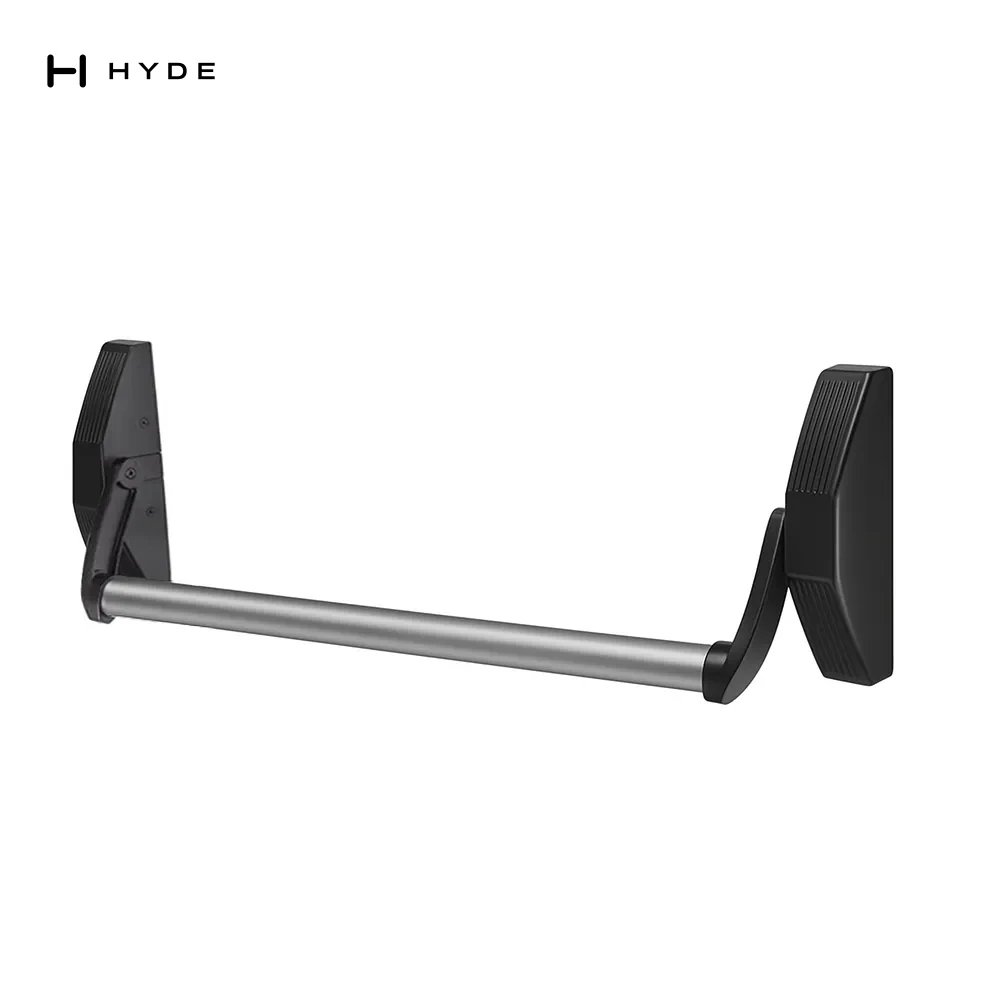
Panic and emergency exit hardware. EN 1125 covers panic exit devices operated by a horizontal bar, intended for premises where the public may be present and untrained in the hardware. EN 179 covers emergency exit devices operated by a lever or push pad, intended where occupants are familiar with the exit. On the ANSI/BHMA side, A156.3 covers exit devices, and the trained-versus-untrained distinction that separates EN 1125 from EN 179 is handled by building code occupancy rules rather than by the hardware standard.
Mechanically operated locks and latches. EN 12209 covers the lock case and its latching and locking functions. ANSI/BHMA splits by lock architecture instead: A156.13 for mortise locks, A156.2 for bored and preassembled locks. A European mortise lock and an American mortise lock are graded under standards that do not divide the category the same way.
Lever handles and knob furniture. EN 1906 covers the handle set as its own product with its own eight-position classification. The ANSI/BHMA system generally treats the trim as part of the lockset it belongs to rather than as a separately graded item, which is why a European handle carries a classification of its own and an American one usually does not.
Door closers. EN 1154 covers controlled door closing devices, including a power size derived from door width and mass. A156.4 covers door controls. The power-size concept is the closest the two systems come to a genuinely comparable value, and even there the sizing input differs.
Hinges. EN 1935 covers single-axis hinges with a classification including durability and door mass. A156.1 covers butts and hinges. Both grade load and cycles; neither expresses them in the other's units.
Cylinders. EN 1303 covers cylinders for locks, classified on key-related security, durability and attack resistance. A156.5 covers auxiliary locks and associated products, with cylinder security addressed alongside. The dimensional side of the European cylinder is not in EN 1303 at all — it is in DIN 18252, which describes the profile itself.
Finishes and corrosion. EN 1670 classifies corrosion resistance by exposure grade. A156.18 covers materials and finishes, and is where the 600-series finish numbers live. These two are complementary rather than equivalent: one grades how long a finish survives a salt spray, the other names what the finish is.
Fire resistance. EN 1634-1 is the European test for fire resistance of door assemblies. UL 10C and NFPA 252 are the North American tests. All three subject a complete assembly to a furnace, and they differ on the pressure regime, which is the reason a result under one is not accepted as a result under another.
THE FOUR PLACES THE MAPPING BREAKS
First, the assembly rule. Both systems certify a door as a complete assembly — leaf, frame, hardware, seals, glazing — not as a bag of individually approved parts. A hinge tested in one assembly does not carry its rating into another. This catches more projects than any other single misunderstanding, and it is true on both sides of the Atlantic.
Second, listing is not grading. A UL listing states that a product was tested and is subject to ongoing factory surveillance for a specific construction. An ANSI/BHMA grade states performance against a test suite. They are different kinds of statement, and a product can hold one without the other. We publish a separate article on why UL 305 is a listing rather than a grade.
Third, the fire test pressure differs. The neutral pressure plane used in the European and North American furnace tests is not the same, so an EN 1634-1 result cannot be read across to UL 10C or NFPA 252 even for an identical assembly. This is the technical core of why a European fire door certificate does not satisfy a North American authority having jurisdiction.
Fourth, the finish codes are a naming system, not a performance grade. US26D, BHMA 626 and a factory code like SN can all describe the same satin finish, and none of them states corrosion performance. That is EN 1670's job, and a finish code carries no EN 1670 class with it.
WHAT WE HOLD, STATED PLAINLY
Our exit device range is certified to EN 1125 and CE marked. We do not hold ANSI/BHMA grades or UL listings on this range today. Two models, 307 and 311, are in testing for North American certification and no certificate number exists yet.
That sentence is written this way because UL Product iQ and the BHMA certified product directory are both publicly searchable, and a specifier writes certificate numbers into submittal documents. A claim that cannot survive a search costs more than the order it was meant to win.
If a project needs an ANSI/BHMA grade or a UL listing today, the honest answer is that our EN 1125 certification does not substitute for it, and we would rather say that now than after a container has shipped.
HOW TO WRITE A SPECIFICATION THAT WORKS IN BOTH MARKETS
Specify the behaviour, then name the standard for the market the building is in. A schedule that says a device must release the latch under a single motion in the direction of egress describes a requirement both systems test. A schedule that says Grade 1 describes a requirement only one of them can answer.
Where a project genuinely spans both markets, the workable pattern is two hardware sets with one functional description, rather than one set with two certificates. That is more paperwork and less rework, and rework on hardware means a door that does not close.
Questions this answers
Is there a conversion table between EN and ANSI/BHMA door hardware standards?
No, and one cannot honestly exist. ANSI/BHMA compresses performance into a single grade; the EN system spreads it across several independent classification digits. A scope map showing which standard covers which product family is possible, and this page is one. An equivalence table is not.
Which EN standard corresponds to ANSI/BHMA A156.3?
A156.3 covers exit devices. On the EN side the category is split in two: EN 1125 for panic exit devices with a horizontal bar, for premises where the public may be present and untrained, and EN 179 for emergency exit devices with a lever or pad, where occupants know the exit.
Does EN 1125 certification satisfy a North American authority having jurisdiction?
Generally no. The fire test furnace pressure regimes differ between EN 1634-1 and UL 10C or NFPA 252, so results do not read across, and North American codes commonly call for a UL listing or an ANSI/BHMA grade by name. Confirm with the authority having jurisdiction before assuming a substitution.
Is a UL listing the same as an ANSI Grade 1?
No. A listing states that a specific construction was tested and remains under factory surveillance. A grade states performance against a test suite. A product can hold either without the other, and a specification asking for both is asking for two separate pieces of evidence.
Does a BHMA 626 finish code tell me anything about corrosion resistance?
No. Finish codes name a finish; they do not grade how long it lasts. Corrosion performance is classified by EN 1670 on the European side, and a finish code carries no EN 1670 class with it. If corrosion matters to the project, specify it separately.
Does Canton Hyland hold ANSI or UL certification?
Not today on the exit device range. That range is certified to EN 1125 and CE marked. Models 307 and 311 are in testing for North American certification and no certificate number exists yet. UL Product iQ and the BHMA directory are publicly searchable, which is why this is stated plainly rather than implied.
About Canton Hyland — Canton Hyland manufactures panic exit devices, locks and architectural door hardware for commercial and institutional projects, supplying specifiers and distributors internationally.