
The Rim Night Latch: What 564 and 1073 Actually Measure
A rim night latch sits on the face of the door rather than inside it, which changes every dimension that matters: backset, door thickness range, latch extension and deadbolt throw. The 564 and the 1073 answer the same job in two different metals, and the difference between single-side and double-side is a security decision rather than a convenience one.
Insight
Johnson LiuDigital Communications, Canton HylandMA Digital Media, Johns Hopkins University
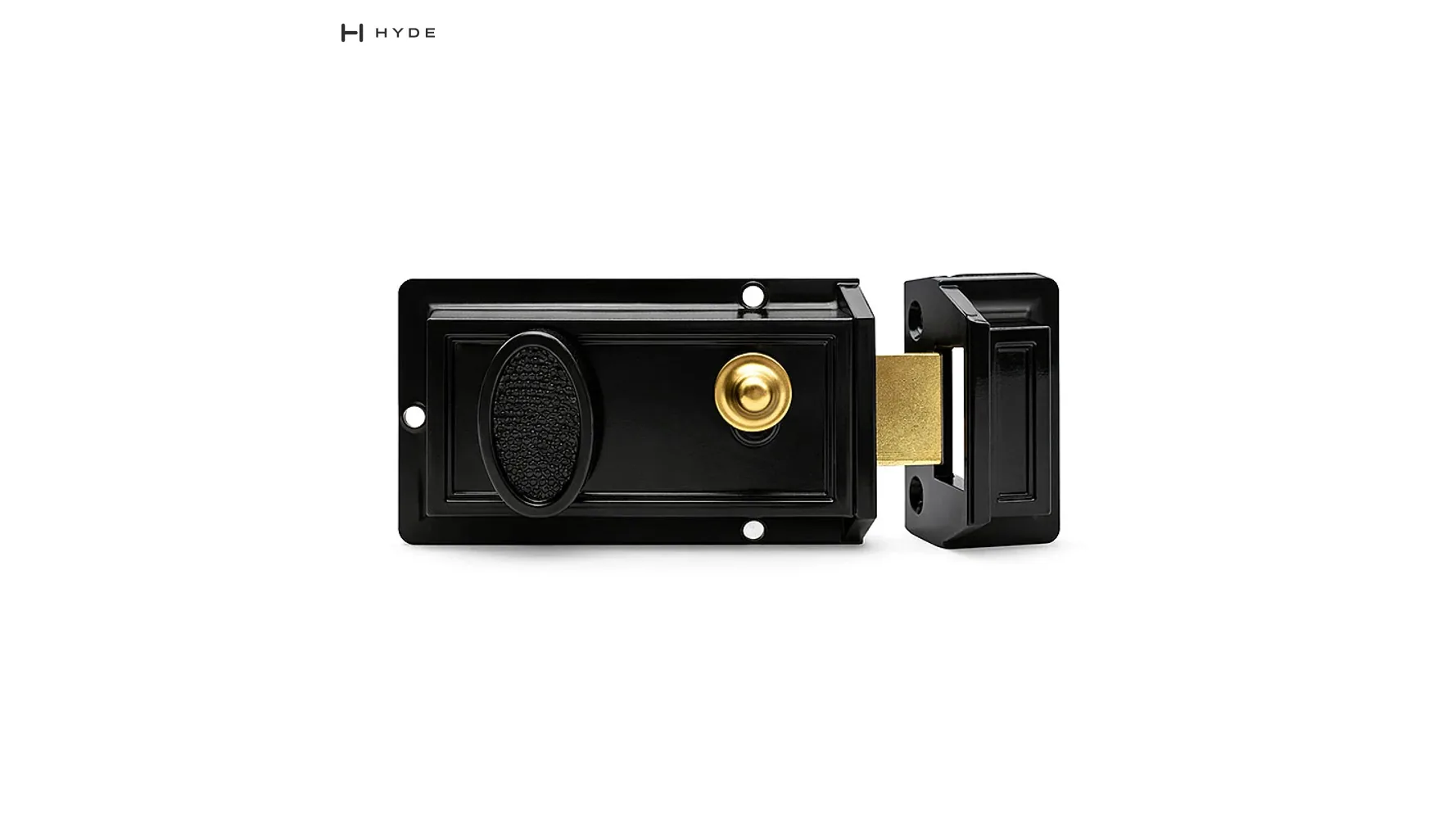
A rim lock is a lock that does not go inside the door. The case screws to the inside face of the leaf, the cylinder passes through a single hole, and the latch engages a keep screwed to the frame rather than a mortised strike. Everything that follows from that is why a rim night latch is dimensioned differently from a mortise case, and why the numbers a buyer asks for are not the same numbers.
Start with backset, because it is the one that gets confused. On a mortise lock the backset is measured from the edge of the door to the centre of the spindle. On a rim night latch it is measured from the edge of the door to the centre of the cylinder hole, and on both our 564 and the 1073 it is 60mm — 2-3/8 inches in the form a North American buyer will write it. That single hole is the whole of the door preparation, which is why a rim lock is the lock people fit to a door that already exists.
Door thickness is the next constraint, and it is a range rather than a figure: 35mm to 55mm as standard on both models, and 30mm to 60mm on request. The range exists because the cylinder tail bar has to reach the mechanism, and a cylinder too long for its door leaves the lock proud and the fixing loose. If your leaf is outside 35 to 55, say so in the enquiry rather than at the packing stage.
Two throws matter and they are not the same throw. The latch extension is 13mm — that is the sprung latch that closes the door behind you — and it carries an inside deadlocking button, which is the part that turns a night latch from a door-closer into a lock. The deadbolt throw is 25mm on the rim deadbolt versions, and 25mm is the figure a specification usually means when it asks for a full-throw deadbolt on a rim lock.
Handing is the question a rim lock mostly does not have. Both models are fully reversible, left or right hand, which on a lock that mounts to the face rather than into the edge is a matter of assembly rather than of a different part number. What is not reversible is the strike: an angle strike is standard for an inward-opening door, and a flat strike is available. Ordering the wrong one is a site problem, not a factory one, so it belongs in the schedule.
The 564 and the 1073 differ in the metal, and the difference is stated rather than implied. The 564 is a zinc die-cast case with zinc-plated steel internals, a brass thumbturn button, a brass cylinder core and an aluminium cylinder housing. The 1073 is an iron case with zinc-plated steel internals, a brass rolling latch, a brass cylinder, and it ships with three brass keys. Both are residential-to-light-commercial locks; neither is presented here as a high-security product, and a project that needs one should be asking about a mortise case instead.
The choice buyers actually have to make is 1073S against 1073D: single-side opening against double-side. A single-side night latch is opened by key from outside and by knob from inside, always, with no key required to get out. A double-side version needs a key on both faces. That second arrangement is more secure against somebody reaching through broken glass and less safe in a fire, and in many jurisdictions it is not permitted on a final exit door at all. It is a decision about the building, and we will supply either, but it is not a preference.
One feature is worth naming because it is easy to skip in a specification: an anti-picking slide gate on the single-cylinder deadlock. That is a mechanical obstruction in the case rather than a property of the cylinder, so it is independent of whichever cylinder you key the lock with, and it is the kind of thing that does not show up in a photograph. If you are comparing our 564 against a competitor's night latch, that row is worth comparing directly, because catalogues tend to state it only when they have it.
About Canton Hyland — Canton Hyland manufactures panic exit devices, locks and architectural door hardware for commercial and institutional projects, supplying specifiers and distributors internationally.