
Lever on a Rose or on a Backplate: What the Door Decides
A lever on a rose and a lever on a backplate drive the same mortise lock, but they are not interchangeable. A rose follows any lock and needs only a small flat area; a backplate must match the lock's lever-to-cylinder center and needs a long flat stile. Here is how to read the door before choosing, with the 9088 SS, 9014, 9007 and LH852 SSET as worked examples.

Johnson LiuDigital Communications, Canton HylandMA Digital Media, Johns Hopkins University
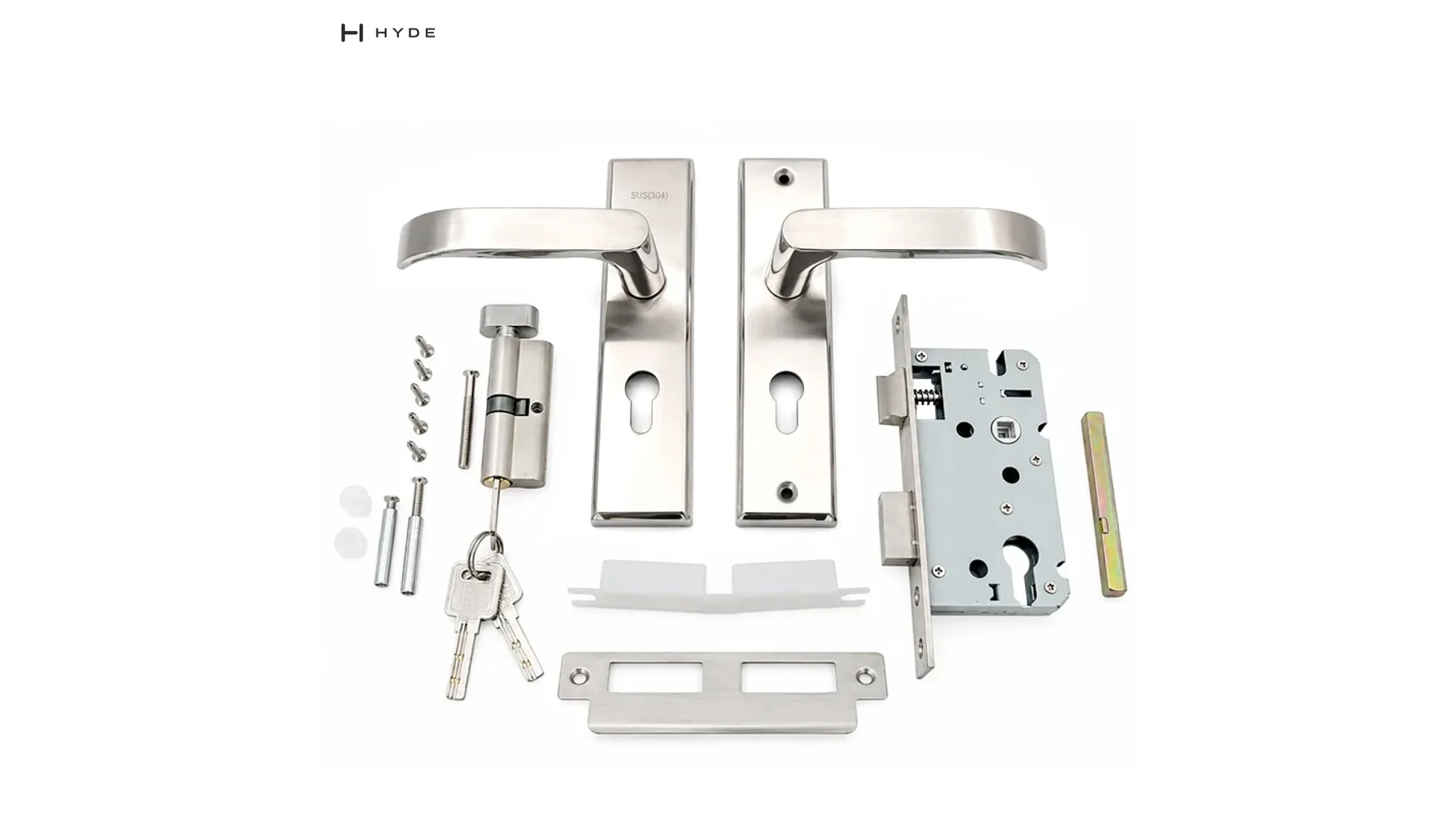
Choose a rose when the door gives you little flat stile, when the lock already in the door has a center distance you cannot change, or when the lever and the cylinder need to sit independently of each other. Choose a backplate when the lever and cylinder arrive as a matched set with their lock, when the door face carries holes or marks from earlier hardware that a rose cannot cover, or when you want the fixings spread along a long plate rather than gathered round the spindle. Neither is the better product. The door, and the lock in it or planned for it, decide.
The reason comes down to one dimension. On a backplate, the spindle hole and the cylinder cutout are punched into the same piece of metal, so the distance between them is fixed at the factory and has to equal the center distance of the lock body behind it. On a rose set, the lever rose and the cylinder escutcheon are separate pieces, each placed wherever the lock needs it. A rose can follow any lock. A backplate can only follow the lock it was made for.
A rose is the round or square base the lever springs from. It covers the spindle hole and carries the fixings, and on a lock version the cylinder gets its own matching escutcheon below it. A backplate, also called a long plate, is a vertical plate that carries the lever and, on a lock version, a cutout for the cylinder or keyhole, all on one piece. On European hardware both usually drive the same thing: a square spindle turning the follower of a mortise lock. What differs is how much of the door face they occupy, and how much of the lock's geometry they commit you to.
The lock's center distance decides first
The 9088 SS is our backplate set, and its record shows why plate and lock belong together. The plates are SUS 304 stainless steel, 200 × 50mm (7-7/8" × 1-15/16"), 1mm thick, 10mm deep, brushed with polished edges. The lever-to-cylinder center is 58mm and the backset 45mm (1-3/4"). The set is supplied with its own mortise lock body (iron case, 175mm faceplate, latch and square deadbolt), a zinc-alloy euro cylinder with the key outside and a thumbturn inside, a spindle, a strike plate and the fixings.
That 58mm is the number to take to site. The long-plate centers most often seen on European-pattern locks are 72mm and 92mm, so a 9088 SS plate will not line up with most mortise locks already fitted in those doors. It lines up with the lock in its own box. Order it as the complete set it is sold as, and do not order the plates alone to dress an existing lock without first measuring that lock's center distance.
A rose set carries no such dependency. The 9014 is a lever on a 53mm (2-1/16") rose, 9mm thick, on an 8mm spindle, for doors 35–50mm thick, with a brass cylinder. The rose goes where the follower is and the cylinder escutcheon goes where the cylinder is, whatever the gap between them. If a door already holds a sound lock with an unusual center distance, a rose set is normally the trim that fits without replacing the lock.
Scroll sideways to compare columns. Select a column heading to sort; select it three times to restore source order.
| Base | Plate 200 × 50mm, 1mm thick | Rose 53mm diameter, 9mm thick |
|---|---|---|
| Fixing centers | 170mm | Not published |
| Lever section | 22.5mm | 19mm |
| Lock body | Supplied: 45mm backset, 58mm center | Not listed on the record |
| Door thickness | Not published | 35–50mm |
| Projection | Not published | 60mm |
| Return spring | Cassette behind each plate | Not published |
7 rows · Source order
The stile decides second
A backplate needs an uninterrupted flat zone on the lock stile at least as long and as wide as the plate, on both faces. For the 9088 SS that means 200 × 50mm, with fixings 170mm (6-11/16") apart. A door with a raised molding, a glazing bead or a panel edge running close to the lock edge may not have that zone, and a plate that rocks over a molding never sits tight however hard it is screwed. A 53mm rose needs a flat circle a little over two inches across at the spindle and a second, smaller one at the cylinder.
Narrow-stile aluminum doors are a separate case again. They take profile locks with short backsets, and the trim made for them is a narrow plate or a narrow rose sized to the profile. The 9088 SS is built around a 45mm-backset mortise lock with a 175mm faceplate, so it is a set for timber and steel doors with room for that lock, not a plate to put in front of a profile lock. On a profile door, measure the flat width of the stile from the edge to the glazing bead, not the overall profile width on the section drawing.
The door's history decides third
On a replacement job the door already has holes: a spindle hole, a cylinder hole, perhaps fixing holes and the outline of an old rose in the paint. A backplate is the usual way to hide that history, because 200 × 50mm of stainless covers far more of the face than a pair of 53mm roses. But a plate only hides what is beneath it if its own holes land where the old ones are. The spindle still has to reach the follower and the cylinder still has to pass through the cutout. If the old lock's center distance differs from the plate's, the plate can cover the old holes only with a new lock behind it.
So survey three things before quoting: the center distance between spindle and cylinder, the backset, and the outline of the existing marks. The choice then becomes mechanical. Same centers and marks inside the plate outline: a plate covers them. Different centers and a lock that is staying: a rose set. Different centers and a lock that is being replaced anyway: a plate with its matching lock.
Where the fixings put the load
A lever is a cantilever that someone pulls on every time the door is used. On a rose, the fixings sit close to the spindle, inside the rose. On the 9088 SS, the fixings are 170mm apart, above and below the lever and the cylinder, so the pull on the lever is shared along the length of the plate. That is a practical advantage on a heavily used entrance or corridor door. It is not a security feature: a 1mm decorative plate is not a security escutcheon, and protecting a cylinder against attack is a separate specification.
The return spring belongs to the same question. The 9088 SS record lists a return spring cassette behind each plate, so the trim, not only the lock, holds the lever level. On a rose set, whether the rose carries its own spring is a separate check, set out in our article on lever return. It is not published on the 9014 or 9007 records, so confirm it per model.
Function lives in the cutout
A backplate carries the function in its punching. The 9088 SS is cut for a euro cylinder below the lever, which makes it an entrance or office set: key outside, thumbturn inside. A bathroom function on a plate needs either a plate cut for a turn and emergency release or a bathroom lock with a cylinder made for that job; neither is on the 9088 SS record, so ask rather than assume. With rose sets, the function changes in the escutcheon and the lock behind it while the lever stays the same. That is the rose's strongest argument on a mixed project: one lever on entrance, office and bathroom doors alike.
Where a bored lever set fits in
Not every lever sits on a mortise lock. The LH852 SSET is a bored (tubular) lever set: a zinc-alloy lever in a satin stainless steel finish (US32D), entrance function with the key in the outside lever, for doors 35–45mm thick at a 60 or 70mm backset, fully reversible for either hand. Its rose covers the cross bore and holds the chassis. There is no separate cylinder escutcheon and no plate version, because the cylinder lives in the lever. The cross-bore diameter is not published on its record; confirm it against the door preparation.
On a door already prepared for a bored lock, the rose-or-plate question has been answered by the preparation. The reverse holds too: a door bored for a tubular lock cannot take a mortise backplate set without a new mortise cut into its edge, and a door mortised for a European lock cannot take a bored set without the mortise being filled. Read the edge of the door before reading any catalog.
What the 9007 record does not tell you
The 9007 is a stainless lever in the same series as the 9014 and 9007S rose levers, and its record publishes one fact: stainless steel. Its rose diameter, fixing method, door thickness range and spindle are not published there. Its sibling, the 9007S, publishes a 53mm rose 8mm thick on an 8mm spindle, but a sibling's figures are not the 9007's. Before using a 9007 to cover an existing preparation, ask for its own rose diameter and fixing, because the rose diameter is the one figure that decides whether the old holes disappear.
A quick reading of the door
Scroll sideways to compare columns. Select a column heading to sort; select it three times to restore source order.
| Existing mortise lock staying, centers not 58mm | Rose set | A rose follows any center distance |
|---|---|---|
| New door, lock supplied with the trim | Either; a set like the 9088 SS arrives matched | Plate, lock and cylinder share one center |
| Old holes or marks wider than a 53mm rose | Backplate, if the centers match | A plate covers more of the face |
| Molding, bead or glass close to the lock edge | Rose | It needs a much smaller flat area |
| Door bored for a tubular lock | Bored set such as the LH852 SSET | The rose covers the cross bore |
| Same lever on entrance, office and bathroom doors | Rose | Function changes in the escutcheon and lock |
6 rows · Source order
What to send with an inquiry
Door thickness, backset, the lock's center distance if a lock is staying, the flat width of the stile on both faces, the function door by door, and a photograph of the door edge and of each face. With those, the choice between rose and plate is usually settled before a sample is needed. Where a figure is not on a product record, as door thickness and projection are not on the 9088 SS record, ask us for the measured figure; we do not quote estimates in their place.
Questions this answers
What is the difference between a lever on a rose and a lever on a backplate?
Both drive the same spindle and mortise lock. A rose is a small round or square base for the lever, with the cylinder on its own separate escutcheon, so it follows any lock's center distance. A backplate carries the lever and the cylinder cutout on one long plate, so the distance between them is fixed and must match the lock. The 9088 SS backplate, for example, is 200 × 50mm with a 58mm lever-to-cylinder center and comes with its own lock.
Can I fit a backplate lever to an existing mortise lock?
Only if the plate's lever-to-cylinder center equals the lock's. Measure the distance between the spindle and the cylinder on the existing lock first. Common European long-plate centers are 72mm and 92mm; the 9088 SS plate is 58mm and is sold as a set with its matching lock body, so it will not line up with most existing European-pattern locks. If the lock is staying and the centers differ, use a rose set.
Which covers old holes better when replacing door handles, a rose or a backplate?
A backplate covers far more of the door face: 200 × 50mm on the 9088 SS against a 53mm rose on the 9014. But a plate only covers the old holes if its own holes line up with the lock's spindle and cylinder. Survey the center distance, the backset and the outline of the old marks before choosing; if the centers differ, the plate needs a new lock behind it.
Do backplate levers work on narrow-stile aluminum doors?
Only plates made for them. Narrow-stile aluminum doors take profile locks with short backsets and need a narrow plate or narrow rose sized to the profile. The 9088 SS is built around a 45mm-backset mortise lock with a 175mm faceplate, so it suits timber and steel doors with room for that lock. Measure the flat width of the stile from the edge to the glazing bead before choosing any trim.
Related products
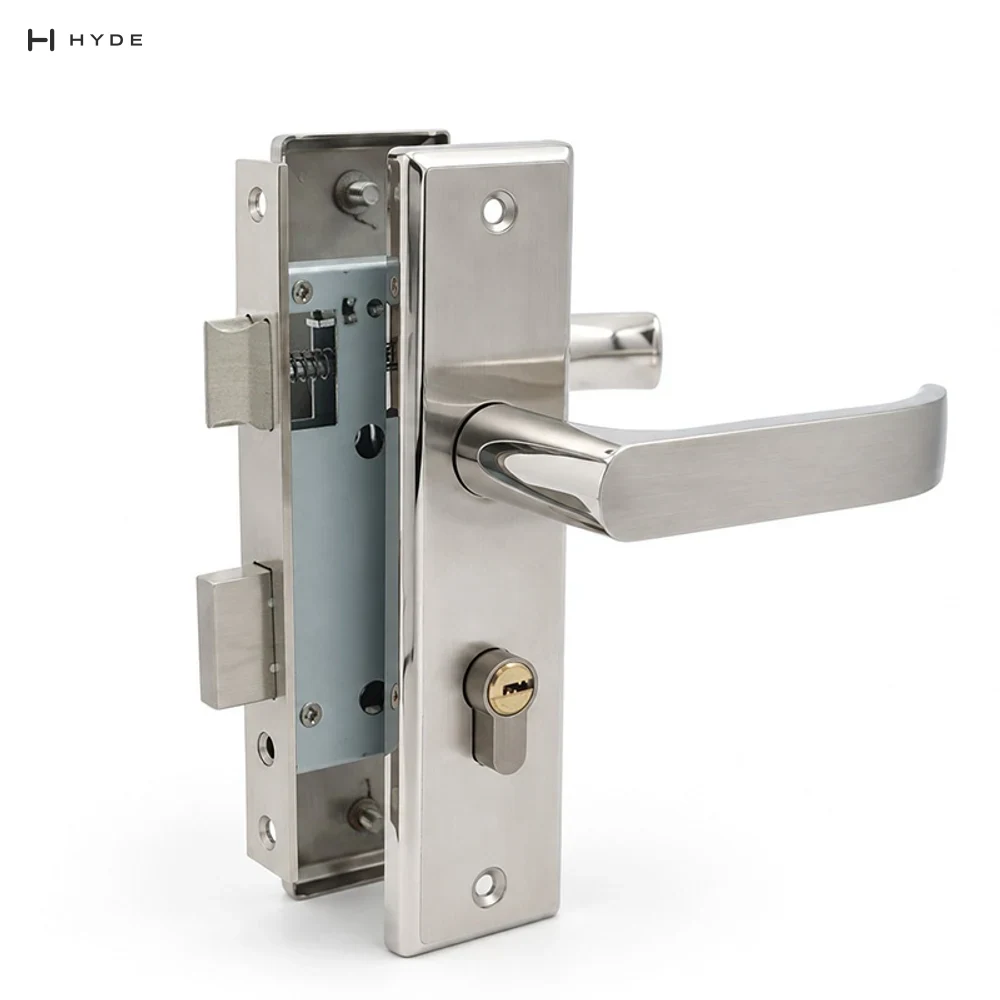
Backset 45mm
Stainless Steel Handle
Model 9088 SS · Video
Stainless Steel
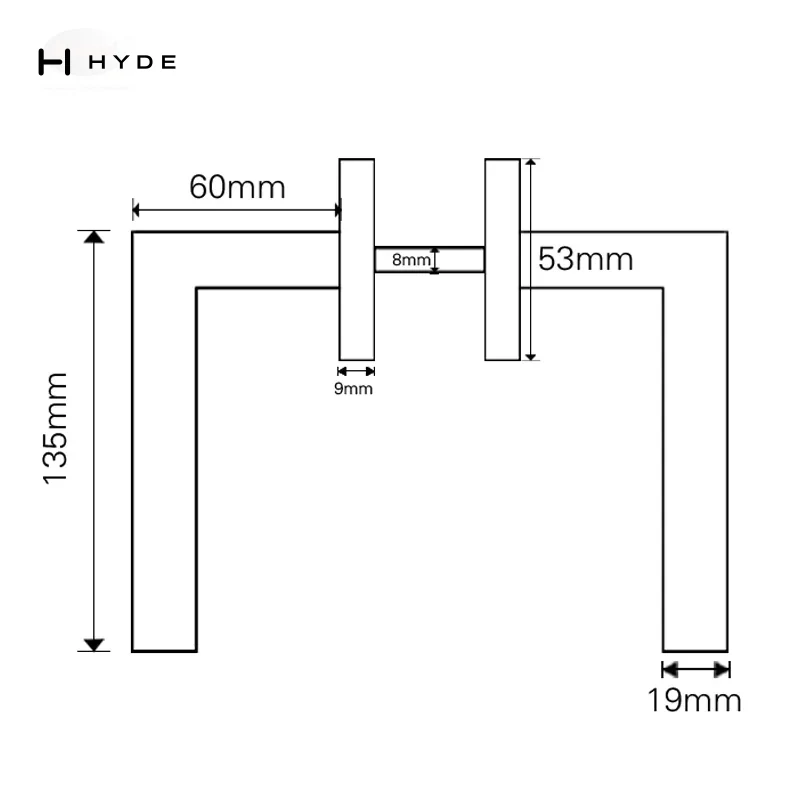
Door thickness 35–50mm
Stainless Steel Handle
Model 9014
Stainless Steel
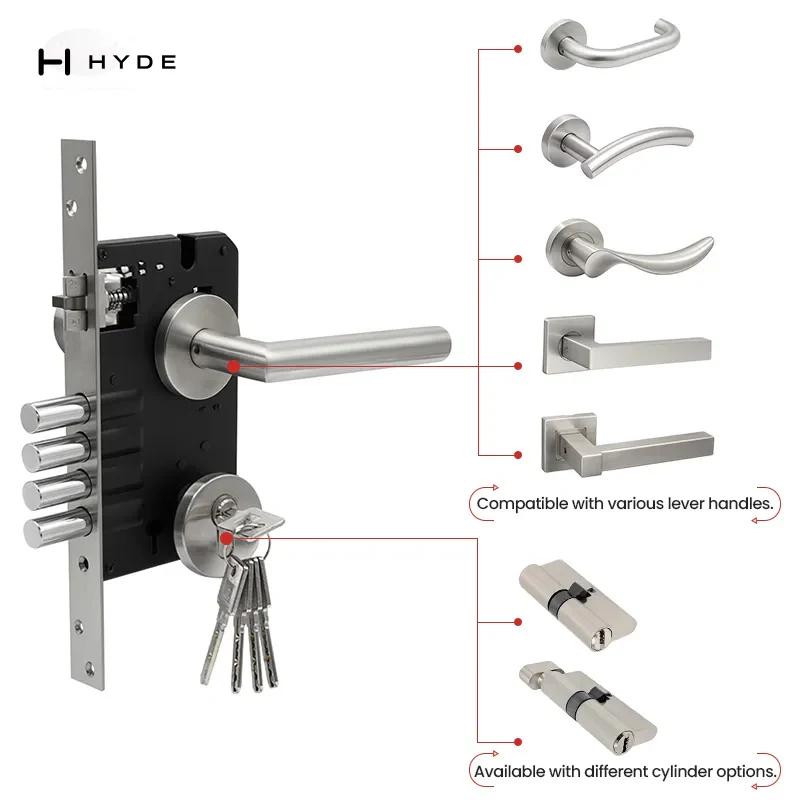
Stainless Steel Handle
Model 9007
Stainless Steel
About Canton Hyland — Canton Hyland manufactures panic exit devices, locks and architectural door hardware for commercial and institutional projects, supplying specifiers and distributors internationally.