
Door Guard or Door Chain: What a Swing-Bar Guard Does Differently
A swing-bar door guard and a door chain do the same job: they let someone inside open the door a little without letting it open further. The difference is the link, a rigid hinged bar or a flexible chain, and it changes how the gap is set, how the guard releases and how it fits a hotel or apartment door.

Johnson LiuDigital Communications, Canton HylandMA Digital Media, Johns Hopkins University
A door guard and a door chain do the same job. From inside the room, they let the occupant open the door a narrow gap to speak to someone or take a delivery, and they stop the door there. The difference is the link between door and frame. A swing-bar guard uses a rigid U-shaped bar that drops over a knob; a door chain uses a chain whose end slides in a slotted track.
That one difference decides the rest. The rigid bar sets the gap by its geometry, folds flat when it is not in use, and can only be released once the door is closed. A chain sets the gap by its length, takes up some slack before it holds, and hangs from the frame when it is unhooked. The swing bar is the type commonly seen on hotel guestroom doors; the chain is still the familiar choice on apartment and house doors.
Neither is a lock, and we publish no load, impact or security rating for any of our guards. The choice between them is about how they operate, where they fit and how they look, plus the fixings, which decide more of the real strength than the guard does. Our models cover both types: F001 and F002 are swing-bar guards, F004 is a chain guard, F005 combines a chain with a bolt, and F006 appears to be a concealed chain guard.
How a swing-bar guard works
A swing-bar guard has two parts. One plate carries a U-shaped bar on a hinge; the other carries a knob on a short post. With the door closed, the occupant swings the bar over so that the knob sits inside the loop of the bar. When the door is opened, the knob travels along the loop until it reaches the closed end, and the door stops.
The bar can only come off the knob at one point, and that point lines up with the knob only when the door is shut. While the door is held open on the guard, the bar is pulled tight against the knob, and a hand reaching in through the gap from the corridor has nothing to lift. The occupant closes the door, swings the bar back, and the door is free. When the guard is not in use, the bar folds back against its own plate. Nothing hangs and nothing swings against the door face.
How a door chain works
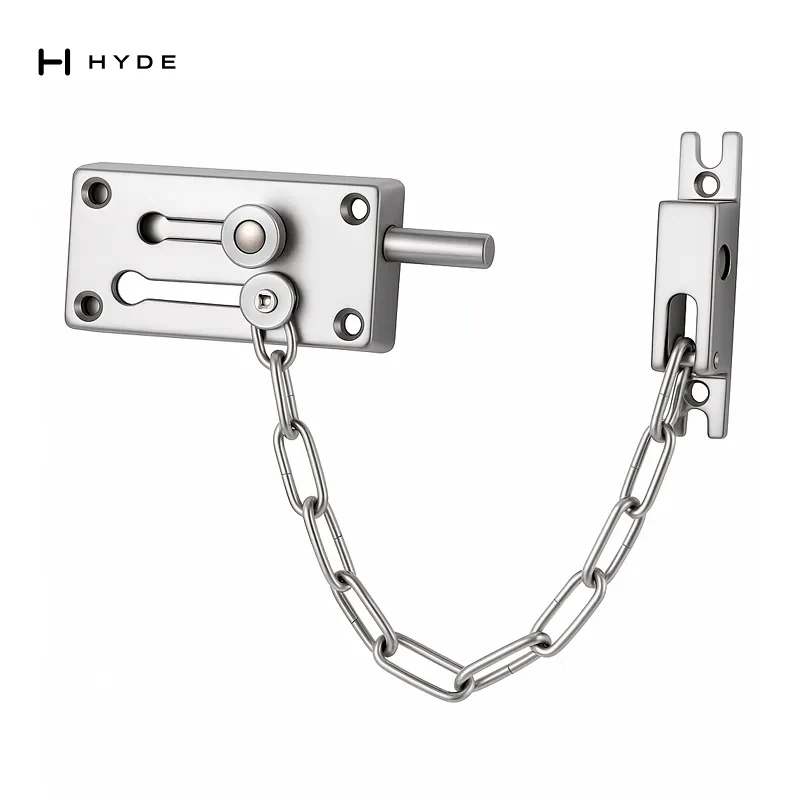
A door chain has a slide plate with a slotted track, fixed to the door, and a chain anchored on a plate fixed to the frame. The free end of the chain carries a slide head. The occupant feeds the head into the open end of the track and slides it along; when the door is opened, it stops as soon as the chain is pulled straight. Because the chain is flexible, the gap depends on the chain's length and on where the head sits in the track, and a slack chain lets the door move before the chain takes the load. To release it, the door is pushed nearly closed so the head can travel back to the open end of the track. Unhooked, the chain hangs down from the frame plate.
Swing bar or chain: the differences that matter
Scroll sideways to compare columns. Select a column heading to sort; select it three times to restore source order.
| Link | Rigid hinged bar | Flexible chain |
|---|---|---|
| Opening gap | Set by the bar and plate geometry | Set by chain length; some slack before it holds |
| Release | Close the door, then swing the bar off the knob | Push the door nearly closed, slide the head out of the track |
| When not in use | Folds flat against its plate | Hangs from the frame plate |
| Commonly seen on | Hotel guestroom doors | Apartment and house entry doors |
| Our models | F001, F002 | F004; F005 with a bolt; F006 concealed |
6 rows · Source order
The table is not a ranking. A chain is familiar to most residents and easy to add to an existing door. A swing bar is tidier, its gap does not vary, and it cannot be left dangling. Both depend, more than anything else, on what their screws go into.
The fixings decide more than the guard
When someone pushes on a door held by a guard, the load goes through the screws into the door and the frame. A guard fixed with short screws into a thin frame lining, or into the skin of a hollow-core door, pulls out long before the metal of the guard is tested. That is why we do not quote a strength for a guard on its own: the same part behaves very differently on a solid timber frame, a pressed-steel frame and a hollow door. So put the substrate on the inquiry: timber or steel frame, solid or hollow leaf, and the leaf thickness. On a pressed-steel frame, the frame-side plate needs fixings suited to sheet metal or a reinforcement behind the frame face, and that is agreed with the frame supplier before the frames are made, not discovered on site. We do not publish the screws supplied with our guards, so ask what comes in the box and replace them if they are wrong for the substrate.
Fitting it to the door
Both parts of either type go on the room side. One plate sits on the lock stile of the door, near the edge; the other sits on the frame face beside it. Before ordering, check three things: that the frame face on the room side is wide enough for the plate, that the guard clears the lever and its rose, and that it does not cover the strike. Our published sizes are overall sizes: F001 is 110 × 66 mm, F002 is 103 × 66 mm, F004 is 115 × 53 mm, and F005 has a published length of 83 mm. We do not publish the footprint of each plate or its hole positions, so ask for the drawing before the frame is detailed.
Mounting height belongs in the project's hardware schedule, not in the installer's judgment. The guard has to be within easy reach of every occupant and clear of the lock. In accessible rooms, ask the accessibility consultant whether the local code treats the guard as an operable part, and set its height and operation from that answer. Guards are made for doors that swing into the room, which is how guestroom doors are normally hung so that they do not swing into the corridor. If an entry door swings outward, the geometry between door and frame changes and a standard guard may not fit; send us the door section before ordering.
Fire doors, egress and staff access
A guestroom or apartment entry door is often a fire door. Anything screwed to the leaf of a fire door has to stay within what the door's own test evidence allows, so check with the door supplier before a guard is added. We publish no fire test data for our guards. Egress rules allow these devices, within limits. The International Building Code generally requires a door to unlatch in one operation, but it lets doors of individual dwelling and sleeping units in Group R occupancies with small occupant loads also carry a night latch, deadbolt or security chain, provided it opens from inside without a key or tool. Both guard types open from inside by hand. Check the edition and any local amendments that apply to the project; other countries word this differently.
Hotels have one more question: can staff get in? With a swing bar or chain engaged, a keycard opens the lock but the guard still holds the door. Some guards on the market have a release that staff can operate from the corridor with a special tool. None of our product records describes that feature, so treat our guards as having no outside release and tell us if the operator requires one.
Our models, one by one
F001 and F002 are swing-bar guards in zinc alloy, at 110 × 66 mm and 103 × 66 mm. Both are published in the same ten finishes: antique brass (AB), antique copper (AC), satin nickel (SN), nickel plated (NP), chrome plated (CP), and the codes GP, NB, BRN, BC and CB as listed. With that range the guard can usually be ordered in the same finish as the lever on the door, which is the rule worth keeping: one door, one finish.
F004 is a chain guard in iron, 115 × 53 mm, in five finishes: polished brass (PB), antique brass (AB), antique copper (AC), SS and satin chrome (SC). Settle one point before ordering it. The part is iron, so SS on its finish list describes a surface finish, not stainless steel material, and we have not published what that finish is. If the door is in a humid or coastal location, ask before relying on it.
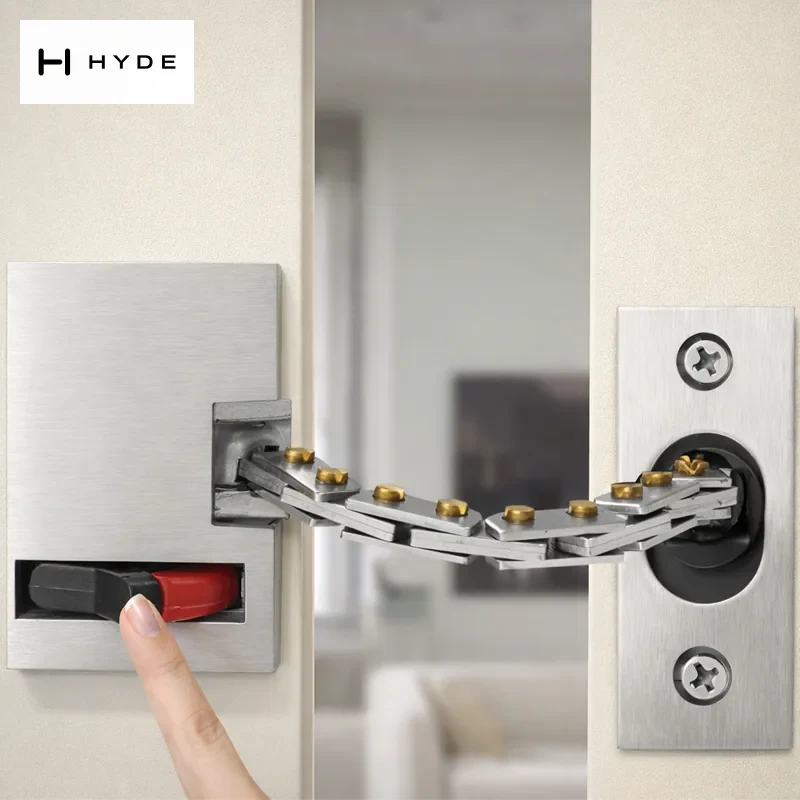
F005 is a zinc alloy guard that, as its photograph shows, combines a chain with a surface bolt in one body, so the same fitting can bolt the door shut or hold it on the chain. Its published length is 83 mm; its width is not published. It comes in the same five finishes as F004. F006 is published in zinc alloy in four finishes: GP, NB, antique brass (AB) and chrome plated (CP). Its photograph shows a tubular body behind a narrow faceplate, a flat-link chain and a box-shaped keeper, which is the layout of a concealed chain guard set into the door edge. We have not published its dimensions, bore size or door thickness range, so treat it as a model to discuss with a drawing, not one to order from the page.
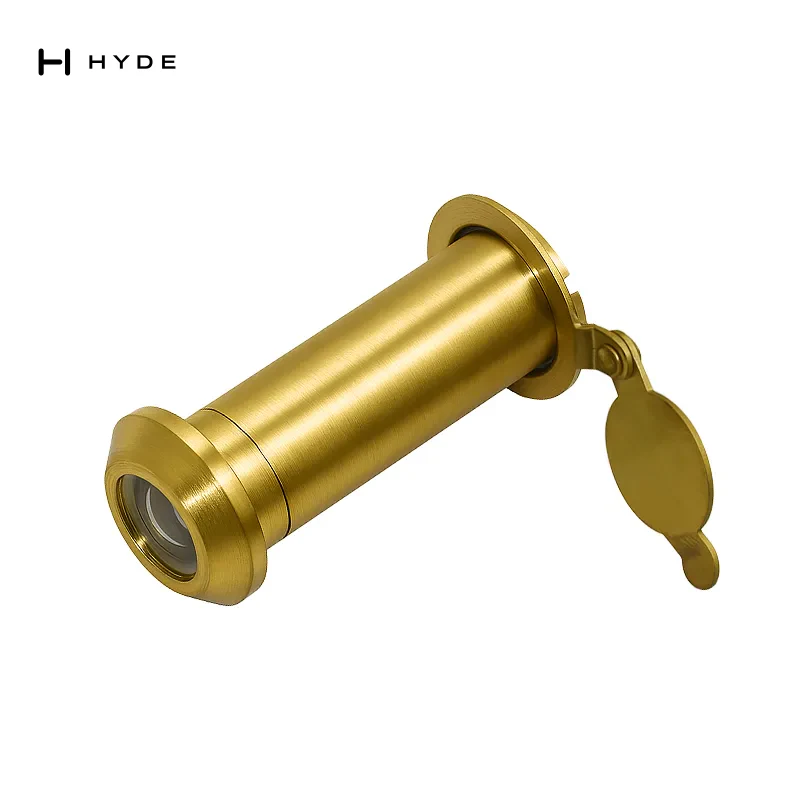
A guard answers only half the question at the door. The other half is seeing who is there before opening it at all, which is a door viewer's job. DV06 is a brass viewer published in 12, 14 and 16 mm diameters with 160°, 180° and 200° viewing angles, and the door thickness decides which version fits. Specify the viewer and the guard together, from the same hardware schedule.
What to put on the inquiry
Name the type, swing bar or chain, and the model. Add the finish matched to the lever, the direction the door swings, the frame material and the width of its face on the room side, the leaf construction and thickness, whether the door is a fire door, and whether staff need a release from outside. With that list in hand, the reply can be a drawing and a finish sample instead of another round of questions.
Questions this answers
What is the difference between a door guard and a door chain?
Both let someone inside open the door a narrow gap and stop it there. A swing-bar door guard uses a rigid hinged bar that drops over a knob; a door chain uses a chain whose end slides in a track on the door. The bar sets the gap by its geometry, can only be released with the door closed and folds flat when not in use. The chain sets the gap by its length, has some slack before it holds and hangs from the frame when unhooked.
Is a swing bar or a chain better for hotel room doors?
The swing bar is the type commonly seen on hotel guestroom doors, because its gap does not vary, it folds away tidily and it cannot be left dangling. A chain does the same job and is familiar in homes. Either way, check the fire door's test evidence before adding it, set the mounting height in the hardware schedule, and decide whether staff need a release from the corridor. None of our product records describes an outside release.
How strong is a door guard?
We publish no load, impact or security rating for our guards. In practice the screws and what they go into decide more than the guard itself: short screws in a thin frame lining or a hollow-core door pull out first. Tell us the frame material, leaf construction and thickness, and agree any reinforcement for a steel frame with the frame supplier.
Can hotel staff open a door when the swing bar guard is engaged?
Not with the keycard alone: the card opens the lock but the guard still holds the door. Some guards on the market have a release staff can operate from the corridor with a special tool. None of our product records describes that feature, so tell us if the operator requires one.
Is a door chain allowed on an apartment entry door?
The International Building Code generally requires a door to unlatch in one operation, but allows doors of individual dwelling and sleeping units in Group R occupancies with small occupant loads to also carry a night latch, deadbolt or security chain, provided it opens from inside without a key or tool. Check the edition and local amendments that apply; other countries word this differently.
Related products
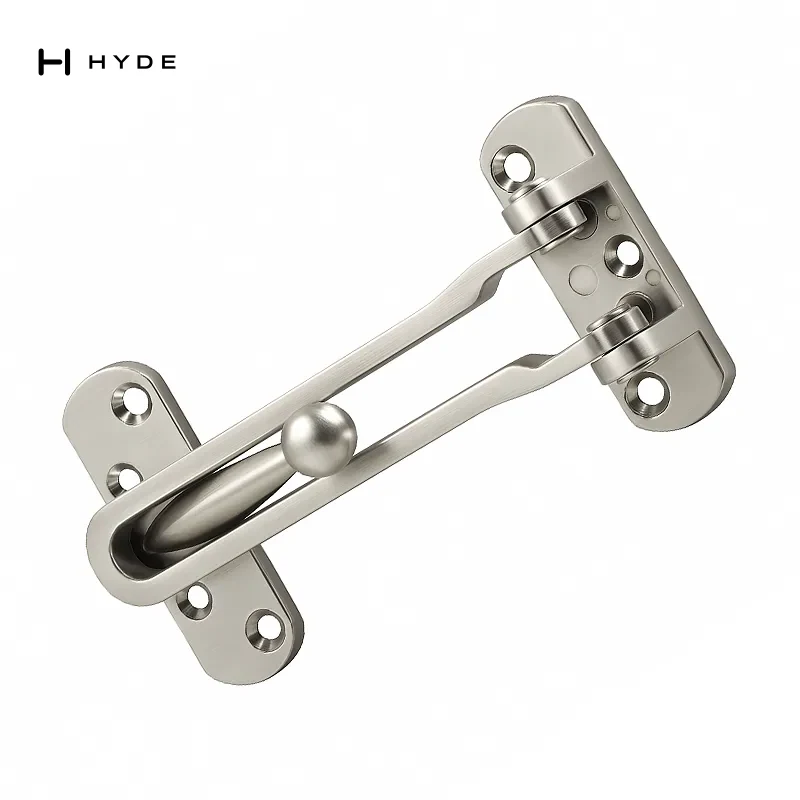
Length 110mm
Security Door Guard
Model F001
Zinc Alloy
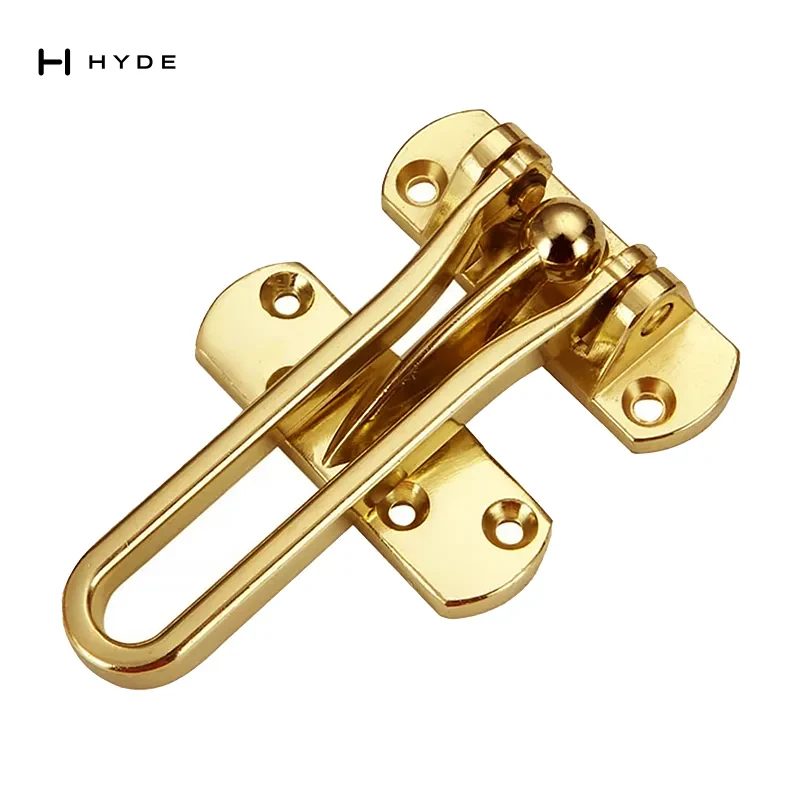
Length 103mm
Security Door Guard
Model F002
Zinc Alloy
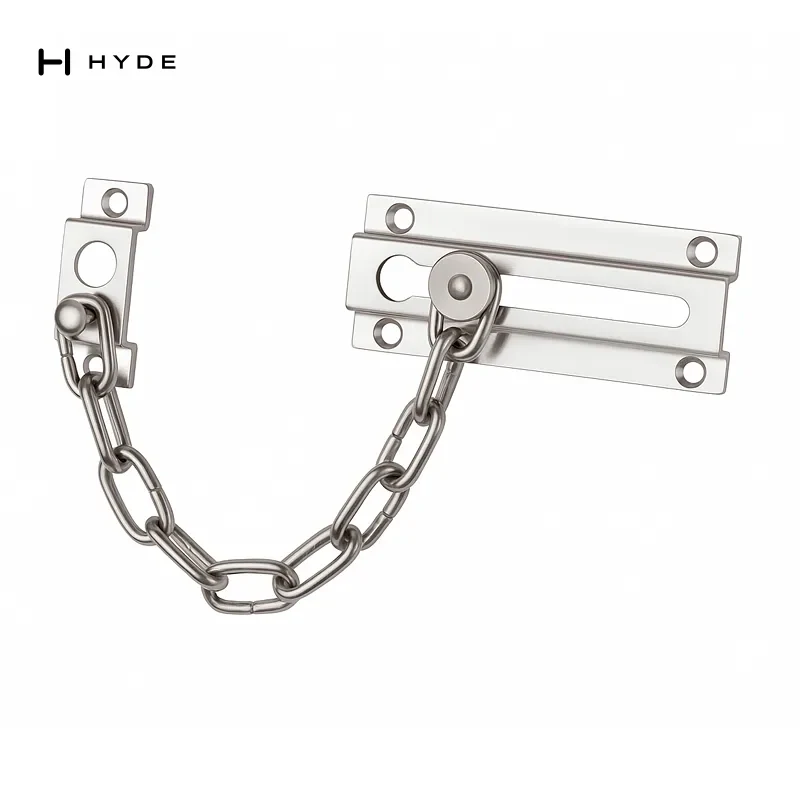
Length 115mm
Security Door Guard
Model F004
Iron
About Canton Hyland — Canton Hyland manufactures panic exit devices, locks and architectural door hardware for commercial and institutional projects, supplying specifiers and distributors internationally.