Entrance, Privacy, Passage: Choosing Between Twelve Cylindrical Locks
587, 607, 5807, 5870, 592, 598, 575, 578, 9210, 595, 609 and 5831 look like twelve choices and are mostly one choice made twelve times. Nearly all of them take a 60/70mm adjustable backset and a 35–45mm (1-3/8" to 1-3/4") door, so the decision is function first, chassis second, and one of the twelve goes to a 90mm (3-9/16") backset when the others stop at 70.
Insight
Johnson LiuDigital Communications, Canton HylandMA Digital Media, Johns Hopkins University
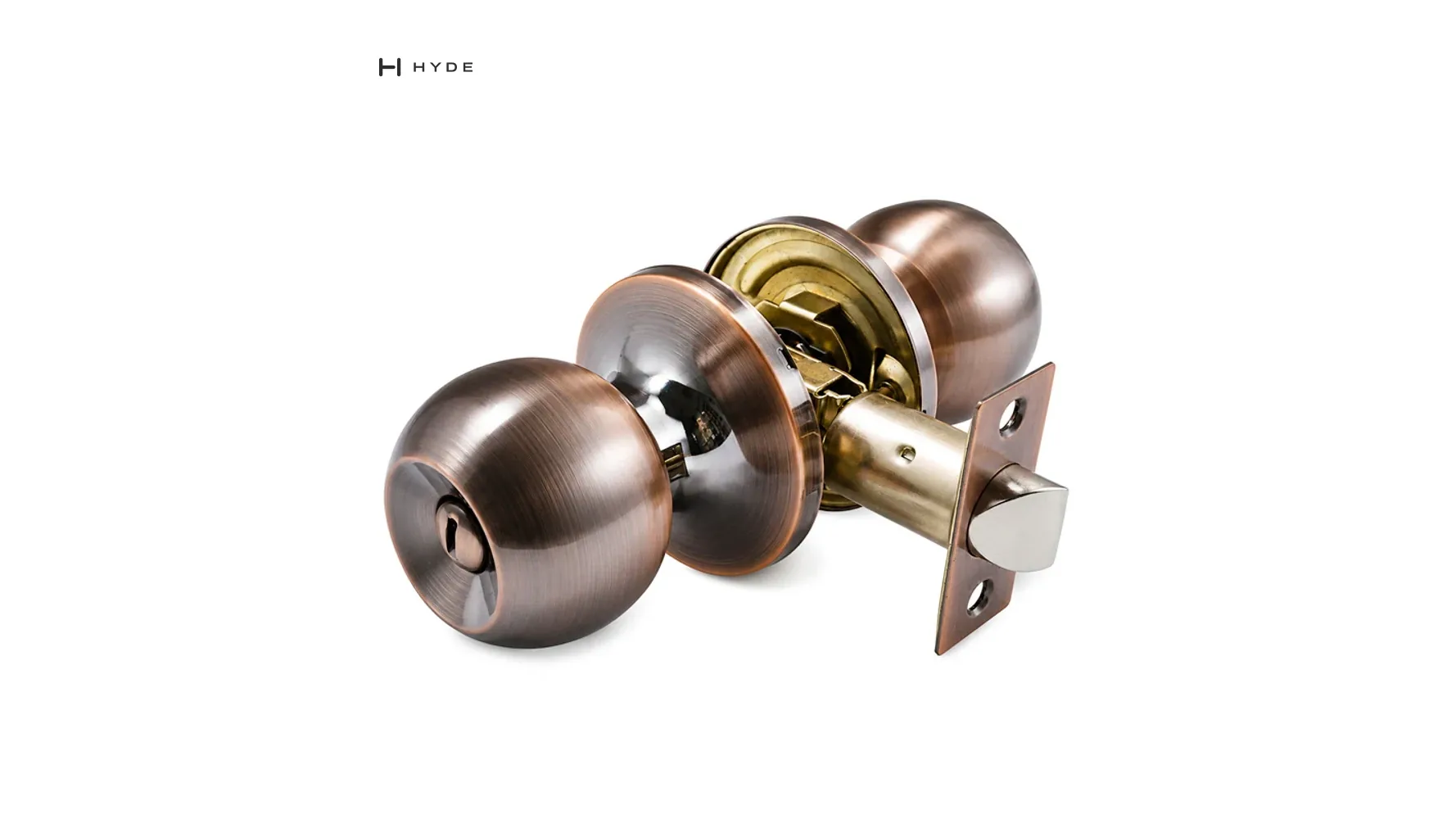
A cylindrical lock (a knob or lever set that fits two bored holes rather than a mortised pocket) is the commonest lock in the world, and choosing one from a catalog is harder than it should be because the model numbers do not tell you what differs. This piece takes the twelve numbers in our own selected range and says plainly which decisions actually separate them.
The first thing to know is how much they have in common. Across 607, 592, 598, 575, 595 and 609 the backset is stated as 60mm (2-3/8") or 70mm (2-3/4") adjustable and the door thickness as 35mm (1-3/8") to 45mm (1-3/4") adjustable. That is not laziness in the data; it is the point of a bored lock. One part covers the two backsets the world installs, and the same part covers most residential and light commercial door thicknesses, so a specification error on either of those two rows is recoverable on site rather than in a container. One correction to earlier versions of this page: the 587 was listed here with the same backset and door range, but none of its eleven records publishes either row, so it has been taken out of that sentence until the factory confirms them.
So the real first decision is function, and there are three that cover most doors. Entrance is keyed on the outside and always free on the inside. Privacy is the bathroom and bedroom function: a turn button inside, no key, and a small emergency release outside. Passage is not a lock at all, it latches the door and has no locking function in either direction, which is what you want on a corridor door that has to stay closed against smoke but must never trap anybody.
Then there is a fourth group that most catalogs bury, and it is the one an institutional project needs. The 5807 is published with functions named COMMUNICATION LOCK, CLASSROOM LOCK and EXIT LATCH. A classroom function keys from the corridor side only, so a teacher can lock the door from inside the room without a key being required to leave it. If your specification names a school, a clinic or a hall of residence, look at the 5807 first, because the other eleven in this range are specified around the entrance-privacy-passage set.
The chassis is the second decision and it is mostly a decision about the building's traffic. Most of these are stainless steel; the 5870 is published in one variant as iron plus stainless steel and in another as Stainless Steel 304/201; the 592 and 595 are published as brass or stainless steel, which means the base metal is a choice the buyer has not made yet. That last point matters more than it reads, a finish specification written in BHMA numbers cannot be answered until the base metal is settled, for the reason set out in our article on finish codes.
The 5831 is the outlier and it is the reason a range this size exists at all. Its backset is published as 60, 70, 80 or 90mm (3-9/16") adjustable and its door thickness as 35 to 50mm (1-3/8" to 1-15/16"), where the rest of the range stops at 70mm (2-3/4") and 45mm. That is a lock for a thicker leaf and a deeper stile, a security door, a heavier timber door, a door where the ironmonger has already discovered that a 70mm backset puts the knob too close to the edge. If a survey comes back with a backset over 70, this is the number to quote.
The 5870 sits between the two: 60mm (2-3/8")/70mm on some variants, 70mm only on others, and a door thickness published as 35–50mm (1-3/8" to 1-15/16") rather than 35–45mm (1-3/8" to 1-3/4") on one variant. If you are standardizing a project on one part number, that difference between variants is worth confirming against the specific finish code you are ordering, because it is not constant across the model.
One honest gap. The 9210 is in this selected range and carries four published variants, and it has no specification rows at all, no backset, no door thickness, no function. We are not going to fill those in by analogy with its neighbors, because a backset copied from a similar-looking lock is exactly the kind of plausible number this site refuses to publish. If the 9210 is the one you want, ask us and we will measure it against the drawing.
Reading the model code: finish first, function last
The twelve numbers stop looking like twelve choices once you read the letters after them. On most of this range the suffix is two pairs: the first pair is the finish and the last pair is the function. 587 MBET, 587 MBBK and 587 PBPS are one lock body in two finishes and three functions, ET is entrance, BK is the privacy (bathroom) function with a turn button inside, and PS is passage. The finish pairs follow the same logic: on the 575 and 598 pages AC is published as antique copper (US11), SS as satin stainless steel (US32D) and SN as satin nickel.
The commercial models carry longer function codes because they carry more functions. The 5807 is published as SSCL (communication), SSCR (classroom), SSEL (exit latch) and SSR (storeroom); the 5870 adds SSCC, published as entrance and communication. These are our codes, not an industry standard, so the rule on a purchase order is simple: quote the full code, and check it against the Function row on the product page rather than decoding it from memory. A two-letter slip between ET and PS is the difference between a door that locks and one that cannot.
Light duty or heavy duty: what the label actually changes
The range divides into two lines, and it is worth being exact about what separates them, because the obvious assumption is wrong. The 587 and 578 are published as light duty, for standard residential use. The 5807, 5870 and 5831 are published as heavy duty, for commercial offices, schools and heavy-duty residential doors.
What does not separate them in our data is the cycle figure. Wherever a cycle row is published, on either line, it reads 200,000 cycles, and both with a solid steel chassis and latch case, zinc plated. So the cycle number is not a reason to choose one over the other on this site, and we would rather say so than let a buyer infer a difference we have not published. What the data does show is a different trim construction (wrought stainless steel or brass on the light-duty line, zinc die-cast electroplated or solid brass on the heavy-duty line) and a different intended application.
Neither label is a test grade. Light and heavy duty are our own application guidance; they are not an ANSI/BHMA grade, and nothing on this page should be read as a claim to one. If your specification calls for a graded cylindrical lock, the specification is asking for a certificate, and the answer to that is a document, not a model number.
The functions that get misread on site
Entrance, privacy and passage are rarely confused. The three that cause trouble are the institutional ones, because each looks like a lock you already know. Storeroom, in the usual meaning of the term, is locked on the outside at all times and opened only by key, while the inside stays free, right for a plant room or a stock room, wrong for an office, where a person who steps out without a key is locked out every time. Classroom locks from the corridor side by key. Communication is the connecting-door function, and it is the one most often ordered by name without anyone checking which side does what.
For those three, do not rely on the name. Ask for the function description of the specific code on the specific door, and put it on the door schedule next to the door number. It costs a line on a spreadsheet and removes the single most common reason a cylindrical lock is swapped after installation.
Keying a building's worth of them
The 578 and the heavy-duty models are published with a 5-pin tumbler cylinder, a brass plug and two nickel-plated brass keys; the 587 is published with a solid brass or zinc-and-brass cylinder and no pin count, so ask if the pin count matters to your keying. On every one of them the latch is deadlocking on keyed functions. The light-duty 587 and 578 are published as able to be keyed alike to our deadbolt series or master keyed; the heavy-duty entries are published as able to be keyed alike to deadbolts. If a heavy-duty door needs to sit inside a master key system, say so at inquiry rather than assuming it, because that is exactly the kind of capability we will not claim on a page until it is written against the model.
The practical point is timing. Keying is done when the cylinders are pinned, which is before the locks are packed, so a keying schedule that arrives after the order is an order that has to be reopened. Decide which doors share a key, which doors need a master, and which doors must never open to anyone else's key, and send that with the door schedule. Our article on master key systems sets out how many levels a building actually needs.
The strike and the frame
One row almost nobody reads until the latch fails to catch: the strike. On the 575, 592, 595, 598 and 607 it is published as a 57mm (2-1/4") curved lip as standard, with a 70mm (2-3/4") lip available on request. The lip guides the latch bolt over the frame as the door closes. Where the frame has a wide stop or a deep casing, a short lip lets the latch strike the frame edge instead of riding onto the plate, and the door has to be pushed shut. If your frames are anything other than a plain timber lining, measure the stop and the casing and ask for the longer lip at the same time as the lock, not after the first complaint.
Handing is the one decision you do not have to make. Every variant in this range that publishes a handing row is fully reversible, left or right hand, so a door schedule does not need a handing column for those. The few variants with no handing row (the 5807 commercial codes among them) are worth one question before the order.
For a quotation, three rows settle it: the function on each door, the backset your survey found, and the leaf thickness. Finish comes after those three and never before, because the finish never changes what fits and the first three always do. Send a door schedule if you have one; we will answer it line by line rather than sending a catalog back.
Questions this answers
What is the difference between entrance, privacy and passage functions?
Entrance is keyed on the outside and always free on the inside. Privacy is the bathroom and bedroom function: a turn button inside, no key, and a small emergency release outside. Passage is not a lock at all, it latches the door and has no locking function in either direction, which is what you want on a corridor door that has to stay closed against smoke but must never trap anybody.
Which lock function does a school or clinic need?
A classroom function, which most catalogs bury. The 5807 is published with COMMUNICATION LOCK, CLASSROOM LOCK and EXIT LATCH functions: a classroom function keys from the corridor side only, so a teacher can lock the door from inside the room without a key being required to leave it. If your specification names a school, a clinic or a hall of residence, look at the 5807 first, the rest of this range is specified around the entrance-privacy-passage set.
Which cylindrical lock suits a thicker door or a deeper stile?
The 5831. Its backset is published as 60, 70, 80 or 90mm adjustable and its door thickness as 35 to 50mm, where the rest of the range stops at 70mm and 45mm. That is a lock for a security door, a heavier timber door, or a door where a 70mm backset would put the knob too close to the edge. If a survey comes back with a backset over 70, this is the number to quote.
What settles a cylindrical lock quotation?
Three rows: the function on each door, the backset your survey found, and the leaf thickness. Finish comes after those three and never before, because the finish never changes what fits and the first three always do. Most of this range shares a 60mm or 70mm adjustable backset and a 35mm to 45mm door thickness, which is the point of a bored lock, a specification error on either row is recoverable on site rather than in a container.
What do the letters after a cylindrical lock model number mean?
On most of the range the suffix is two pairs: finish first, function last. 587 MBET, 587 MBBK and 587 PBPS are one lock body in two finishes and three functions, ET is entrance, BK is privacy (bathroom, turn button inside) and PS is passage. The commercial codes are longer: the 5807 is published as SSCL communication, SSCR classroom, SSEL exit latch and SSR storeroom. These are our codes rather than an industry standard, so quote the full code and check it against the Function row on the product page.
Is a heavy-duty cylindrical lock rated for more cycles than a light-duty one?
Not in our published data. Wherever a cycle figure is published, the light-duty 587 and 578 and the heavy-duty 5807, 5870 and 5831 all read 200,000 cycles with a solid steel chassis and latch case. What differs is the intended application (standard residential for light duty, commercial offices and schools for heavy duty) and the trim construction. Neither label is an ANSI/BHMA grade; a graded lock requires a certificate, not a model number.
À propos de Canton Hyland — Canton Hyland fabrique des fermetures anti-panique, des serrures et de la quincaillerie de porte pour le bâtiment, destinées aux projets tertiaires et aux établissements publics, et approvisionne prescripteurs et distributeurs à l'international.