
Push Bar or Touch Bar: Which Panic Device Your Door Needs
A push bar pivots and travels; a touch bar depresses flush into its own housing. They cost differently, they fail differently, and only one of them survives a corridor that gets hit by trolleys. Canton Hyland builds the push-bar type across all 42 devices in the range.

Johnson LiuDigital Communications, Canton HylandMA Digital Media, Johns Hopkins University
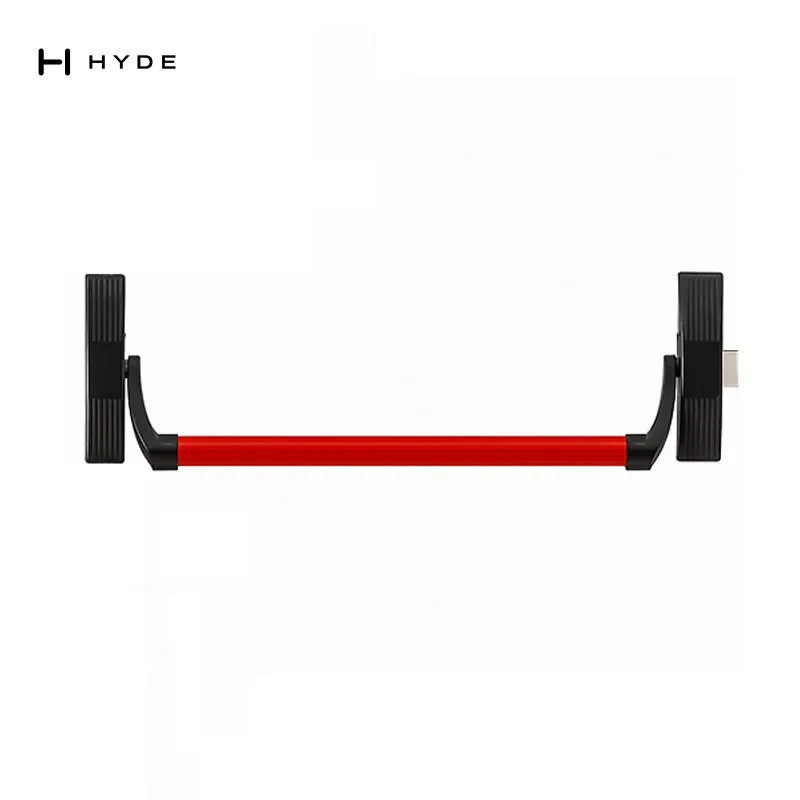
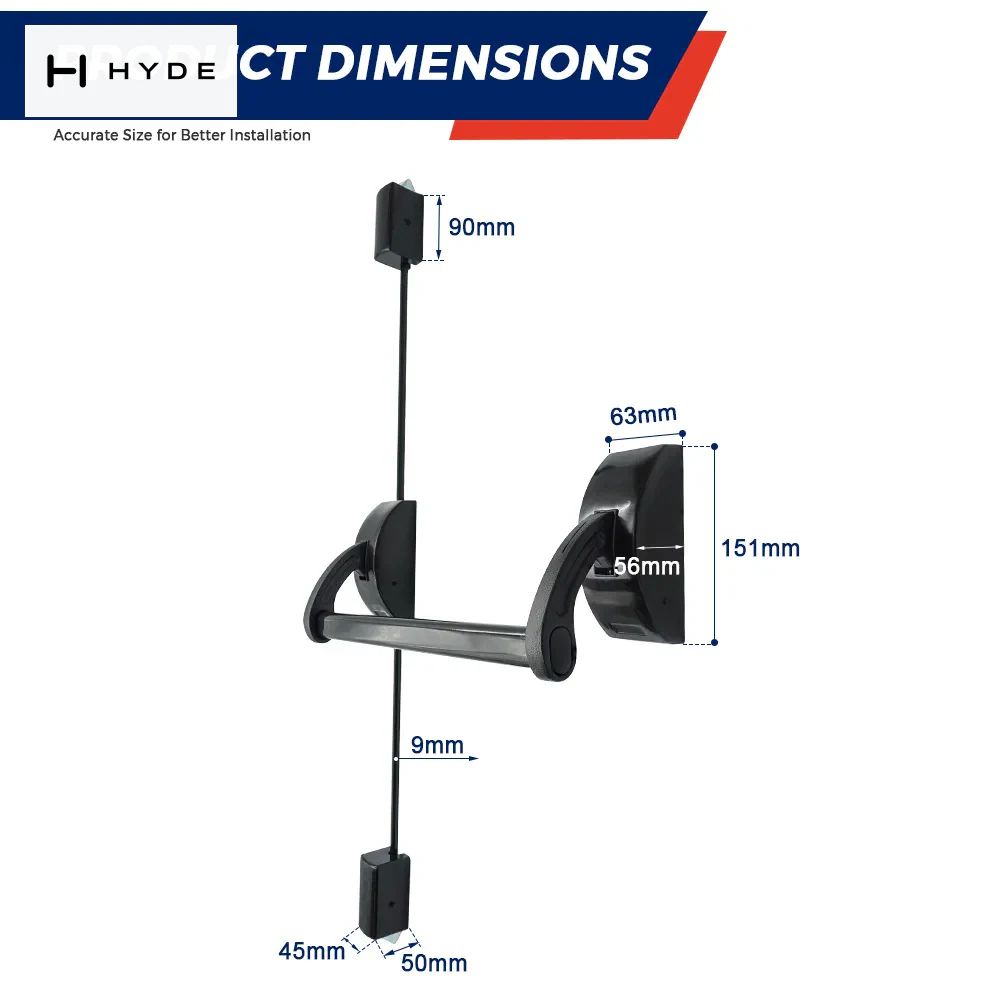

Ask a supplier for a panic exit device and you will be offered two shapes without being told they are different products. One is a bar that stands off the door on two arms and swings toward the leaf when you push it. The other is a bar that sits almost flush in a full-width housing and sinks into that housing when you lean on it. The first is a push bar, sometimes called a crash bar or a panic bolt. The second is a touch bar, sometimes called a touch rail, or a box-style device because the working parts live inside a box. Every one of the 42 devices in the Canton Hyland range is the push-bar type.
Both do the same job in the same way as far as the law is concerned. A person moving at speed, in the dark, possibly carrying someone, hits the bar anywhere along its length and the door opens. Neither requires a key, a code, or a second action, and that single-motion release is the whole point: EN 1125 exists because doors that need two hands or a conscious decision have killed people in fires. What separates the two is not compliance. It is mechanism, and mechanism is what determines cost, wear and how the door behaves after five years of abuse.
A push bar carries its load on two pivoting arms bolted through the door. When you push, the bar travels three or four centimeters toward the leaf and rotates those arms, which retract the latch. That travel is the mechanical advantage: the arms are levers, so a light hand anywhere along a meter of bar produces enough force at the latch to pull it clear of a strike the door is pressing against. The travel is visible and the mechanism is exposed, which sounds like a disadvantage and is mostly the opposite: you can see what is worn, the moving parts are reachable without dismantling a housing, and a bent arm can be replaced on site. The exposed geometry is also why a push bar shrugs off the thing that destroys hardware in real buildings, a trolley, a bed, a pallet truck hitting the door at hip height. It hits the bar, the bar retracts, nothing binds.
A touch bar hides its mechanism inside a housing that runs the full width of the door, and the bar depresses into that housing rather than traveling away from it. It looks better. On a hotel corridor or a gallery it looks considerably better, because there is no gap between bar and door collecting dust, and the profile is a clean horizontal line. It trades the lever for a cam, so the mechanical advantage comes from the shape of the cam rather than from the length of an arm, and the whole of it is inside a sealed extrusion. A distorted housing after an impact is not a part you swap; it is a device you replace. Touch bars are also, as a class, more expensive to manufacture, which is why they dominate specification-led European projects and are rare on the price-sensitive end of the market.
The choice usually makes itself from the building rather than from the door. A school corridor, a warehouse, a back-of-house route in a hotel, a hospital service door (anywhere carts move) takes a push bar, and takes it in stainless steel rather than a coated finish. A front-of-house fire exit in a building where the exit is visible to the public, and where nothing wider than a person passes through it, is where a touch bar earns its price. Between those two cases sits most of the world, and most of the world buys push bars.
One more word, because North American specifications are written in it and European catalogs often are not. Exit devices are grouped by how the latching happens, not by the bar: a rim device latches against a strike on the frame and mounts on the face of the door; a mortise device drives a lock case let into the edge of the leaf; a vertical rod device throws bolts into the head and the threshold, surface-run (SVR) or concealed in the leaf (CVR). The bar shape and the latching family are independent choices, which is why "push bar" answers less of a specification than it appears to. Our records state the lock body and the bar length for each model rather than a family label, so if your specification names one of these four, quote the model number back to us and ask which it is, a straight answer against the drawing is worth more than a category on a web page. The same applies to dogging, the mechanism that holds the latch retracted so a door stays push-open during trading hours: it is listed on the models that have it, as an optional function, and it is not a property of the bar.
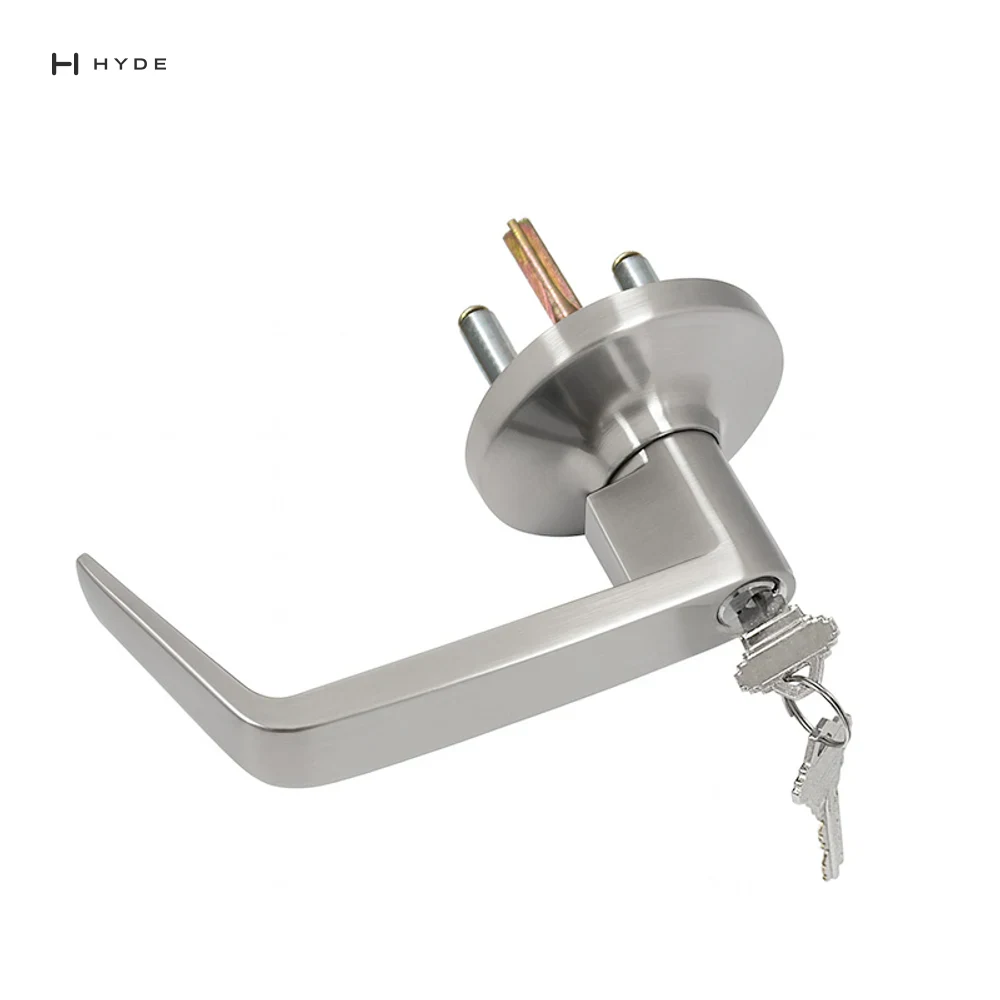
Two questions matter more than the bar shape and are asked less often. The first is what happens on the outside face. A panic device is an exit device: it guarantees you can get out, and says nothing about getting in. If the door is also an entrance, it needs outside trim (a lever, a knob or a pull, keyed or not) and that trim is a separate order line with its own finish and its own handing. Our range carries exterior trim as its own sub-type for exactly this reason, because a device ordered without it arrives as a door that opens one way only, and that is discovered on site.
The second is the double door. Two leaves meeting in the middle need a decision about which leaf is active and what holds the inactive one shut. A device with top-and-bottom bolts (a multi-point or two-point locking version) pins the inactive leaf into the frame and the head, and the active leaf latches against it. Ordering two single-point devices for a pair of doors produces a pair that rattles, does not seal against smoke, and will not pass an inspection. Our multi-point and double-door versions exist as distinct models rather than as an option on the standard one.
So compare them where the difference actually lives, which is in the load path. On a push bar the force you apply travels down two arms into two pivot points, and those pivots are bolted through the leaf. Everything the bar experiences (a shoulder at running speed, a trolley, a decade of feet) arrives at those two points. They are serviceable, visible and greasable, and they are also the two places the device will eventually loosen.
A touch bar spreads the same force along a pad that is supported across the full width of the housing, so no single point carries the whole event. That is the mechanical advantage people ask about, and it is real: the touch bar is the better device in a corridor where the same door is hit thousands of times by people who are not looking at it.
The push bar's advantage is the opposite of subtle. Its mechanism is outside the housing where a maintenance person can see it, and a bent arm is obvious from across the room. When a touch bar goes wrong, the fault is inside a sealed extrusion and the usual repair is a new device. On a site with its own maintenance team, that visibility is worth more than the smoother action.
Scroll sideways to compare columns. Select a column heading to sort; select it three times to restore source order.
| Force path | Two pivot arms through the leaf | Spread along the full-width pad |
|---|---|---|
| Projection from the leaf | Larger, and it moves toward the door | Smaller, the pad sinks into the housing |
| Where it wears | The two pivots | The internal carriage |
| Diagnosing a fault | Visible from across the room | Inside a sealed housing |
| Usual repair | Adjust or replace the arm | Replace the device |
| Suits | Back-of-house, industrial, own maintenance | Public corridors, high traffic, cleaner lines |
6 rows · Source order
Neither row in that table is a reason on its own. Read the whole column against the building: who walks through this door, how often, and who fixes it when it stops working.
Double doors: the coordinator, the astragal, and the order the leaves close in
A pair of doors with exit devices raises a problem a single leaf never has. The two leaves must close in a specific order (the inactive leaf first, then the active one over it) because the astragal (the vertical strip that closes the gap between them) sits on one leaf and overlaps the other. Close them in the wrong order and the active leaf lands on top of the astragal instead of behind it, and the door stands open by the thickness of that strip.
A door coordinator is the small mechanical arm above the leaves that enforces that order. It holds the active leaf back until the inactive one has passed, then releases it. It is not optional on a pair with an astragal, and it is the single most frequently omitted item on a double-door schedule, usually because the schedule was written leaf by leaf, and a coordinator belongs to the pair rather than to either leaf.
Two more things get missed on the same opening. The inactive leaf needs flush bolts or a vertical rod device to hold it, and whoever specifies them has to decide whether they are manual (someone has to bend down) or automatic (released by the active leaf). And if the pair is fire rated, the coordinator, the bolts and both devices all have to be part of the rated assembly, a coordinator added afterwards from a different maker is a change to a tested assembly, which is exactly the situation our page on what a test report actually covers is about.
On certification, we will be plain, because this is where catalogs are least honest. Panic hardware sold into Europe is expected to carry EN 1125, and a compliant device is a tested assembly (bar, latch, trim, fixings) not a shape. So ask for the report against the specific model you are quoting, and read whose name is on it: a test another buyer paid for covers that buyer's product, and a report is only any use to you if it names the model you are buying. Specify the model before the finish, because the finish never changes the test and the model always does. Treat any datasheet quoting a standard number that does not exist as what it is. We have seen a competitor's page for a device in this category cite EN 1205 compliance. There is no EN 1205. It is a typo for EN 1125 that has been copied from price list to price list for years, and it tells you how much of this industry's paperwork is transcription rather than testing.
Questions this answers
What is the mechanical advantage of a push bar over a touch bar?
A push bar carries its load on two pivoting arms bolted through the door, and those arms are levers: the bar travels three or four centimeters toward the leaf, so a light hand anywhere along a meter of bar produces enough force at the latch to pull it clear of a strike the door is pressing against. A touch bar trades the lever for a cam, so its mechanical advantage comes from the shape of the cam rather than the length of an arm.
What is a box-style exit device?
It is the touch-bar type: a bar that sits almost flush in a full-width housing and sinks into that housing when you lean on it, rather than traveling away from the door. It is called box-style because the working parts live inside a box. The cost of that is that everything moving is inside a sealed extrusion, so a distorted housing after an impact is a device you replace rather than a part you swap.
What is the difference between a rim, mortise and vertical rod exit device?
They are grouped by how the latching happens, not by the bar. A rim device latches against a strike on the frame and mounts on the face of the door; a mortise device drives a lock case let into the edge of the leaf; a vertical rod device throws bolts into the head and the threshold, surface-run (SVR) or concealed in the leaf (CVR). The bar shape and the latching family are independent choices.
Which type survives a corridor where trolleys hit the door?
The push bar. Its mechanism is exposed and its geometry is why it shrugs off a trolley, a bed or a pallet truck hitting the door at hip height: the impact hits the bar, the bar retracts, nothing binds. Worn parts are also reachable without dismantling a housing, and a bent arm can be replaced on site.
Related products

Grip center distance 179mm
Panic Exit Device Trim
Model 001
304SS

Door thickness Up to 80mm
Panic Exit Device Trim
Model 015 · Video
ABS
Panic Exit Device Trim
Model 023 ET · Video
steel material with spray painting , different finishes are available .
About Canton Hyland — Canton Hyland manufactures panic exit devices, locks and architectural door hardware for commercial and institutional projects, supplying specifiers and distributors internationally.