
A 25mm Throw and a Collar That Spins: Deadbolts D101 and D102
A deadbolt does one job the latch above it cannot: it throws a solid bolt that no card and no shim will move. Ours throw 25mm, in zinc die-cast with a hardened steel roller pin against sawing, on a five-pin solid brass cylinder — and the free-turning collar is the detail that matters most and photographs least.
Insight
Johnson LiuDigital Communications, Canton HylandMA Digital Media, Johns Hopkins University
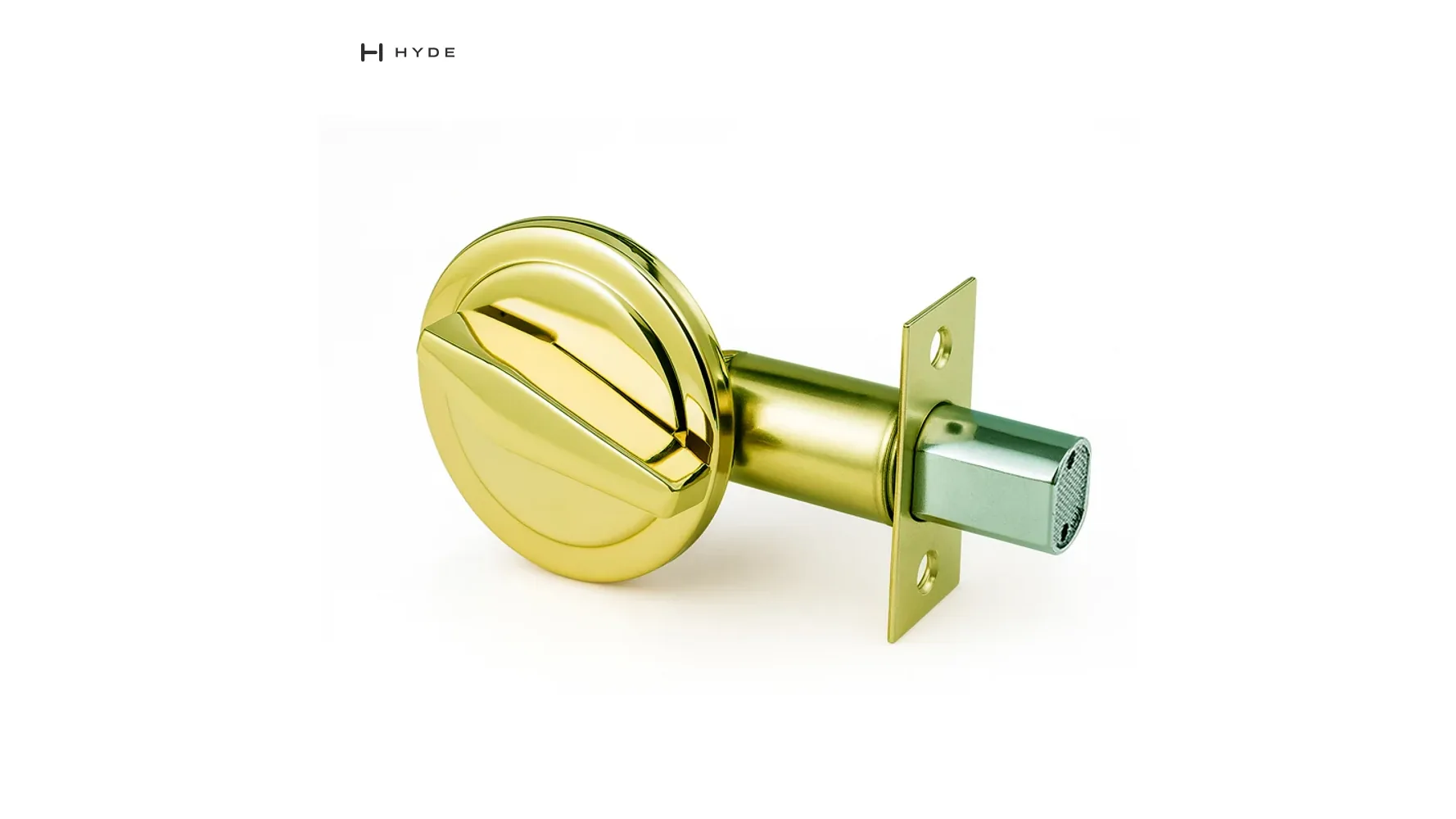
A deadbolt is the second lock on a door, and it exists because the first one cannot do this job. A latch is sprung, so it can be pushed back; a deadbolt is thrown by a key or a turn and has no spring behind it, which means the only way past it is through the bolt, the door or the frame. Everything worth specifying about one follows from that sentence.
The throw is the first number and ours is 25mm on both the D101 and the D102. Twenty-five millimetres is the figure most specifications mean when they ask for a full-throw or one-inch deadbolt, and the reason it is a specification at all is the frame: a bolt that engages less than about 20mm can be forced by spreading the jamb, which is a two-minute attack with a car jack that does not look like forced entry afterwards.
The bolt itself is published as zinc die-cast with a hardened steel roller pin. The roller pin is the anti-saw feature and it works mechanically rather than by hardness alone: a hacksaw blade drawn across it makes the pin rotate, so the teeth skate instead of cutting. It is a detail that costs almost nothing to include and is left out of cheap deadbolts, and it is invisible in a product photograph, which is why it belongs in a comparison rather than in a showroom.
The cylinder on the D101 is published as a five-pin tumbler with a solid brass plug and two nickel-plated keys. Five pins is the residential standard; the plug being solid brass rather than a zinc casting is what lets it be re-pinned cleanly, which matters on any building where keys will be changed between tenants. If your project needs more than five pins or a restricted keyway, that is a different conversation and worth having before the order.
The feature that decides more attacks than any of the above is the free-turning cylinder trim. The collar around the cylinder spins freely, so a wrench or a pipe put on the outside of the lock turns the collar and not the mechanism. Without it, the commonest forced entry on a deadbolt is simply twisting the whole cylinder out of the door, which takes about as long as it takes to describe. Both the D101 and the D102 publish it.
Both are fully reversible, left or right hand, and both publish an internal chassis of zinc-plated steel with exposed trim available in stainless steel, brass or steel. Finishes differ between the two: the D101 is published in antique brass (US5) and antique copper (US11) among others, the D102 in antique copper and polished brass (US3). Those US numbers are the older convention; antique finishes are relieved rather than uniform, so they are not translatable to a single BHMA number, for the reason set out in our finish-code article.
The row that turns these from a component into a specification is keying: both are published as keyable to pair with an entrance bored lock. That is what a building actually wants — one key for the lever set and the deadbolt on the same door, rather than a tenant carrying two. It also means the deadbolt has to be ordered in the same keying group as the lock above it, which is a decision taken at order stage and not afterwards.
If the door you are working on cannot take a bored deadbolt at all — because it is glazed, because the stile is too narrow, or because it is an existing door nobody wants to drill twice — the rim night latch is the alternative, and we have written that range up separately. A 564 or a 1073 mounts on the face and needs one hole, and the rim deadbolt versions of those throw the same 25mm. It is a different fixing, not a lesser lock.
For a quotation: the door thickness, whether the deadbolt is single or double cylinder, and whether it is keyed with the lock above it. That third one is the question most enquiries leave out and the one that determines how the keys arrive.
About Canton Hyland — Canton Hyland manufactures panic exit devices, locks and architectural door hardware for commercial and institutional projects, supplying specifiers and distributors internationally.