
Door Closer Power Size 2026: EN 1154 Sizes 1–7, A156.4, and How to Pick One from the Door
A door closer is specified by a power size, and the power size is derived from the door — its leaf width and its mass — not from the opening or the building type. This page sets out the EN 1154 size ladder with the leaf widths each covers, how the ANSI/BHMA A156.4 approach differs, the three adjustments that are not the power size, and the accessibility constraint that overrides all of it.
Johnson LiuDigital Communications, Canton HylandMA Digital Media, Johns Hopkins University
Products mentioned
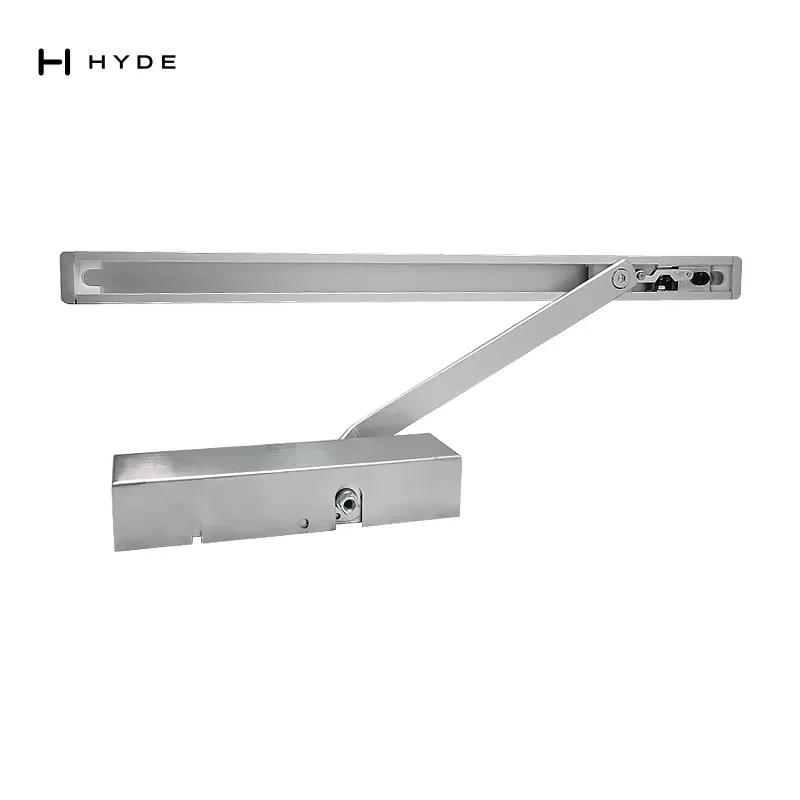
A door closer is chosen by power size, and the single most common specification error is choosing it by room. A heavy door in a small office and a light door in a grand entrance need the closers their doors call for, not the ones the spaces suggest.
The power size is derived from two properties of the leaf: its width and its mass. Everything else — the mounting position, the backcheck, the delayed action — is an adjustment made after the size is right.
THE EN 1154 SIZE LADDER
EN 1154 defines power sizes 1 to 7, ascending. Each size corresponds to a maximum door leaf width and a maximum leaf mass, and a closer is selected by taking whichever of the two puts it in the higher size.
Scroll sideways to compare columns. Select a column heading to sort; select it three times to restore source order.
| 1 | 750mm | 29-1/2" | 20 kg |
|---|---|---|---|
| 2 | 850mm | 33-1/2" | 40 kg |
| 3 | 950mm | 37-3/8" | 60 kg |
| 4 | 1100mm | 43-1/4" | 80 kg |
| 5 | 1250mm | 49-1/4" | 100 kg |
| 6 | 1400mm | 55-1/8" | 120 kg |
| 7 | 1600mm | 63" | 160 kg |
7 rows · Source order
The reason both a width and a mass appear is leverage. A wide light door and a narrow heavy door can present the same closing problem for different reasons, and the size that handles one will not necessarily handle the other. Take the higher of the two answers.
A closer below the door's size will not close and latch it reliably against a seal or a draught. A closer above it will close the door harder than anyone in the building wants, and on an accessible opening it may make the door non-compliant.
WHY MOST COMMERCIAL CLOSERS ARE ADJUSTABLE
A fixed-size closer has to be specified correctly before it ships. An adjustable closer covers a band — commonly sizes 2 to 4, or 3 to 6 — and is set on site, which removes the failure mode where a schedule and a door disagree by one size and nobody finds out until installation day.
It also collapses several part numbers into one for a distributor holding stock, which is why adjustable sizes dominate commercial ranges. The trade is that an adjustable closer set to its lowest setting is not identical to a fixed closer of that size; it is a larger mechanism turned down.
HOW THE NORTH AMERICAN APPROACH DIFFERS
ANSI/BHMA A156.4 covers door controls and grades them, but the North American selection convention leans more on the spring size and the arm configuration than on a single published power number, and accessibility limits are set by code rather than by the hardware standard.
The practical consequence for anyone specifying across both markets: an EN power size is a value you can write in a schedule and a supplier can match. There is no single equivalent number on the American side, so a cross-market schedule should state the leaf width, the leaf mass and the required opening force, and let each market's supplier select from those.
THE CONSTRAINT THAT OVERRIDES THE SIZE
Accessibility. On an opening that has to be usable by someone with limited strength, there is a maximum force permitted to open the door, and that limit can conflict with the power size the leaf would otherwise call for.
Where the two conflict, the closer cannot simply be turned down until it complies, because a closer set below the door's requirement will not close and latch it — and on a fire door, not latching is a failure of the fire door, not an inconvenience. The resolution is usually a different device class: a closer with a lower opening force and a boosted closing moment, or a powered operator.
The specific force limits differ by jurisdiction and are set by building regulation rather than by EN 1154 or A156.4. Confirm the number that applies to the building before selecting, because it is the one constraint that cannot be adjusted away on site.
THE THREE ADJUSTMENTS THAT ARE NOT THE POWER SIZE
Closing speed controls how fast the door travels through most of its arc. Latching speed controls the last few degrees, where the latch has to engage the strike. Backcheck resists the door being thrown open against a wall or a person.
These are set on site with the valves on the body, and none of them changes the power size. A door that will not latch is not fixed by increasing the latching speed if the power size is too low; a door that slams is not fixed by slowing the closing speed if the power size is too high. Diagnose the size first.
DELAYED ACTION, AND WHERE IT DOES NOT BELONG
Delayed action holds the door open at a wide angle for a period before closing, which is useful where trolleys, wheelchairs or deliveries pass through. It is a valve function, not a hold-open device.
It does not belong on a fire door unless the whole assembly is rated for it, because anything that keeps a fire door open changes what the assembly does in a fire. A hold-open on a fire door has to be an electromagnetic device released by the alarm system, not a mechanical setting.
WHAT WE PUBLISH
Our catalogue carries nine door closer models. Where a model publishes a power size or an adjustable band, it is in the specification table on the product page. Where it does not, the row is absent rather than filled with a typical figure — a closer specified one size out is a door that either slams or does not latch, and both are discovered after installation.
Questions this answers
How do I choose a door closer power size?
From the leaf, not the room. Take the door's width and its mass, find the EN 1154 size that covers each, and use whichever of the two is higher. A wide light door and a narrow heavy door can need the same size for different reasons.
What are the EN 1154 power sizes?
Sizes 1 to 7 ascending. Roughly: size 1 to 750mm (29-1/2") and 20 kg, size 2 to 850mm and 40 kg, size 3 to 950mm and 60 kg, size 4 to 1100mm (43-1/4") and 80 kg, size 5 to 1250mm and 100 kg, size 6 to 1400mm and 120 kg, size 7 to 1600mm (63") and 160 kg.
Why are most commercial door closers adjustable?
Because a fixed size has to be right before it ships, and a schedule and a door disagreeing by one size is only discovered on installation day. An adjustable closer covers a band such as sizes 2 to 4 and is set on site. It also reduces the number of part numbers a distributor has to stock.
My door will not latch. Should I increase the latching speed?
Not first. Latching speed controls the last few degrees of travel; it does not add closing force. If the power size is too low for the leaf the door will not latch reliably at any speed setting. Diagnose the size before adjusting the valves.
Can I turn a closer down to meet an accessibility opening-force limit?
Not safely. A closer set below the door's requirement will not close and latch it, and on a fire door failing to latch is a failure of the assembly. Where the accessible opening force and the power size conflict, the answer is a different device class, not a lower setting.
Is delayed action allowed on a fire door?
Not as a mechanical setting. Delayed action holds the door open at a wide angle, and anything holding a fire door open changes what the assembly does in a fire. A hold-open on a fire door has to be an electromagnetic device released by the alarm system.
About Canton Hyland — Canton Hyland manufactures panic exit devices, locks and architectural door hardware for commercial and institutional projects, supplying specifiers and distributors internationally.