
How Many Levels Your Master Key System Actually Needs
We build master key systems up to 5 levels, GGMK down to the change key, and most buildings need 3: every extra level spends key combinations the building may need later. This article gives the level chart, a worked example for a 4-floor office with 36 cylinders (the grand master opens all 36, the facilities master 8, the cleaners' sub-master 3) and a blank chart to print and fill in.

Johnson LiuDigital Communications, Canton HylandMA Digital Media, Johns Hopkins University
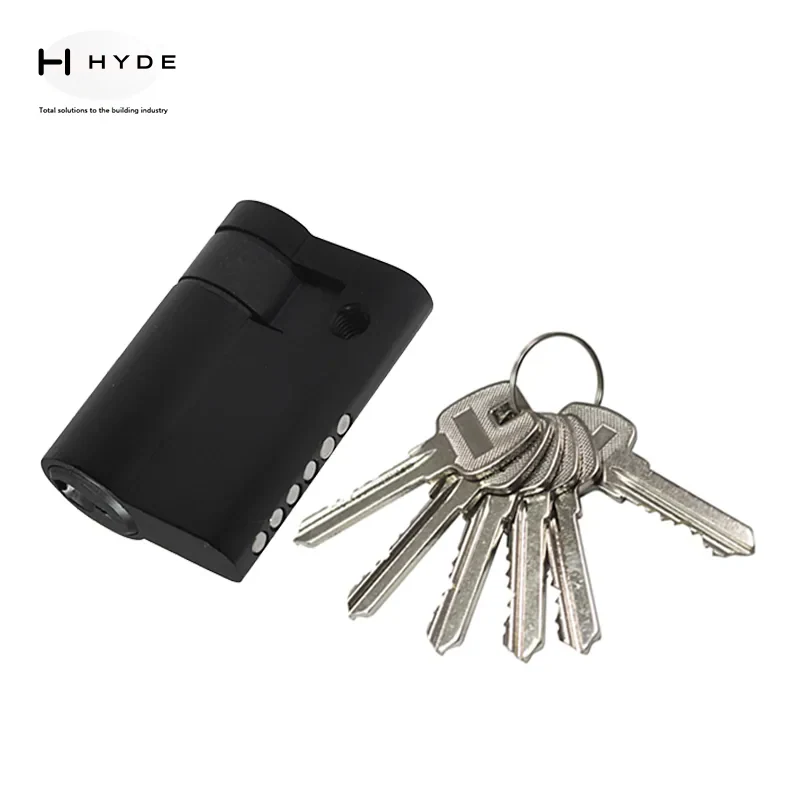

Almost every inquiry we get about master keying opens the same way: "can you do master key?" The answer is yes, and it is not useful, because master keying is not a feature a cylinder either has or lacks. It is a plan (a map of who may open what) and the cylinders are cut afterwards to match the plan. The question that actually moves an order forward is how many levels that plan has.
HYDE (Canton Hyland, Zhongshan, since 1998) makes the 70SN, 65SN and 80SN covered in this article.
The vocabulary is worth getting straight, because the abbreviations are used loosely and they are not interchangeable. A change key (CK) opens one lock and nothing else, the key a tenant or an office occupant carries. A master key (MK) opens every lock in one defined group: a floor, a wing, a department. A grand master key (GMK) opens several groups. A great grand master key (GGMK) sits above those. Between them sit the management levels a facilities team actually uses day to day, the cleaner who needs every room on two floors but no plant room, the maintenance contractor who needs plant rooms across the whole site and no offices.
We build to five levels, from GGMK down to the change key, with four tiers of management keying between the top and the individual lock. That is the ceiling, not the recommendation. Most buildings we quote need three: a change key per door, a master per floor or department, and one grand master for the building manager. Specifying five levels for a building that needs three does not add security, it adds cross-keying complexity, and every additional level narrows the number of distinct key cuts available below it.
That last point is the one most often missed, and it is arithmetic rather than opinion. A cylinder has a fixed number of pin positions and a fixed number of depths per position, so the total number of distinct keys is finite. Every master level consumes some of that space, because a master key works by adding a second shear line in the pin stack, and each added shear line reduces how many change keys can remain unique underneath. A five-level system in a small building is not more secure than a three-level one; it is a three-level building with fewer available combinations and more keys that accidentally fit more than they should.
So the design starts from the building, not from the hardware. What we need to draw a system is the door schedule with a line per door, and for each door: who must be able to open it, and which group it belongs to. That is usually a spreadsheet the facilities manager already has. From it we produce a keying chart (every door, every key that opens it, and the total key count) and that chart is what gets approved before a single cylinder is pinned.
Two practical constraints worth raising before the chart, because they change it. First, all cylinders in one system must be the same keyway, and that keyway has to be decided at the start, a system cannot be extended later with cylinders from a different profile. Second, decide early how many keys each level needs, including spares held by the building owner. Cutting additional keys to an existing system later is straightforward; discovering that the chart never allowed for the night cleaner is not.
Our cylinders are solid brass, in euro profile. The catalog carries them in nine overall lengths (45, 47, 54, 56, 60, 65, 70, 80 and 90mm (3-9/16")) and the length is the leading figure of the model number, which is how the factory names them. Ask us to confirm the exact overall length for the model you settle on: only ten of the forty-five published cylinders state it as a specification row, and on the rest the model number is the only thing carrying it. Overall length is also not the split: a 70mm (2-3/4") cylinder can be 35/35, 30/40 or 40/30, and which one fits depends on your door. That is a separate decision from the keying plan and it is explained in our note on cylinder length and split, but the two arrive together on the same order, so it is worth measuring while you draw the chart.
The chart itself
Here is the hierarchy as a chart, because that is what people are actually looking for when they search for one. Read it downward: each level opens everything below it and nothing above it.
Scroll sideways to compare columns. Select a column heading to sort; select it three times to restore source order.
| 1 | GGMK: Great Grand Master | Every lock in the system | Owner, estates director | One, sometimes two |
|---|---|---|---|---|
| 2 | GMK: Grand Master | Every lock in one building or one whole function | Building manager, head of security | One per building |
| 3 | MK, Master | Every lock in one department, floor or wing | Floor manager, housekeeping supervisor | One per group |
| 4 | SMK, Sub-master | A small named set of doors | Team leader, contractor with limited access | One per sub-group |
| 5 | CK, Change key | One lock, or a keyed-alike set | The person who uses that room | One per door |
5 rows · Source order
Two labels sit outside the hierarchy and are constantly confused with it. Keyed alike (KA) means several locks share one change key, two doors into the same office, or a run of identical store cupboards. It is not a level; it is a decision made at the bottom of the chart. Keyed different (KD) is the default: every lock has its own change key.
A maison key is the other one worth naming. It is a key that a lock accepts in addition to its own, the classic case being a main entrance that every flat key must open. Maison working is a property of the lock, not of the key, and it is specified per door rather than per level.
A worked example, so the chart has a shape
Take a four-storey office building with a ground-floor reception, three tenant floors, a plant room, and a cleaners' store on each floor. The system that fits it is four levels, not five:
Scroll sideways to compare columns. Select a column heading to sort; select it three times to restore source order.
| Building owner | GMK | Everything |
|---|---|---|
| Facilities manager | MK-A | Plant room, risers, all cleaners' stores |
| Cleaning contractor | SMK-1 | The three cleaners' stores only |
| Floor 2 tenant | CK ×9 | Their own nine doors, keyed different |
| Main entrance | maison | Accepts every tenant CK plus GMK |
5 rows · Source order
Nobody in that building needs a GGMK, because there is only one building. Adding the sixth line (a GGMK above the owner's GMK) costs pin space on every cylinder in the system and buys nothing until there is a second building. That is the whole argument for designing down rather than up.
How many doors each key opens
The same building, counted. Say each of the three tenant floors has nine doors, each of the four floors has a riser cupboard, and there is one plant room and one main entrance: 36 cylinders in all. This is how the four keys divide them.
Scroll sideways to compare columns. Select a column heading to sort; select it three times to restore source order.
| GMK | Building owner | Everything | 36 |
|---|---|---|---|
| MK-A | Facilities manager | Plant room, four risers, three cleaners' stores | 8 |
| SMK-1 | Cleaning contractor | The three cleaners' stores | 3 |
| CK ×27 | One per tenant room | Its own door, plus the main entrance by maison working | 1 each, plus the entrance |
4 rows · Source order
Counting doors per key is the check that catches a bad chart before any cylinder is cut. A sub-master that opens almost as many doors as the master above it is a level the building does not need.
A blank chart to print and fill in
Print this page, or copy the table into the spreadsheet that holds your door schedule. Fill in one row per key: who holds it, which doors it opens, how many doors that is, and how many copies to cut. Delete the levels you do not need. Sent back to us filled in, it is enough to draw the cylinder plan.
Scroll sideways to compare columns. Select a column heading to sort; select it three times to restore source order.
| GGMK | ||||||
|---|---|---|---|---|---|---|
| GMK | ||||||
| MK | ||||||
| MK | ||||||
| SMK | ||||||
| SMK | ||||||
| CK | ||||||
| Keyed-alike set | ||||||
| Maison door |
9 rows · Source order
Drawing the plan from two levels to four, with the standard symbols
A chart says who opens what. A plan adds a symbol to every key and every cylinder, so that anyone reading the schedule can tell a key's place in the hierarchy from its name. The convention most North American schedules follow is the one in the Door and Hardware Institute's handbook, Keying Systems and Nomenclature; the ANSI/BHMA recommended practice for mechanical keying systems, A156.28, sits alongside it and covers the keying conference and key management. The rule underneath the symbols is short: letters are master keying, numbers are change keys, and every cylinder with the same symbol is keyed alike.
One level is no master key at all. Cylinders are keyed different, or keyed alike in sets written KA1, KA2 or simply Set 1, Set 2. Homes and small shops rarely need more.
Two levels add a single master. The master key takes two letters, AA, and the change keys put their number first: 1AA, 2AA, 3AA. A second system with no connection to the first takes a different pair, AB, so the two cannot be confused on paper.
Three levels put a grand master on top, written as one letter, A. Each master under it takes two letters beginning with that letter, AA, AB, AC, and from this level up the change-key number goes last: AA1, AA2, AB1. Read AB2 and it says change key 2, under master AB, under grand master A.
Four levels add a great grand master, GGM, which is taken to open every cylinder in the system. Each grand master underneath starts its own letter, A and B, and below each one the system is built exactly like a three-level system: masters AA, AB and BA, change keys AA1, AB1, BA1.
Scroll sideways to compare columns. Select a column heading to sort; select it three times to restore source order.
| Top key | AA, master | A, grand master | GGM, great grand master |
|---|---|---|---|
| Grand masters | — | — | A, B |
| Masters | — | AA, AB | AA, AB, BA |
| Change keys | 1AA, 2AA, 3AA | AA1, AA2, AB1 | AA1, AB1, BA1 |
| Typical building | Primary school, apartment building, factory | Office building, large school, hospital | University, large hospital, government campus |
5 rows · Source order
The exceptions are written in the same alphabet, which is what makes the symbols worth using. A cylinder opened only by a master and the keys above it carries the master's symbol alone: AA. A cylinder opened by its change key and the grand master, with no master in between, takes the grand master's letter and a number: A1. A cylinder keyed alike to another but not opened by the master keys keeps the symbol and adds NMK, not master keyed: AA1 (NMK). An X in front marks a cross-keyed cylinder, and the schedule names every key that opens it: XAA1, operated by AA1, AA2, AA and A. In a four-level system a cylinder for the great grand master alone is GGM, and a change key directly under it is GGM1.
Three housekeeping rules prevent most misreadings. The letters I, O and Q are left out because they read as 1 and 0. A system with more masters than letters inserts a number for each pass through the alphabet, so the master after AZ is A2A. And where a supplier's software needs fixed-width codes, leading zeros are allowed: AA001.
What each level costs you in pin space
The arithmetic in the previous section is not abstract, and it is worth stating as a rule of thumb rather than a formula. Every level above the change key needs at least one extra split in the pin stack of every cylinder that the level must open. Splits are what make a cylinder pickable and what make it wear unevenly, so the count matters to security and to service life, not only to whether the system can be drawn at all.
The practical consequence: a five-level system on a six-pin cylinder leaves very little room for future doors. If the building will grow, the honest move is to use fewer levels now and leave depth unspent, rather than to design the maximum system and discover in year three that no more keys can be cut in it.
Each level also has a ceiling, and the DHI handbook gives a planning rule for finding it before the keying conference rather than after the first order. On a common ten-depth, six-pin cylinder where cuts in one chamber must differ by two steps, each pin chamber offers four usable choices to any one level, so the number of keys a level can hold is four multiplied by itself once for every chamber assigned to it: 4, 16, 64, 256. A chamber given to one level is not available to the next. A three-level plan that gives one chamber to the grand master and two to the masters has room for 16 masters and leaves three chambers, 64 change keys, under each. Ask for 20 masters and the masters need three chambers, which leaves two: 16 change keys per master. That is why the number of masters and the size of the largest group have to be settled together. It is a rule for planning, not a guarantee; the real ceiling depends on the cylinder's depths, its maximum adjacent cut and the manufacturer's mastering method.
Above four levels the DHI handbook stops describing symbols and refers the reader to the lock manufacturer. That is why a five-level system, the most we build, is drawn with us against the door schedule rather than from a template, and why the keying schedule that comes out of it carries its own legend.
This is also why we ask for the schedule before quoting rather than after. A system is not a product we take off a shelf; it is a chart drawn against a specific building, and a chart drawn against the wrong building cannot be corrected later without recutting every cylinder in it.
What you get back, and why it has to be kept
The deliverable is not a box of cylinders. It is a key schedule: one row per door, naming the door, the cylinder, which levels open it, and how many change keys were cut. Alongside it sits the bitting list, the actual pin depths behind every key in the system.
Keep both, and keep them somewhere that survives a change of facilities manager. A master key system whose chart has been lost is not a master key system any more; it is a set of cylinders nobody can extend, because the next key has to be cut into a scheme that no longer exists on paper. Rebuilding a lost chart means pulling and reading cylinders one at a time, and on a large building that costs more than the original system did.
Send the door schedule and say how many levels you think you need. If the schedule suggests fewer, we will say so: a system with one level more than the building uses is a cost and a complication that shows up years later, when somebody has to explain why a key opens a door it should not. And if the building is likely to grow, say that too, because spare capacity has to be designed in at the start.
Questions this answers
How many levels does a master key system need?
Most buildings we quote need three: a change key per door, a master per floor or department, and one grand master for the building manager. We build to five levels, from great grand master down to the change key, with four tiers of management keying in between, but that is the ceiling, not the recommendation.
Is a five-level system more secure than a three-level one?
No, and the reason is arithmetic rather than opinion. A cylinder has a fixed number of pin positions and depths, so the total number of distinct keys is finite. A master key works by adding a second shear line in the pin stack, and each added shear line reduces how many change keys can remain unique underneath. A five-level system in a small building is a three-level building with fewer available combinations and more keys that accidentally fit more than they should.
What is the difference between a change key, a master and a grand master?
A change key (CK) opens one lock and nothing else, the key a tenant or office occupant carries. A master key (MK) opens every lock in one defined group: a floor, a wing, a department. A grand master key (GMK) opens several groups, and a great grand master (GGMK) sits above those. Between them sit the management levels a facilities team actually uses, the cleaner who needs every room on two floors but no plant room, the contractor who needs plant rooms across the site and no offices.
What do you need to design a master key system?
The door schedule with a line per door, and for each door who must be able to open it and which group it belongs to, usually a spreadsheet the facilities manager already has. From it we produce a keying chart: every door, every key that opens it, and the total key count. That chart is approved before a single cylinder is pinned. Two constraints change the chart, so raise them first: every cylinder in one system must share a keyway decided at the start, and the spares each level needs have to be counted in.
How are master key symbols written for a three-level system?
In the DHI convention the grand master takes one letter, A. Masters under it take two letters beginning with it, AA and AB, and change keys add a number at the end: AA1, AB2. In a two-level system the master is AA and the change number comes first: 1AA, 2AA.
How many masters and change keys can a master key system hold?
It depends on the cylinder. As a planning rule from the DHI handbook, on a ten-depth, six-pin cylinder each pin chamber gives a level four choices, so one chamber holds 4 keys, two hold 16 and three hold 64, and a chamber used by one level is not available to the next.
Related products
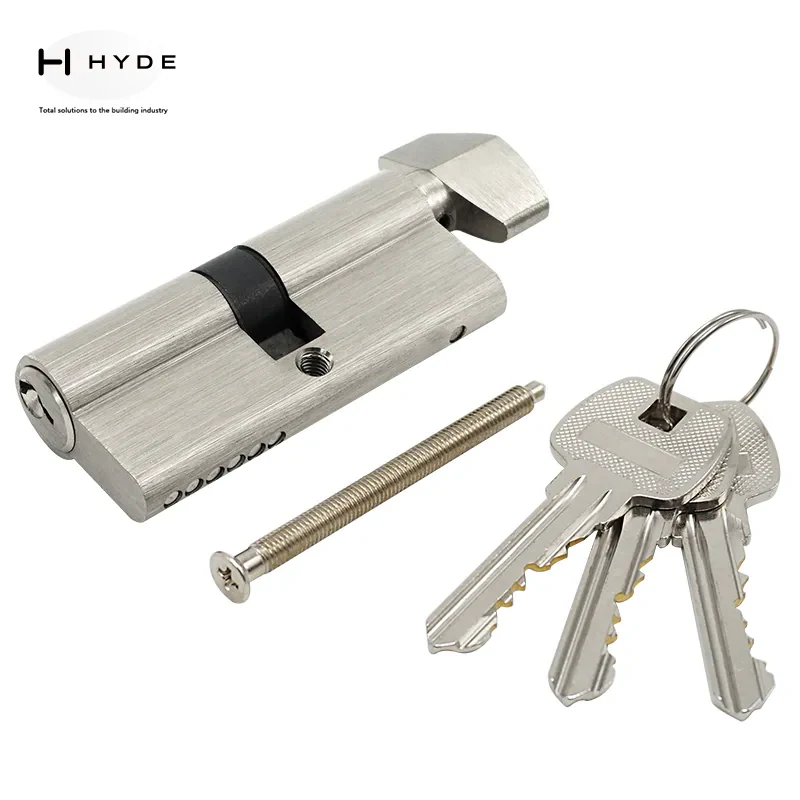
Size 70mm
Lock Cylinder
Model 70SN
Solid Brass
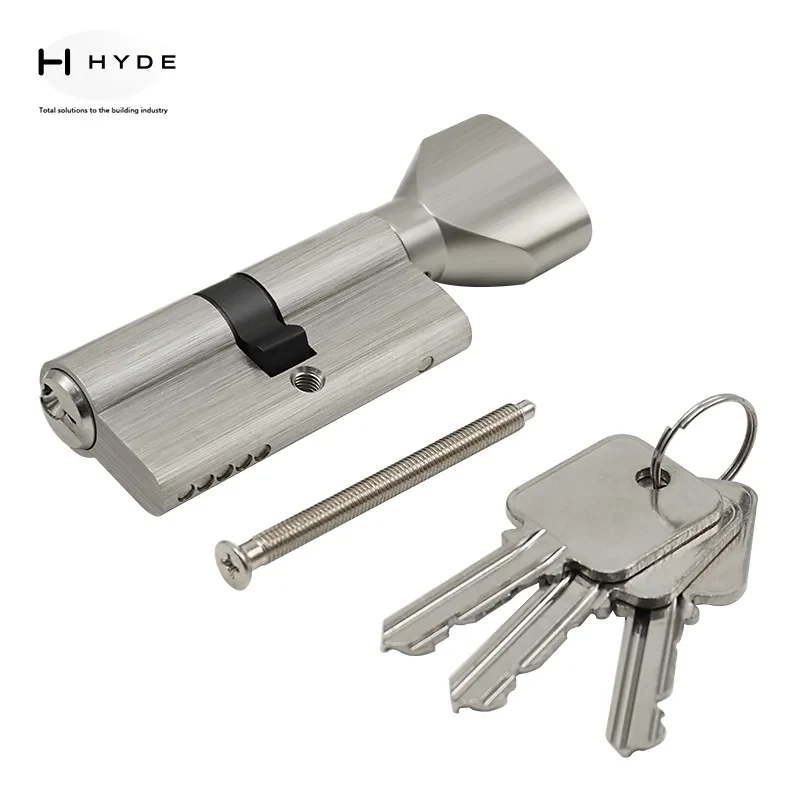
Size 65mm
Lock Cylinder
Model 65SN
Solid Brass
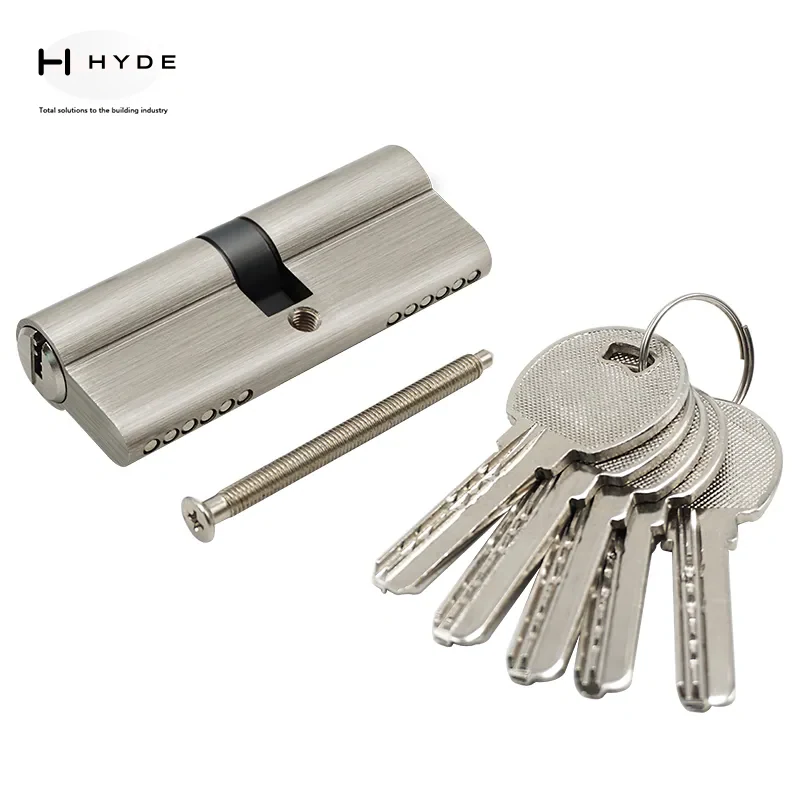
Size 80mm
Lock Cylinder
Model 80SN
Solid Brass
About Canton Hyland — Canton Hyland manufactures panic exit devices, locks and architectural door hardware for commercial and institutional projects, supplying specifiers and distributors internationally.