
Handing: The One-Letter Answer That Holds Up Orders
Left, right or universal is a single character on an order line and the most common reason a quotation goes back for clarification. It is decided by where the hinges are and which way the door opens, and the two conventions in use disagree with each other.

Johnson LiuDigital Communications, Canton HylandMA Digital Media, Johns Hopkins University
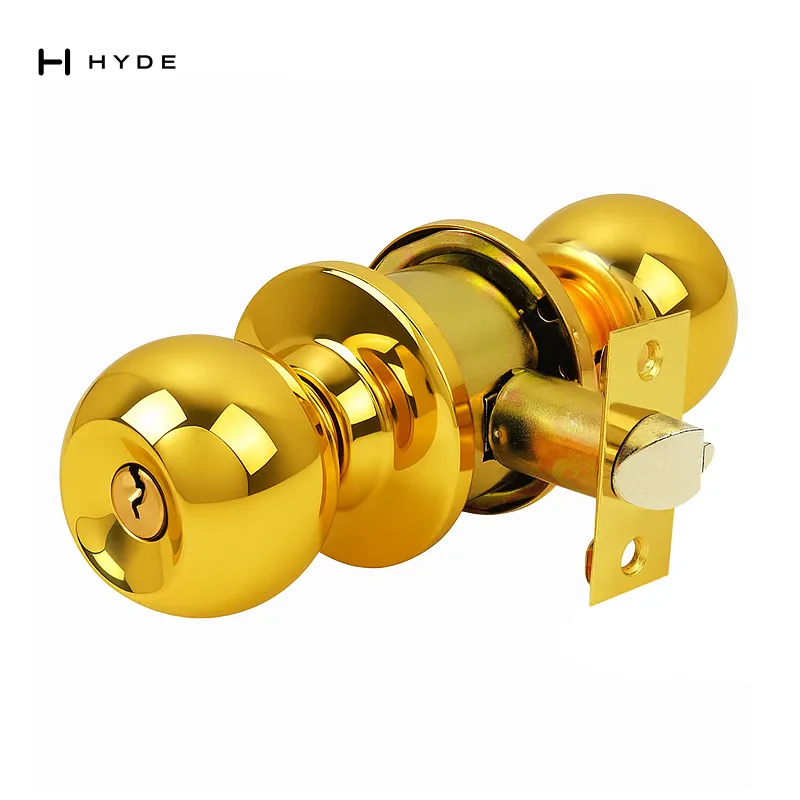

Handing describes which edge of the door the hinges are on and which way the leaf swings. It matters because a lever has to fall the right way, a latch bolt has a bevel that must face the frame, and a lock case machined for one hand will not close on the other. It is one letter, and it is the field most often left blank on an inquiry.
HYDE (Canton Hyland, Zhongshan, since 1998) makes the LC07 85×45mm, LC14 85×50mm and 9001 covered in this article.
There are two conventions and they do not agree. The European method stands the observer on the side the door opens TOWARDS (the pull side) and calls it left-handed if the hinges are on the left. The American method (ANSI/BHMA A156.115) stands the observer OUTSIDE, on the side you would use a key from, and adds "reverse" for doors that swing toward them. The same physical door is DIN-left under one and right hand under the other.
This is why "left-handed" written on its own is not an answer. It is an answer plus an assumption about which convention the reader uses, and the reader is on the other side of the world. The unambiguous way to say it is to describe the door: hinges on the left as you look at it from the corridor, opens away from you. Twenty words that cannot be misread beat one letter that can.
A useful test that needs no convention at all: stand where the key goes. If the hinge knuckles are on your left, it is left-handed in the American sense; if the door swings towards you from there, it is "reverse". Say which side you stood on and the sentence survives translation.
Some hardware does not care. A tubular latch with a symmetrical bolt, most euro-profile cylinders, hinges themselves, and any lever on a sprung rose are non-handed (universal, marked U) and the field can honestly say so. Reversible latches are a middle case: the bolt can be turned on site, which is a real convenience and also a real opportunity for it to be turned wrong and never checked.
What is genuinely handed, and where the cost lands: mortise cases with an asymmetric follower, rebated pairs, and anything with a deadlocking latch whose auxiliary bolt has to meet the keep. On those, a wrong hand is not adjustable with a file, it is a different part number, and on a container quantity it is a different shipment.
The practical rule for a schedule: give every opening a hand or the word universal, and never leave the column empty. An empty column reads as "not decided yet" to the person filling the order and as "universal" to the person in a hurry, and only one of those is safe.
Left hand reverse (LHR) and right hand reverse (RHR)
Left hand reverse (LHR) is a door with its hinges on the left that swings toward you when you stand on the outside; right hand reverse (RHR) is the same door with the hinges on the right. "Outside" in the North American convention is the key side, the side the door is secured against: the street side of an entrance, the corridor side of an office or a plant room. Stand there, face the door, and answer two questions in order: which side are the hinges on, and does the leaf come toward you when it opens? The hinge side gives the left or right, and a leaf that comes toward you adds the R.
Scroll sideways to compare columns. Select a column heading to sort; select it three times to restore source order.
| LH, left hand | Left | Away from you (inward) | Outside | DIN rechts |
|---|---|---|---|---|
| RH, right hand | Right | Away from you (inward) | Outside | DIN links |
| LHR, left hand reverse | Left | Toward you (outward) | Inside | DIN links |
| RHR, right hand reverse | Right | Toward you (outward) | Inside | DIN rechts |
4 rows · Source order
Reverse does not change the hinge side, only the swing: LH and LHR share a hinge side and differ in which way the leaf travels, and so do RH and RHR. Nor does it mean the door is unusual or that anything has been flipped. An outward-opening door is reverse by definition, which makes the reverse pair the normal case on exit doors. The DIN column follows from the mapping table further down: the European observer stands on the side the door opens toward, which on a reverse door is the outside, so LHR and DIN links agree on the letter while LH is DIN rechts. That is why a plain "left" on an international order is not enough.
Reverse matters wherever the latch has a bevel. A spring latch bolt is angled so that its sloped face meets the strike as the door closes, so the bevel always faces the direction the door closes in: toward the outside on an LH or RH door, toward the inside on an LHR or RHR door. North American hardware schedules therefore often write a reverse hand as LHRB or RHRB, the B standing for bevel. On a reversible latch the bolt is turned on site; on a handed lock case a reverse bevel is a different part, and a latch with its bevel the wrong way does not close against the strike, it stops on it.
Exit devices and outswinging doors are where this lands. An exit door opens in the direction of escape: the push side is the inside and the key side is the outside, so seen from outside every such door swings toward you and is LHR or RHR. The same holds for any door that opens out into a corridor, a plant room door included. The bar sits on the push side, and whether it is handed depends on the model; the outside trim, a mortise or vertical-rod latch and the closer arm are where a hand can show up. Example (hypothetical): a plant room door that opens out into the corridor, hinges on the right seen from the corridor, is RHR, DIN rechts, with the latch bevel facing into the plant room.
Our product data does not publish LHR, RHR or reverse bevel as a separate option on any model. The handing rows we do publish say reversible or non-handed for left or right hand, and most of our panic bars publish no handing row at all. So for a reverse door, put the four-letter term, the convention and the plain description on the order line, ask whether that model's latch covers a reverse bevel, and ask for it to be set before packing rather than on site.
DIN, and what a European product code is telling you
European codes carry the hand as DIN left or DIN right, and DIN follows the European convention: look at the door from the side it opens toward you, and name the hand by the hinge side. A code ending in a DIN designation is describing the lock case, not the door, which matters, because a DIN-left case fitted into a door somebody has described as right-handed in the American sense is not necessarily a mistake.
That is the trap in one sentence: a door correctly called left hand in one convention can be correctly called right hand in the other, and nobody has made an error. It is why "LH" written alone on an international order is a coin toss, and why the convention has to be named next to the hand every single time.
DIN links and DIN rechts, mapped to LH, RH, LHR and RHR
German specifications state the hand as the Anschlagseite: DIN links or DIN rechts. The rule comes from the former DIN 107, whose terminology is now in DIN EN 12519: look at the door from the side on which the hinges are visible, which is the side it opens toward, and name the hand by the hinge side. Hinges on the left is DIN links; hinges on the right is DIN rechts. That designation describes the leaf completely, and it says nothing about which face is outside.
That last point is what a conversion needs. The American designation is read from outside, so the same DIN links door becomes RH or LHR depending on its Öffnungsrichtung relative to the outside face, and the plain "viewed from outside" convention some suppliers use, which names only the hinge side seen from outside and has no reverse, changes with it. Seen from outside, an inward-opening door shows its hinges on the opposite side to the one the DIN observer sees; an outward-opening door shows them on the same side, because then the outside is the opening side.
Scroll sideways to compare columns. Select a column heading to sort; select it three times to restore source order.
| DIN links | Opens away from you (inward) | RH | Right |
|---|---|---|---|
| DIN links | Opens toward you (outward) | LHR | Left |
| DIN rechts | Opens away from you (inward) | LH | Left |
| DIN rechts | Opens toward you (outward) | RHR | Right |
4 rows · Source order
Two checks follow from the table. On an outward-opening door, such as an exit door that opens in the direction of escape, all three columns agree on the letter: DIN links is LHR and left from outside. On an inward-opening door they disagree: DIN links is RH and right from outside. So a German order that gives DIN links or DIN rechts plus the Öffnungsrichtung, inward or outward as seen from outside, converts without a question; one that gives only DIN links is complete for the joiner and incomplete for anyone ordering a lock by the American letter.
Reversible, universal and field-reversible are three different claims
These three words get used interchangeably in catalogs and they promise different things. The difference decides whether your fitter can solve a problem on site or has to order another part.
Scroll sideways to compare columns. Select a column heading to sort; select it three times to restore source order.
| Non-handed / universal | The part is symmetrical or hand-independent as shipped | Nothing. Fit it either way |
|---|---|---|
| Reversible | The part can be converted, usually with the lock out of the door | Bench work, tools, sometimes a spring moved |
| Field-reversible | Converted in place, typically one screw or a lever flip | A minute at the door, no dismantling |
3 rows · Source order
When a supplier says "reversible" and means the first row, everyone is happy. When they say it and mean the second row, a fitter on a ladder discovers it at the worst possible moment. Ask which of the three it is, in those words, and ask whether the conversion needs the lock removed.
What our own catalog actually says
We should be concrete about this rather than general, because the answer surprised us when we counted it.
Where our products publish a handing row, almost all of them say the product is fully reversible or non-handed. Very few name a handed left-or-right choice, and the product page says so when one does.
So for almost everything we sell, the honest answer to "what hand do you need?" is: we do not need one. The lever, the latch, the rim lock, the cylinder, they go either way.
That is not a reason to stop recording the hand, and this is the part worth saying plainly rather than quietly. The hand is not a property of the hardware; it is a property of the opening. It still decides which way the door is hung, which side the frame is rebated, where the closer arm goes, which leaf of a pair is active, and which way round the strike is cut. Reversible hardware removes one of those decisions and leaves the rest untouched.
Where handing still bites, even with reversible hardware
The frame and the strike: a keep is cut into one side of the frame. Reversible hardware does not move it.
The closer: a closer arm, a backcheck setting and a parallel-arm bracket are all handed by the opening even when the lock is not.
Pairs of doors: which leaf is active is a handing decision, and it determines where the astragal, the flush bolts and the coordinator go.
Anything with a thumbturn, an indicator, or a lettered face: symmetry ends where text or an icon begins, an occupied/vacant indicator read upside down is a defect, not an orientation.
Anything bought elsewhere: the ironmongery on the same door from another supplier may be genuinely handed, and it will be handed in whichever convention that supplier writes in.
So record the hand on the schedule, name the convention beside it, and then enjoy the fact that on our side of the order it usually will not change what we ship.
Why there are two conventions at all
Neither convention is wrong, and knowing why they differ makes them easier to keep straight than memorising them does. They were written by two different trades solving two different problems.
The European convention was written from the leaf. A joiner hanging a door cares which edge the hinges go on, and answers that standing where the door opens toward him. One axis, two answers, and it maps directly onto the work.
The North American convention was written from the lock. A locksmith cares where the key goes, so the observer is planted on the outside face, and once you are standing outside, the swing direction becomes a second thing you can see and therefore a second thing worth naming. One axis became two, and two terms became four.
So the conventions are not rivals; they are answers to "which way does this door work?" asked by a carpenter and by a locksmith. That is also why the disagreement is so stubborn: each one is the shortest correct answer to its own question.
When the order already says "LH" and nobody knows whose LH it is
This happens constantly on a re-order, where the original schedule is gone and all that survives is two letters. Do not guess, and do not assume the previous supplier used your convention.
Go back to the physical evidence in this order. Look at an installed door from the original batch, if one exists, and record the three plain observations, hinge side, swing direction, which face is outside. Those three survive any convention. Failing that, look at the part itself: a handed lock case shows its latch bevel, and the bevel always faces the direction the door closes in. Failing that, ask what the original supplier's catalog said, because the convention is usually printed in its front matter even when the order is not.
If none of the three is available, say so on the order rather than picking one. On our catalog it will almost certainly not matter (see the count above) and on a genuinely handed item, an honest "hand unknown, please confirm" costs one email. A guess costs a container.
Where a model is handed, our specification tables state it as a row rather than burying it in the description, and the guided selector asks for it before it offers a model number, because the answer changes which models can be offered at all, not just which variant of one.
Questions this answers
If a door is hinged on the left and opens away from you, what handing does the lock need?
Stand where the key goes (outside) and the American convention answers it: hinge knuckles on your left makes it left-handed, and because the leaf swings away from you rather than towards you it is not a reverse. The same door is DIN-right under the European convention, which stands the observer on the pull side instead. That is why the safe way to write it on an order is the description you just gave rather than the letter it resolves to.
What do left hand reverse (LHR) and right hand reverse (RHR) mean?
Stand on the outside, the key side. If the hinges are on your left and the door swings toward you, it is left hand reverse (LHR); hinges on your right and swinging toward you is right hand reverse (RHR). A door that swings away from you is plain LH or RH. In the European convention LHR is DIN links and RHR is DIN rechts, because the European observer stands on the side the door opens toward, which on a reverse door is the outside.
Why does reverse bevel matter on an exit door?
An exit door opens outward in the direction of escape, so seen from outside it is always LHR or RHR, and the latch bevel has to face the inside to meet the strike as the door closes. A latch fitted with its bevel facing outside stops on the strike instead of latching. Our product data does not publish reverse bevel as a separate option, so ask per model whether the latch covers it.
Is handing decided by the hinges or by the bolt?
By the hinges and the swing. Handing describes which edge of the door the hinges are on and which way the leaf opens; where the latch bolt ends up, and which way its bevel faces, follows from that. This matters because the two conventions in use disagree about the same physical door (one calls it DIN-left, the other right hand) so a letter on its own is an answer plus an unstated assumption about which convention the reader uses.
What does universal or non-handed hardware mean?
That the part works either way round, so the handing field can honestly say so. A tubular latch with a symmetrical bolt, most euro-profile cylinders, hinges themselves and any lever on a sprung rose are non-handed and marked U. Reversible latches are a middle case: the bolt can be turned on site, which is a real convenience and also a real opportunity for it to be turned wrong and never checked.
Which hardware is genuinely handed, and what does getting it wrong cost?
Mortise cases with an asymmetric follower, rebated pairs, and anything with a deadlocking latch whose auxiliary bolt has to meet the keep. On those a wrong hand is not adjustable with a file, it is a different part number, and on a container quantity it is a different shipment.
Related products
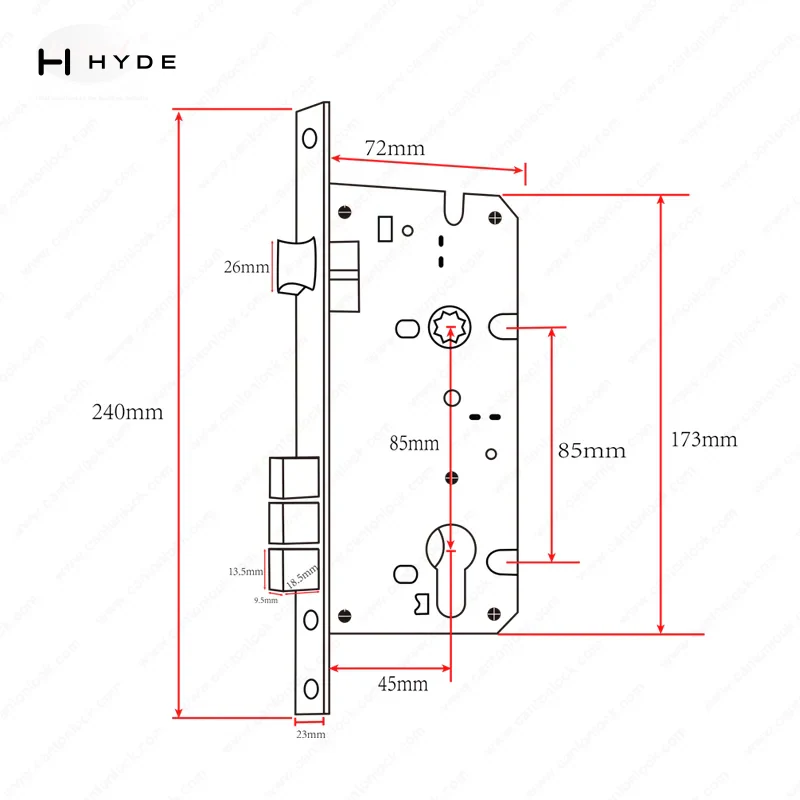
Backset 45mm
Lock Case
Model LC07 85×45mm
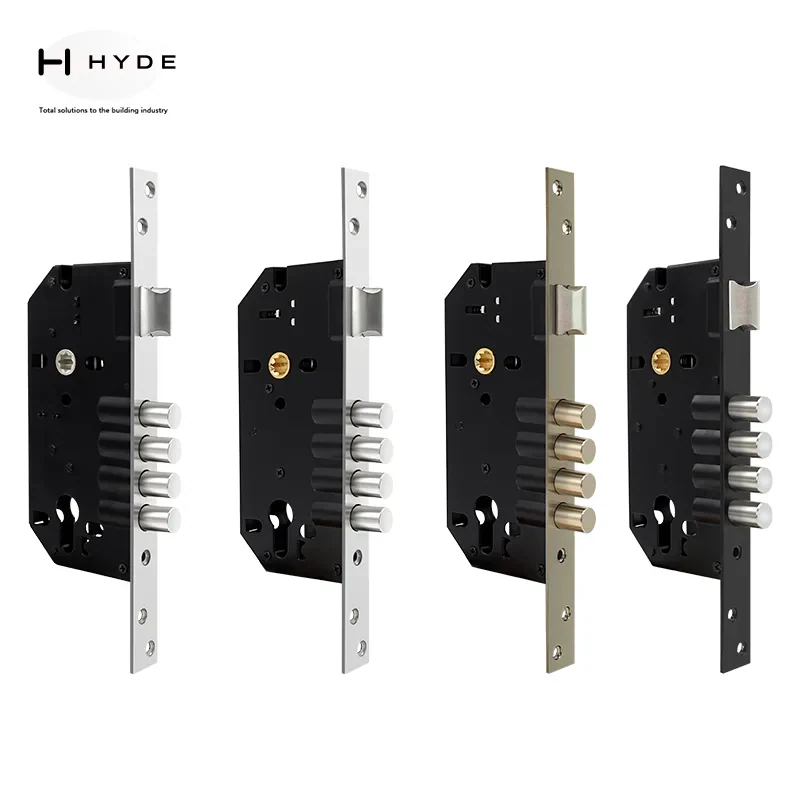
Backset 50mm
Lock Case
Model LC14 85×50mm
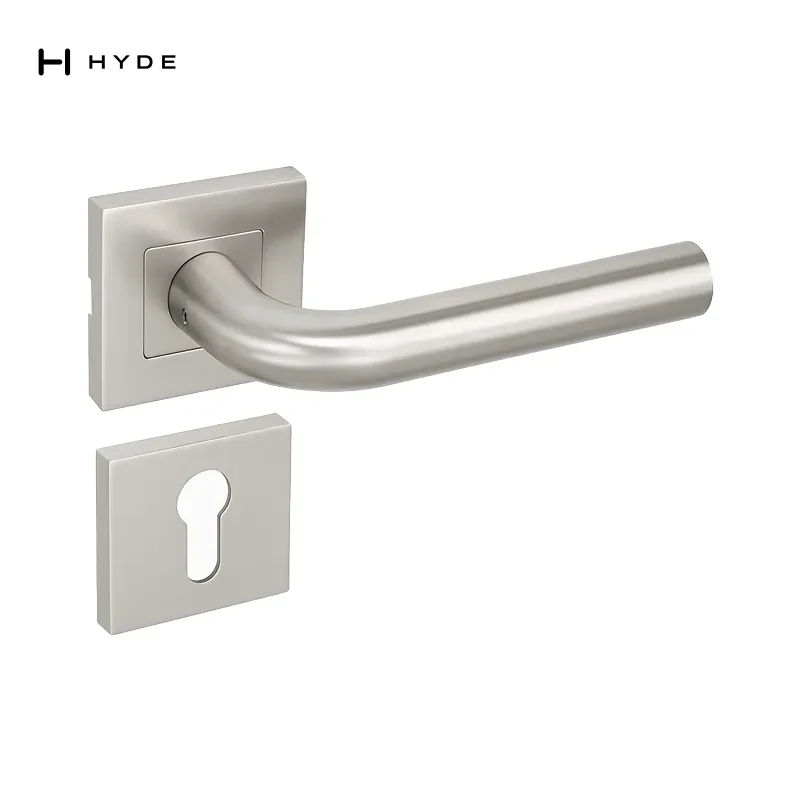
Door thickness 35–50mm
Stainless Steel Handle
Model 9001 · Video
Stainless Steel
About Canton Hyland — Canton Hyland manufactures panic exit devices, locks and architectural door hardware for commercial and institutional projects, supplying specifiers and distributors internationally.