
Sliding Door Locks: Why the Bolt Is a Hook (Hakenriegelschloss)
A sliding door opens along the same line a straight bolt projects, so a straight bolt pulls straight back out of its strike. A hook bolt (in German, Hakenriegel) turns through a right angle and catches behind the strike instead. What to specify for timber pocket doors and for aluminum profile sliders, and what no lock can do for a patio door.

Johnson LiuDigital Communications, Canton HylandMA Digital Media, Johns Hopkins University
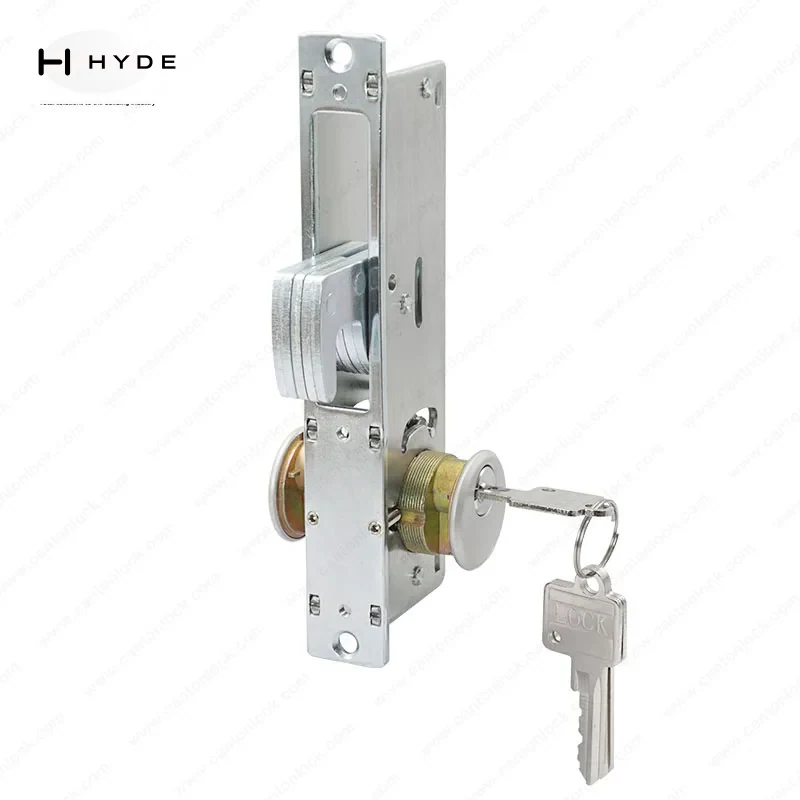
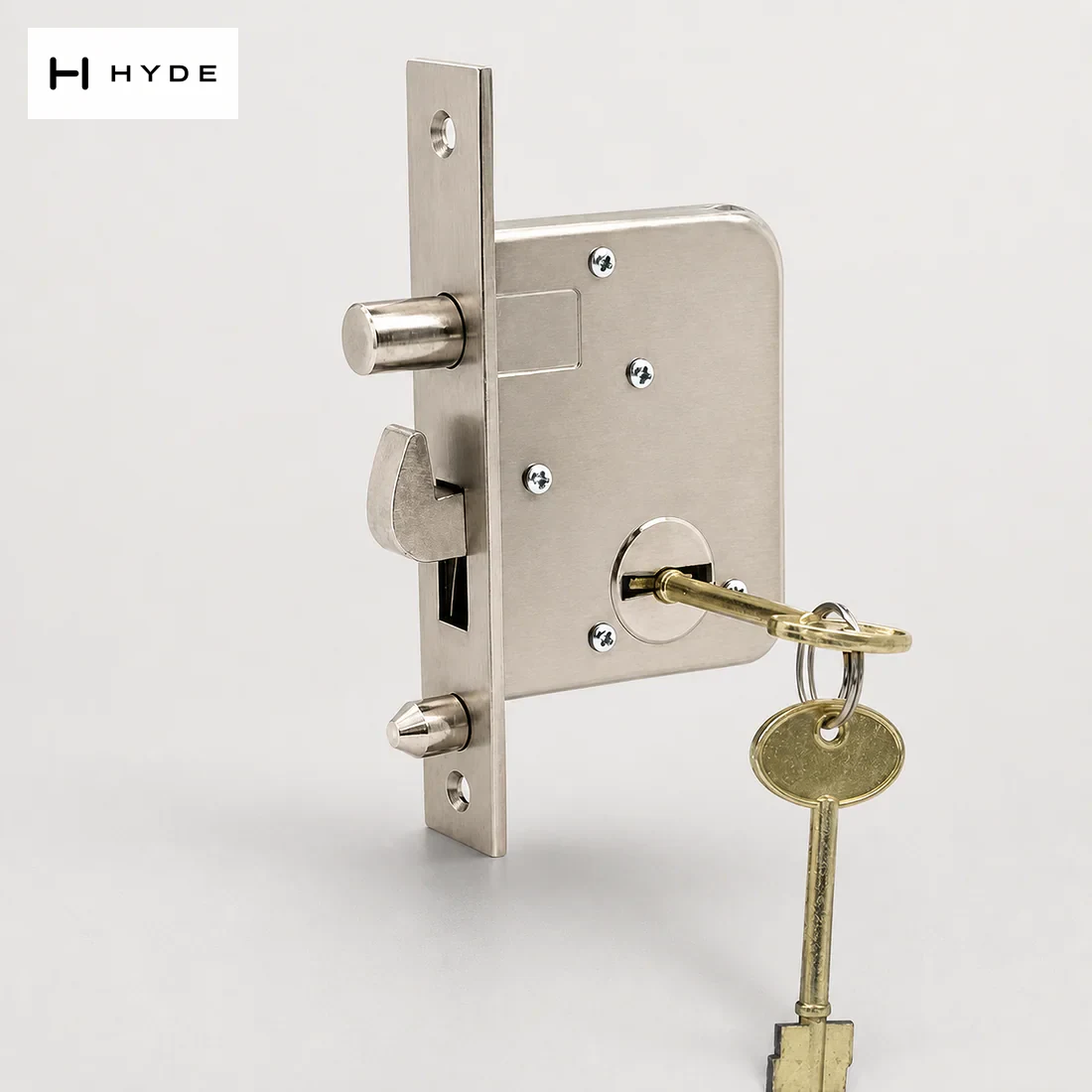
A sliding door needs a hook bolt because of the direction it opens. A swing door turns away from its frame, so a straight bolt projecting sideways into the jamb is caught by the strike the moment anyone pulls the door. A sliding leaf moves along the wall, straight away from the jamb it closes against, and that is exactly the line a straight bolt projects along. Pull the door open and a straight bolt simply slides back out of the strike hole. Nothing holds it.
The hook solves this by turning the bolt through a right angle. When the key or the turn is operated, the hook swings out of the faceplate on a pivot and catches behind the lip of the strike on the jamb. Now the force of somebody pulling the door open lands on the back of the hook and the edge of the strike, which is the direction both parts are built to resist. In German the part is a Hakenriegel and the lock a Hakenriegelschloss, and a German specification for a sliding door (Schiebetür) will usually ask for one by that name.
The same reasoning rules out the ordinary spring latch. A bevelled latch works on a swing door because the closing door pushes it back against the strike and its spring throws it into the hole; on a slider nothing stops it being drawn straight back out again. That is why sliding door locks are deadlocking (the bolt is thrown by key or turn and stays thrown) rather than self-latching, and why simply closing a sliding door does not lock it.
Where the hook-bolt lock goes on a sliding door
The lock is mortised into the leading edge of the leaf, the edge that meets the jamb when the door is shut, and the strike is fixed to that jamb facing it. On a pocket door, which slides into a cavity inside the wall, the leading edge is the only edge that ever meets the frame, so the lock and strike can go nowhere else. On a surface slider running across the face of the wall the rule is the same: lock in the leading stile, strike on the jamb it closes against.
The handles change as well. A projecting lever or knob would catch on the cavity of a pocket door, or on the wall a surface slider passes, so sliding door kits use flush pulls: recessed plates set level with the face of the leaf. The key cylinder and the thumbturn are built into those plates, normally with the key on the outside face and the turn on the inside.
Two kinds of sliding door, two kinds of hook-bolt lock
What gets specified depends on what the door is made of. A timber or board leaf can be mortised to take a self-contained kit. An aluminum profile door has a hollow extruded stile with a narrow pocket, and it takes a narrow lock case chosen to fit that pocket, with the cylinder bought as a separate part.
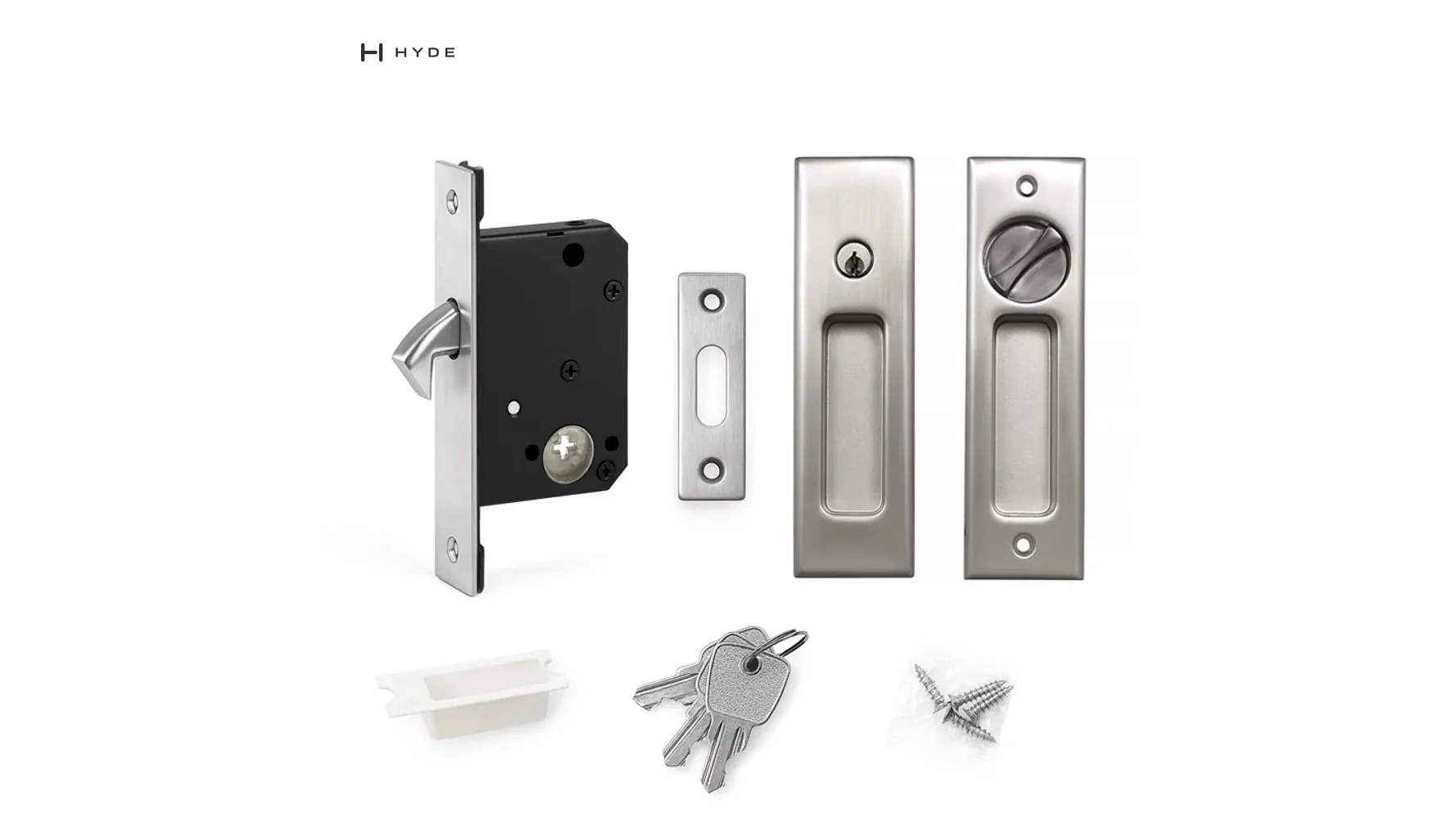
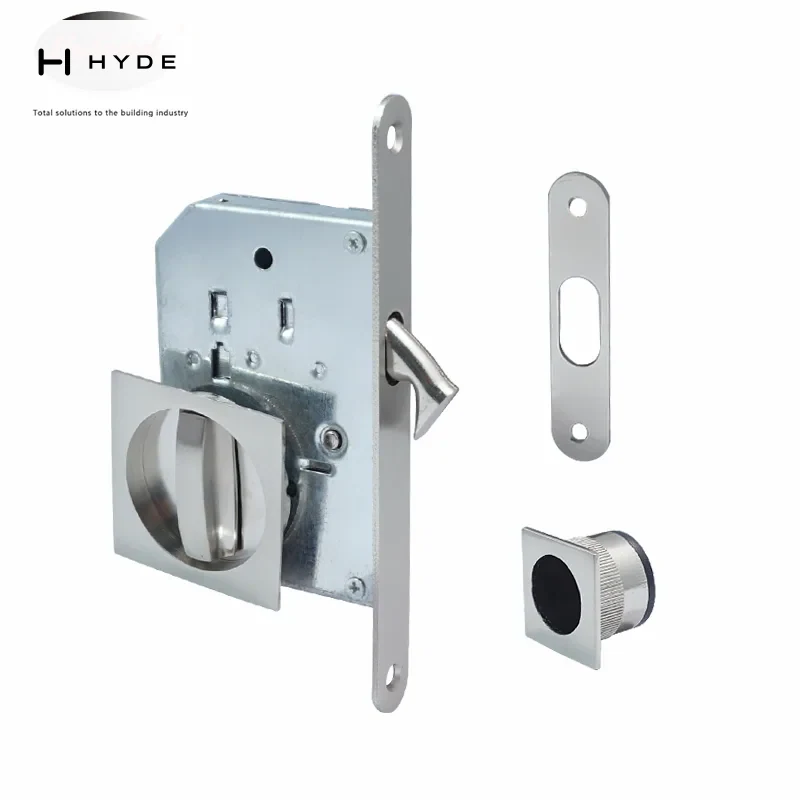
Timber and board interior doors, pocket doors in particular, take the kit: a compact mortise case with the hook bolt, a strike, and a pair of flush pulls carrying the key on one face and the turn on the other. Our 881 SS and S02 CP sliding hook locks are kits of this kind, both in zinc alloy and both listed in SS, AC, AB and BN finishes. The 881 SS kit, as photographed, holds a black lock case with a satin faceplate, a strike, two rectangular flush pulls (one with a key cylinder, one with a turn), keys and screws. The S02 CP is photographed with its case, a strike, square flush pulls and a small round flush pull of the kind set into the leading edge of a pocket door, so the leaf can be drawn back out of its cavity.
Each of those two records publishes a single length, 160mm for 881 SS and 100mm for S02 CP, and they are not the same measurement. On our catalog drawings the 160mm is the length of the 881 SS pull plates, and the 100mm is the height of the S02 CP lock case. Compare like with like before choosing between them. Neither record publishes a backset or a door-thickness range, so ask for the dimensioned drawing and check it against the actual leaf before ordering.
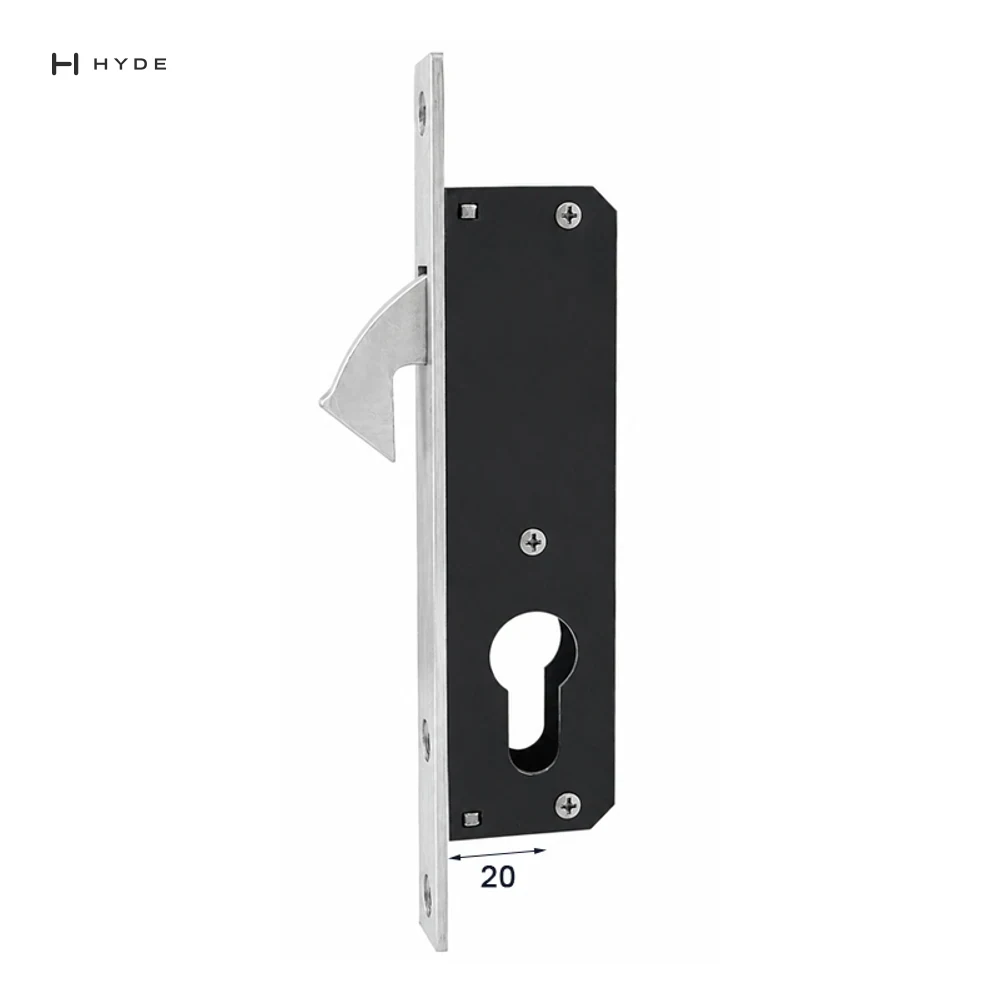
Aluminum profile doors take a narrow-stile case. LC15 is a narrow-stile lock case with a hook bolt, a 20mm backset and a euro cylinder hole; its full specifications are still being confirmed with the factory, so its case and faceplate dimensions are not published yet. HY006DK is a mortise lock case for aluminum narrow-stile doors, with an iron body, an electroplated finish and an American-style brass cylinder, and it is offered in four bolt configurations: double hook, single hook, double flat and single flat.
Hook or flat, and why the strike matters as much as the bolt
Those four HY006DK configurations are the real decision on a profile door, and the first half of it follows from the top of this article. On a swing door in an aluminum system a flat bolt is enough, because the door moves across the bolt. On a sliding leaf in the same system only the hook holds. So the first question on a profile-door order is not the finish; it is whether this leaf swings or slides, and the answer picks the hook or the flat version of the same case. The record names single and double versions of each without describing the difference further, so state which one you want and ask for its drawing.
The strike and the hook are a matched pair. The lip the hook catches has to sit on the side the hook swings toward, and it has to be deep enough for the hook to get behind it. A strike taken from another lock can look right and leave the hook closing on nothing, which is why a sliding door lock should be ordered with its own strike rather than fitted to whatever is already on the jamb.
AR4-1121: a hook-bolt deadlock with its dimensions published
AR4-1121 is a key-operated hook-bolt deadlock from our AR-4 collection of mortise lock bodies, which is configured for the Argentine market. Its record gives a 40mm backset, a 140 × 25mm faceplate, an 82.4 × 66.7mm case, a nickel-plated iron hook bolt, and keys in zinc alloy or brass, two to a lock; the photograph shows a bit key. The record does not name a door type. With the case size and backset published, it can be checked against a stile on paper before anything is ordered, which is the check every lock in this article should get.
A security door for a sliding patio door: what the lock can and cannot do
The question often arrives as: what makes a sliding patio door secure? The hook-bolt lock is one part of the answer, and it covers one kind of attack: pulling the leaf sideways out of its strike. A sliding leaf has two other weaknesses that no lock in its edge addresses. It runs on a track, so a leaf that can be lifted high enough comes off the track altogether, lock and all; anti-lift blocks or screws in the head track, set so the leaf cannot rise off its rollers, deal with that. And on a patio door most of the leaf is glass.
Large patio sliders from window and door system makers often lock at several hook points along the leading stile, all driven by one handle, rather than with a single mortise case. Our hook-bolt cases are single-point locks, and we do not publish a multi-point sliding system.
Burglar-resistance classes, such as the RC classes of EN 1627 in Europe, are given to a tested, complete door set: leaf, frame, glazing, fixings and hardware together. A lock on its own does not carry such a class, and none of the locks named here is claimed to.
What to send with a sliding-door lock inquiry
Scroll sideways to compare columns. Select a column heading to sort; select it three times to restore source order.
| Door type: pocket, surface slider or aluminum profile slider | It chooses between a kit (881 SS, S02 CP) and a narrow-stile case (LC15, HY006DK) |
|---|---|
| Leaf thickness and material | The case and the flush pulls have to fit inside the leaf; neither kit record publishes a door-thickness range |
| Stile width and backset, on a profile door | The extrusion fixes the backset; LC15 is 20mm, AR4-1121 is 40mm |
| Cylinder | LC15 takes a euro cylinder, HY006DK an American-style brass cylinder; the kits carry the key in the pull |
| Hook or flat, single or double | HY006DK is offered in all four; a sliding leaf needs the hook |
| Finish | 881 SS and S02 CP are listed in SS, AC, AB and BN; one finish for every part on the door |
6 rows · Source order
Fitting faults that look like a faulty lock
Three faults account for most sliding hook locks reported as not locking, and none of them is in the lock. The strike is fixed slightly off line, so the hook swings into the space beside the lip instead of behind it; move the strike, not the lock. The case is thicker than the leaf really allows, so it binds when its screws are tightened and the hook drags or stops short. And the recess for a flush pull is cut too deep and breaks through the face of the leaf, which cannot be repaired invisibly.
The short version: on a sliding door, specify a hook bolt, the strike made for it, flush pulls and anti-lift in the track. On an aluminum profile door, choose hook or flat by whether the leaf slides or swings, and send the stile and backset with the inquiry rather than after it.
Questions this answers
What is a Hakenriegelschloss?
Hakenriegelschloss is the German name for a hook-bolt lock: a mortise lock whose bolt (the Hakenriegel) swings out on a pivot and hooks behind the lip of the strike instead of projecting straight into it. It is the standard lock for a sliding door (Schiebetür), because a sliding leaf opens along the same line a straight bolt projects and would simply pull the bolt back out of its strike.
Why do sliding doors use a hook lock instead of a normal latch?
A swing door moves across its bolt, so a straight bolt or a spring latch is caught by the strike. A sliding door moves along the bolt's own line, away from the jamb, so a straight bolt or latch slides back out of the strike with nothing to stop it. The hook turns the bolt through a right angle so that pulling the door open drives the hook against the back of the strike.
Is a hook lock enough to secure a sliding patio door?
It covers one attack, pulling the leaf sideways out of its strike. A sliding leaf can also be lifted off its track, which anti-lift blocks or screws in the head track prevent, and a patio door is mostly glass. Burglar-resistance classes such as the RC classes of EN 1627 are given to a tested complete door set, not to a lock on its own.
Where is a sliding door hook lock installed?
In the leading edge of the leaf, the edge that meets the jamb when the door is closed, with the strike fixed to that jamb facing it. The key and turn are built into flush pulls set level with the face of the leaf, normally key outside and turn inside, because a projecting handle would catch on the wall or the pocket cavity.
Related products
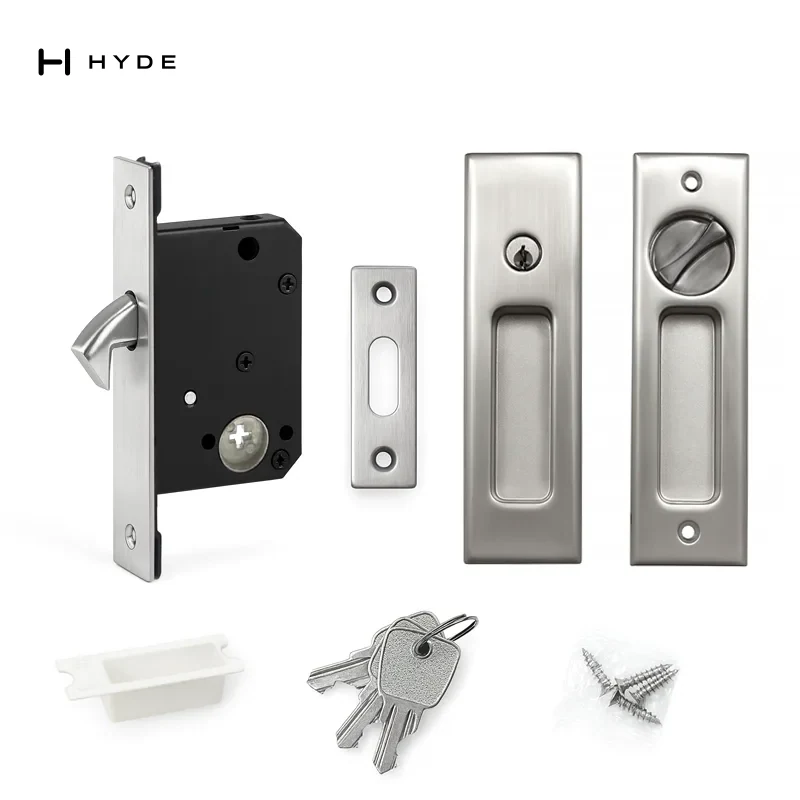
Length 160mm
Sliding Hook Lock
Model 881 SS · Video
Zinc Alloy
Length 100mm
Sliding Hook Lock
Model S02 CP · Video
Zinc Alloy
Lock Case
Model LC15
About Canton Hyland — Canton Hyland manufactures panic exit devices, locks and architectural door hardware for commercial and institutional projects, supplying specifiers and distributors internationally.