
Occupied or Vacant: What a Washroom Indicator Actually Has to Do
An indicator bolt is a lock and a sign in one part, and the sign is the half that gets specified badly. It has to be readable from standing distance, it has to be releasable from outside in an emergency, and on a public washroom it has to survive being operated several hundred times a day by people who are not being careful.
Insight
Johnson LiuDigital Communications, Canton HylandMA Digital Media, Johns Hopkins University
Products mentioned
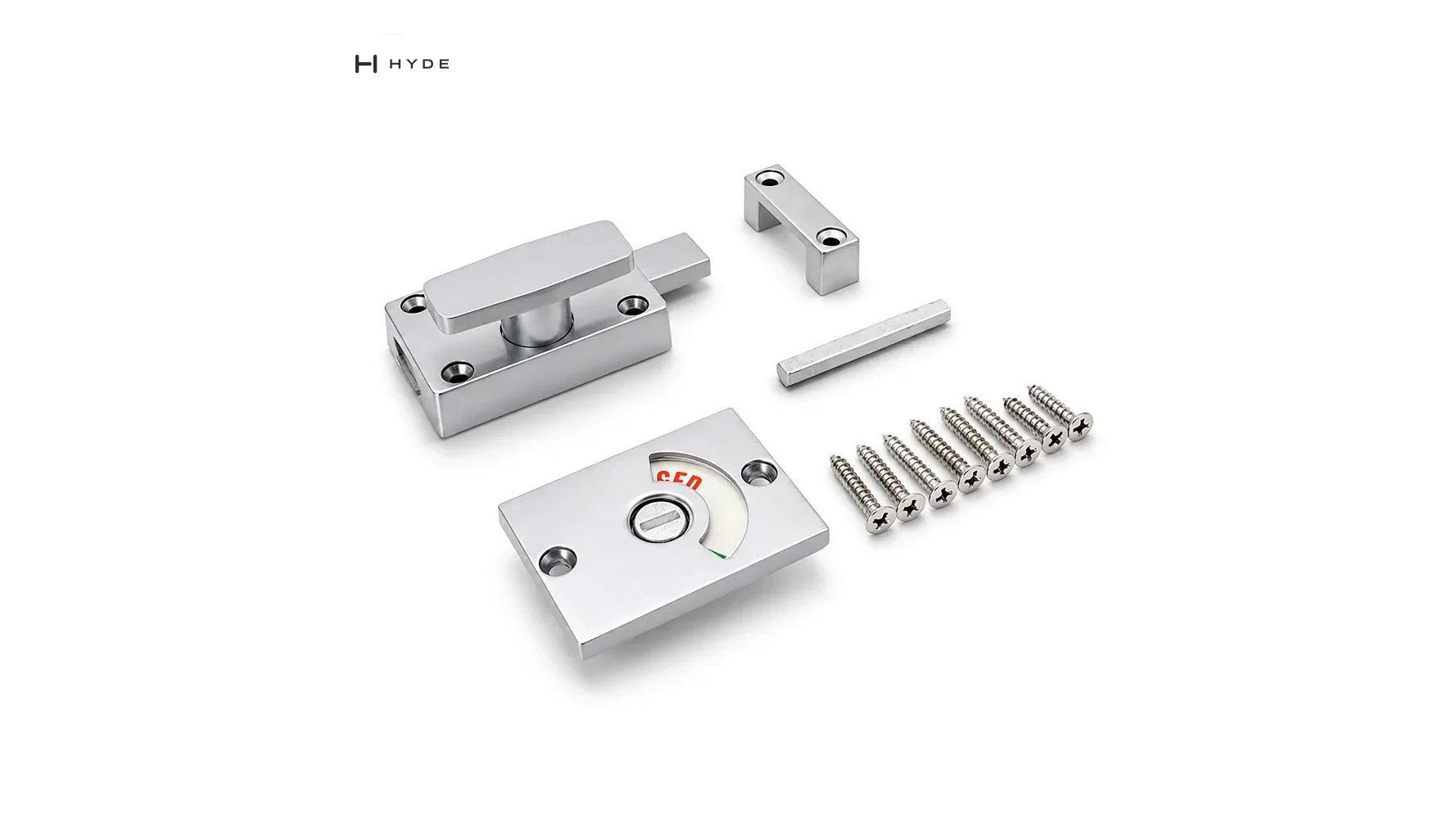
An indicator bolt is the part on a toilet cubicle door that both locks it and tells you it is locked. That is two jobs in one casting, and the two are specified by different people: the ironmonger buys the bolt, and the person who complains about it is whoever could not tell from six feet away whether the cubicle was free. The second job is the one that decides whether the product was a good choice.
Mechanically it is a slide bolt. Turning the inside knob drives a bolt into a keep on the frame and simultaneously rotates a coloured element behind a window on the outside face, so the state of the lock and the state of the sign cannot disagree. That is the whole design argument for an indicator over a plain bolt plus a sign: a separate sign can be wrong, and this one cannot, because it is the same movement.
The feature that matters most is the one nobody looks at in the catalogue photograph: the emergency release. A cubicle door has to be openable from outside by a member of staff, without a key, when somebody inside cannot open it. On a well-made indicator that is a coin-slot or a screwdriver slot in the outside face which overrides the bolt. If you are comparing two indicators and only one states an override, you are comparing a washroom fitting with something that will eventually require the door to be taken off.
The word to search for, and the reason this article exists, is that different markets call it different things. Indicator bolt, indicator lock, occupied-vacant bolt, vacant-engaged bolt, washroom turn, and in a specification often just "privacy set with indicator". They describe the same part. Our own catalogue calls the category Indicator, and lists the function on the 200 as "Vacant & Occupied Indicator" with the structure named plainly as a slide bolt lock.
Our 200 is zinc alloy, surface mounted, in a satin or plated finish, and it is scheduled for toilet cubicle doors, restroom doors, hotels, offices, hospitals and public washrooms. Surface mounted matters more than it sounds: it means the door needs no mortise and no through-preparation beyond the fixings, so an indicator can be retrofitted to a cubicle that already exists, which is most of them.
The 400 and the 500 are the same idea in different metals. The 400 is zinc alloy. The 500 is stainless steel, and it is the one to specify where the washroom is cleaned with anything aggressive or where the building is coastal — a zinc casting with a plated finish and a stainless part are not the same product after two years of that. The 500 is also the one that carries a full finish range: antique brass, antique copper, polished brass, satin brass, stainless steel, bright polished, satin chrome and satin nickel.
Two things we do not state, and they are the two most likely to matter on a public building. We do not publish a cycle-test figure for these, so if your specification calls for a tested bolt at a stated number of operations, ask before you quote rather than assume. And we do not publish a door-thickness range on the 200 the way we do on our night latches. Both are questions for our factory rather than answers we are willing to estimate, and both are on the list.
For a straightforward commercial washroom the honest answer is that the indicator is rarely the expensive decision and often the visible one. Get the override, get the metal right for the cleaning regime, and check that the window reads from the far end of the room rather than from arm's length — a window that is technically two-state and practically unreadable is the most common complaint about this product category, and it is never a manufacturing defect.
About Canton Hyland — Canton Hyland manufactures panic exit devices, locks and architectural door hardware for commercial and institutional projects, supplying specifiers and distributors internationally.