
Occupied or Vacant: What a Washroom Indicator Actually Has to Do
An indicator bolt is a lock and a sign in one part, and the sign is the half that gets specified badly. It has to be readable from standing distance, it has to be releasable from outside in an emergency, and on a public washroom it has to survive being operated several hundred times a day by people who are not being careful.
Insight
Johnson LiuDigital Communications, Canton HylandMA Digital Media, Johns Hopkins University
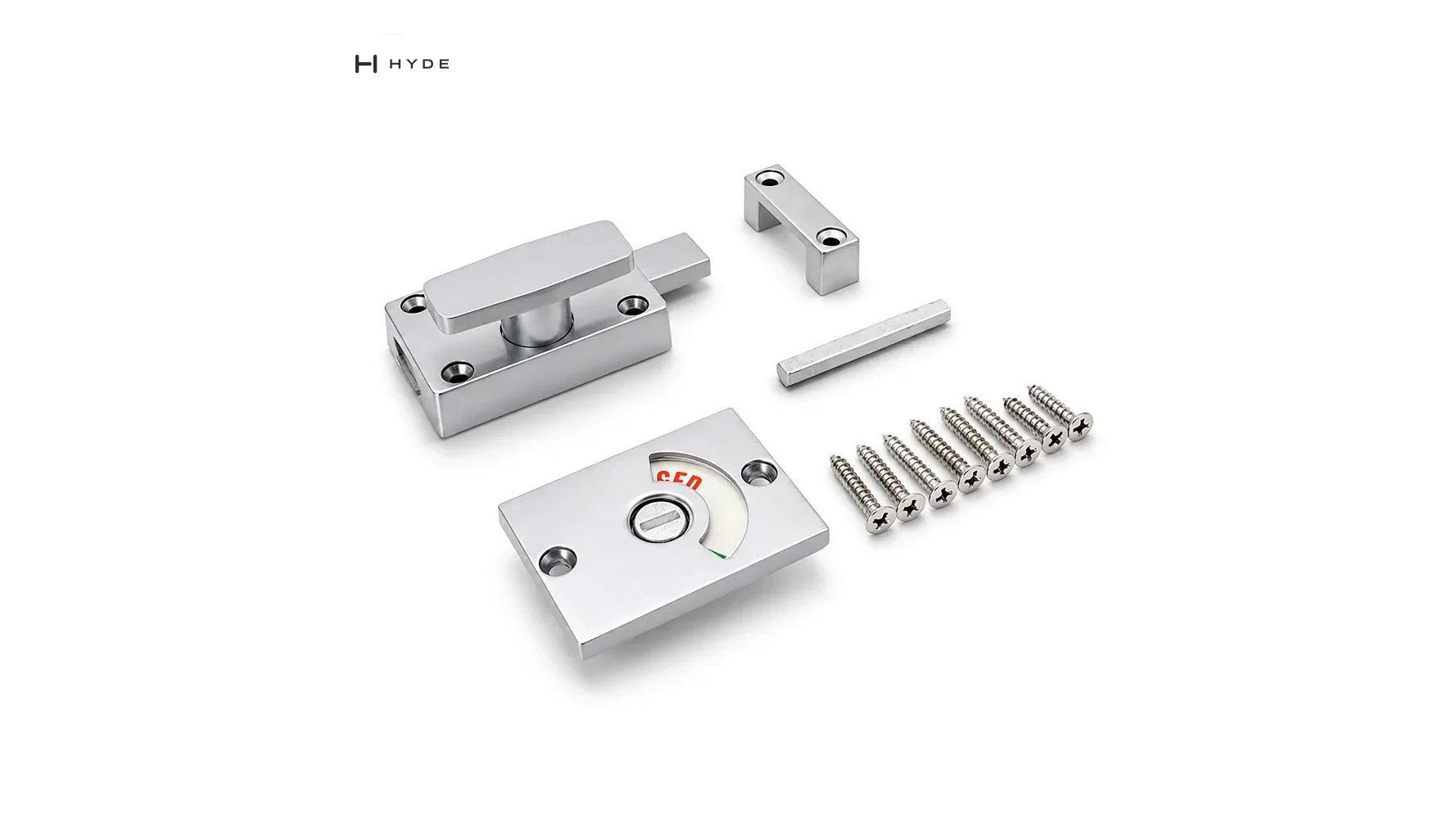
An indicator bolt is the part on a toilet cubicle door that both locks it and tells you it is locked. That is two jobs in one casting, and the two are specified by different people: the ironmonger buys the bolt, and the person who complains about it is whoever could not tell from six feet away whether the cubicle was free. The second job is the one that decides whether the product was a good choice.
Mechanically it is a slide bolt. Turning the inside knob drives a bolt into a keep on the frame and simultaneously rotates a colored element behind a window on the outside face, so the state of the lock and the state of the sign cannot disagree. That is the whole design argument for an indicator over a plain bolt plus a sign: a separate sign can be wrong, and this one cannot, because it is the same movement.
The feature that matters most is the one nobody looks at in the catalog photograph: the emergency release. A cubicle door has to be openable from outside by a member of staff, without a key, when somebody inside cannot open it. On a well-made indicator that is a coin-slot or a screwdriver slot in the outside face which overrides the bolt. If you are comparing two indicators and only one states an override, you are comparing a washroom fitting with something that will eventually require the door to be taken off.
The word to search for, and the reason this article exists, is that different markets call it different things. Indicator bolt, indicator lock, occupied-vacant bolt, vacant-engaged bolt, washroom turn, and in a specification often just "privacy set with indicator". They describe the same part. Our own catalog calls the category Indicator, and lists the function on the 200 as "Vacant & Occupied Indicator" with the structure named plainly as a slide bolt lock.
Our 200 is zinc alloy, surface mounted, in a satin or plated finish, and it is scheduled for toilet cubicle doors, restroom doors, hotels, offices, hospitals and public washrooms. Surface mounted matters more than it sounds: it means the door needs no mortise and no through-preparation beyond the fixings, so an indicator can be retrofitted to a cubicle that already exists, which is most of them.
The 400 and the 500 are the same idea in different metals. The 400 is zinc alloy. The 500 is stainless steel, and it is the one to specify where the washroom is cleaned with anything aggressive or where the building is coastal, a zinc casting with a plated finish and a stainless part are not the same product after two years of that. The 500 is also the one that carries a full finish range: antique brass, antique copper, polished brass, satin brass, stainless steel, bright polished, satin chrome and satin nickel.
Two things we do not state, and they are the two most likely to matter on a public building. We do not publish a cycle-test figure for these, so if your specification calls for a tested bolt at a stated number of operations, ask before you quote rather than assume. And we do not publish a door-thickness range on the 200 the way we do on our night latches. Both are questions for our factory rather than answers we are willing to estimate, and both are on the list.
For a straightforward commercial washroom the honest answer is that the indicator is rarely the expensive decision and often the visible one. Get the override, get the metal right for the cleaning regime, and check that the window reads from the far end of the room rather than from arm's length, a window that is technically two-state and practically unreadable is the most common complaint about this product category, and it is never a manufacturing defect.
Surface indicator or indicator on a bathroom lock
There are two ways to get an occupied-vacant sign onto a washroom door, and they suit different doors. The first is the one described above: a surface-mounted indicator bolt, like our 200, 400 and 500, which is its own lock and needs no preparation beyond its fixings. It belongs on cubicle doors and on existing doors being upgraded.
The second is an indicator turn fitted to a bathroom lock: a mortise or tubular privacy lock whose inside turn operates the bolt, with an indicator on the outside in place of a plain emergency release. That arrangement belongs on a full-height washroom door in a hotel, an office or a hospital, where the door already has a lever set and a lock case and a separate slide bolt would look like an afterthought. Our cylindrical locks with the BK (privacy) function are the starting point for that route, and the indicator is then a matter of the matching outside trim.
The choice follows the door rather than the budget. A cubicle partition does not take a lock case; a solid washroom door with a lever set usually should not carry a surface bolt as well.
Reading the indicator from the far end of the room
The complaint about unreadable windows comes from three things, and each can be specified. Size: the window has to be large enough to read at the distance people actually decide from: the entrance of the washroom, not the cubicle door. Contrast: red and green are the convention, but a significant share of people cannot easily tell them apart, so an indicator that also shows a word or a symbol is more legible than color alone. Wording and language: "occupied" and "vacant" in the local language, or a symbol that needs no language, matters in an airport or a hotel far more than in an office where everyone knows the building.
None of those is a manufacturing claim we can make about the 200, 400 or 500 from the records, which publish the metal, the finish and the mounting but not the window size or the legend. Ask for a photograph of the outside face at actual size, and hold it up at the distance people will read it from. It is the cheapest test in this article.
Accessible washrooms
An accessible toilet puts extra demands on the same small part. The inside control has to be operable by someone with limited grip or strength (a large turn or a lever rather than a small knob) and the emergency release outside matters more, not less, because the person inside is more likely to need help. Accessibility codes differ by country on the details, so treat the local code as the specification and the product page as the starting point, and confirm the inside control shape before ordering for an accessible cubicle.
What to write on the order
For an indicator, the useful order line is short: the door type (cubicle partition or full door), the metal chosen for the cleaning regime, the finish, whether an emergency release from outside is required (it almost always is) and whether the cubicle is accessible. Our 500 is published in eight finishes, from antique brass to satin nickel, and in stainless steel; the 200 and 400 in zinc alloy. If your specification also calls for a cycle figure or a panel-thickness range, say so at inquiry: as noted above, those are not published on these records, and we would rather ask the factory than estimate them.
The keep, and why cubicle bolts stop working
An indicator bolt fails in use far more often at the keep than in the bolt. The keep is the part on the partition or pilaster that the bolt slides into, and on a cubicle it is screwed into a panel that is thinner and softer than a door frame. Two things go wrong. The first is sag: cubicle doors are hung on light hinges and used hard, and after a few months the door drops a few millimeters, the bolt no longer lines up with the keep, and people slam the door or force the knob to make it engage, which is when the knob breaks and the complaint arrives about the indicator. The second is fixing: screws driven into the edge of a laminate or chipboard panel pull out long before screws into timber would.
Both are installation matters rather than product defects, and both are cheaper to prevent than to repair. Check the hinge and door alignment at handover, so the bolt meets the keep without effort. Use fixings made for the panel material (through-bolts or inserts where the panel allows) rather than wood screws into an edge. And if a washroom has a history of broken indicators, look at how far the bolt is traveling into the keep before blaming the bolt.
Replacing indicators in an existing washroom
Most indicator orders are replacements, and the surface-mounted design is what makes them easy, with one catch. The new bolt and keep will rarely have exactly the same fixing-hole positions as the old ones, so the new holes land close to the old ones, and a panel that is already worn around its screw holes may not hold a second set nearby. Before ordering replacements for a whole washroom, take one old indicator off and look at the panel behind it. If the fixing holes are sound, a like-for-like surface indicator is a ten-minute job per door. If they are not, the answer may be a cover plate, a repair to the panel, or a model whose fixings fall on fresh material.
It is also the moment to fix the problems the old ones had. If they were unreadable, choose on legibility. If they corroded, change the metal: the 500 in stainless steel rather than a plated zinc casting in a washroom cleaned with anything aggressive. If staff could not open them in an emergency, make the outside release the first row of the order, not the last.
Questions this answers
What is an indicator bolt?
A slide bolt that locks a toilet cubicle door and shows that it is locked. Turning the inside knob drives a bolt into a keep on the frame and simultaneously rotates a colored element behind a window on the outside face, so the state of the lock and the state of the sign cannot disagree.
What is the most important feature on a washroom indicator?
The emergency release, which almost nobody checks in the catalog photograph. A cubicle door has to be openable from outside by a member of staff, without a key, when somebody inside cannot open it, on a well-made indicator that is a coin or screwdriver slot in the outside face which overrides the bolt.
Which indicator should be specified for an aggressive cleaning regime?
The stainless steel one. A zinc casting with a plated finish and a stainless part are not the same product after two years of harsh cleaning or a coastal building.
Should a washroom use a surface indicator bolt or an indicator on a bathroom lock?
It follows the door. A surface-mounted indicator bolt such as our 200, 400 or 500 is its own lock and needs no preparation beyond its fixings, so it suits cubicle partitions and existing doors. A full-height washroom door with a lever set and lock case is better served by a privacy lock whose inside turn works the bolt, with an indicator on the outside trim. A cubicle does not take a lock case, and a solid door with a lever set usually should not also carry a surface bolt.
How do I make sure a washroom indicator is readable?
Check size, contrast and wording at the distance people decide from: the washroom entrance, not the cubicle door. Red and green alone are hard for many people to distinguish, so a word or symbol as well is more legible. Our records do not publish window size or legend for the 200, 400 or 500, so ask for a photograph of the outside face at actual size and test it at reading distance before ordering.
What does an accessible toilet need from an indicator?
An inside control that someone with limited grip can operate (a large turn or lever rather than a small knob) and a reliable emergency release outside, which matters more because the person inside is more likely to need help. Details differ by country, so the local accessibility code is the specification; confirm the inside control shape before ordering for an accessible cubicle.
Canton Hylandについて — 商業施設・公共施設のプロジェクト向けに、パニックデバイス、錠前、建築用ドア金物を製造し、世界各地の設計者と販売代理店に供給しています。