
Cross-Referencing a Lock You Already Buy
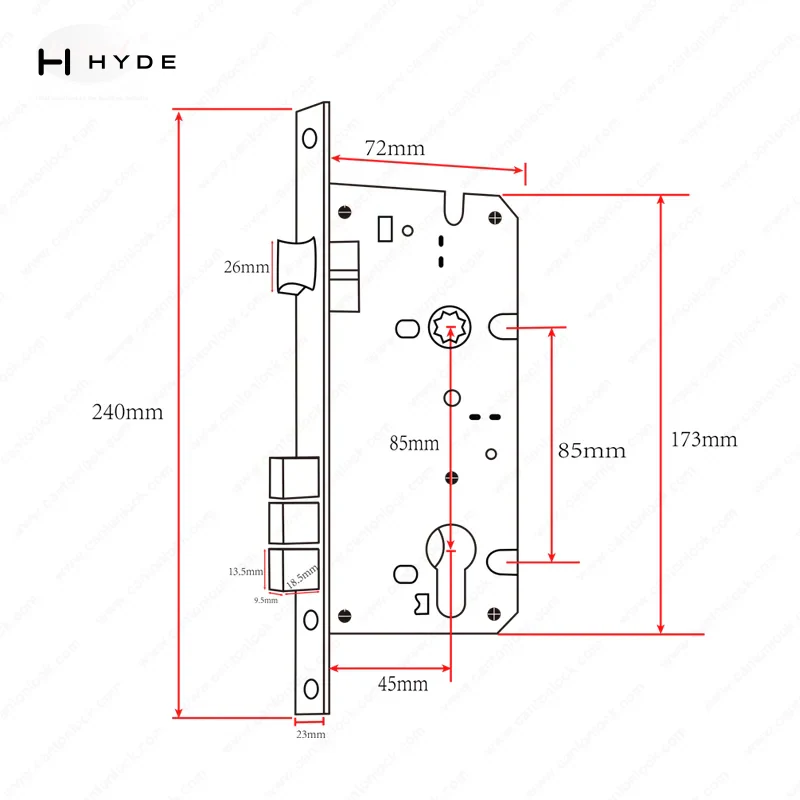
To reorder somebody else's lock, match 6 dimensions, not the model number. For a mortise lock they are backset, center distance, faceplate length and width, case height and depth, spindle size (almost always 8mm square) and door thickness range. Our LC07 85×45mm, for example, has an 85mm center distance and a 45mm backset. Finish names and grade labels do not carry across factories; the dimensions do.

Johnson LiuDigital Communications, Canton HylandMA Digital Media, Johns Hopkins University

Many buyers who contact a hardware factory start from another company's model number. A rim lock from one brand, a concealed hinge from another, a latch code off a twenty-year-old carton, a part reference from a catalog that is out of print. They have a part that works, the supplier is gone or slow or expensive, and they need to know what to order to get the same thing again.
HYDE (Canton Hyland, Zhongshan, since 1998) makes the LC07 85×45mm, 5681 and SSH017 covered in this article.
It is a good question and it has a precise answer, which is that a lock is defined by its geometry and not by its name. Two locks with the same six numbers are interchangeable regardless of what either is called. Two locks with the same name and one different number are not.
For a mortise lock, those six are: backset, from the face of the door to the center of the spindle; center distance, between the spindle and the cylinder or keyhole; faceplate length and width; case height and depth; spindle size, almost always 8mm (5/16") square but worth confirming; and door thickness range. Get those six and the substitution works. Miss the center distance and the handle and the cylinder will not both line up with the holes already cut in the door, and the door is the thing you cannot change.
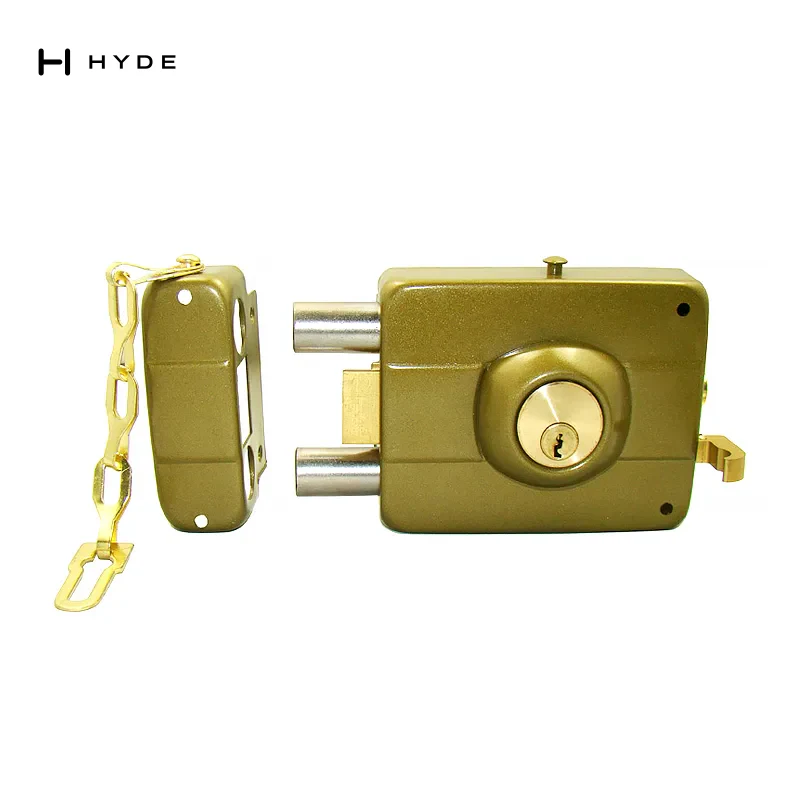
For a rim lock or night latch the list is shorter but the same in character: backset, case size, whether the cylinder is single or double, latch extension, and the strike type, because a rim strike and a rim deadbolt keeper are different castings and the frame is already prepared for one of them.
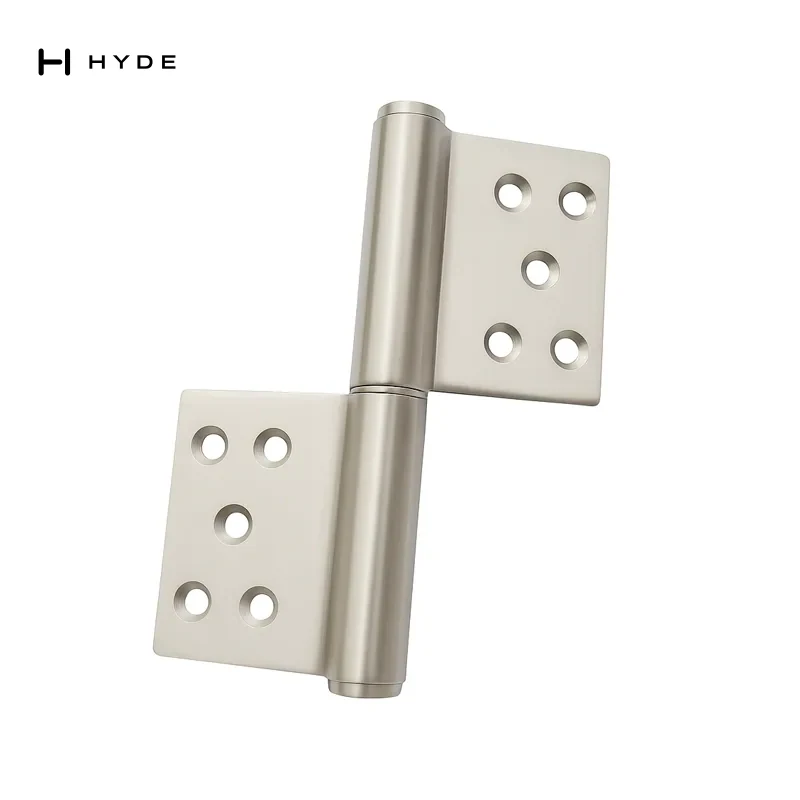
For a hinge: leaf height and width, knuckle count, pin type, and whether it is a fixed pin or loose. A hinge that is 3mm (1/8") taller than the mortise already routed into the frame is a hinge that does not fit, and nothing about the finish or the grade changes that.
What does not carry across, and should be ignored when cross-referencing: the model number itself, the finish name, and the grade designation. Finish naming is not standardized between factories (one supplier's satin nickel is another's brushed nickel is another's SN) so match a finish by looking at a sample rather than by matching a word. Grade designations are standard-specific: an ANSI grade and an EN classification measure different things under different tests and neither translates into the other by arithmetic.
The practical route, and it is short. Measure the part you have, or photograph it beside a ruler with the faceplate visible. Send those numbers, the door thickness, and whether it is a left or right hand door. Our engineering desk will come back with the model that matches, or (and this is the part worth saying) with a straight answer that we do not make one. A near-miss recommended as an equivalent is how a container of unusable metal happens, and we would rather lose the line than send it.
One more thing, for anyone replacing a part in an existing building rather than specifying a new one: check the strike and the keep before you order the lock. In a retrofit the frame is the constraint, not the door, and the item that most often makes a substitution fail is not the lock body at all, it is the strike plate cutout, which was made for the old part and will not be remade.
What a complete set of numbers looks like
It helps to see the six mortise numbers written out for a real part, because it shows how little is needed and how exact it has to be. Our LC07 85×45mm publishes them like this: center distance 85mm (3-3/8"), backset 45mm (1-3/4"), faceplate 240 × 23mm (9-7/16" × 7/8"), case height 173mm (6-13/16"), case depth 72mm (2-13/16"), with a latch throw of 26mm (1") and a bolt projection of 18.5mm (3/4"). Measure your existing lock to that level of detail and a match (or a clear "we do not make one") is a single reply away.
Notice that the model name carries two of those numbers (85 and 45) and that this is common across the trade. It is a convenience, not a guarantee: a case named 85 × 45 by one factory can still differ from another's in faceplate length or case depth, which is exactly why the other four numbers matter.
Measuring a mortise lock you have removed
If the lock is out of the door, the measurements are quick and a steel rule is enough.
Backset: from the outer face of the faceplate to the center of the spindle hole. Measure to the face of the faceplate, not to the case behind it: the difference is the faceplate thickness, and it is enough to put a lever off-center on the door. Center distance: from the center of the spindle hole to the center of the cylinder hole or keyhole. Faceplate: overall length and width, and whether its ends are square or radiused, because a radiused faceplate goes into a routed recess that a square one will not fill. Case: height and depth, measured on the case body. Spindle: across the flats of the square hole. Door thickness: from the door, at the lock position.
Then note the two things that are not dimensions but still decide the match: the latch direction (which way the bevel faces) and whether the lock has a deadbolt as well as a latch, and how far it throws.
Measuring a lock that is still in the door
Often the lock cannot come out until the replacement has arrived. In that case the faceplate length and width, the backset (from the door edge to the spindle center) and the center distance (spindle to cylinder, measured on the door face) can all be taken with the lock in place, and they are the four that matter most. Case height and depth can usually be inferred from the faceplate and the door, but say that they are inferred rather than measured, so the engineer answering knows which numbers are certain.
Photographs that actually help
A photograph is a good substitute for a measurement only if it is taken to be measured from. Photograph each face square-on, not at an angle, with a ruler lying in the same plane as the part (against the faceplate, not in front of it). Include one photograph of the faceplate end-on, one of the case side with any markings, and one of the strike on the frame. Markings stamped into a case or a faceplate are often the fastest route to an identification, so make sure they are legible. If there is no ruler to hand, a coin or a bank card of known size in the same plane is far better than nothing.
When a near-miss can still work
Not every mismatch is fatal, and it is worth knowing which ones sometimes can be managed and which never can. A faceplate slightly shorter than the old recess can sometimes be covered with a packing or cover plate. A case slightly shallower than the old pocket can usually go into it. A different center distance or backset cannot be managed: the holes through the door are already drilled, and a lever or cylinder in the wrong place is visible on both faces for the life of the door.
So if a reply says "this one fits except for the faceplate", it is worth a conversation. If it says "this one fits except for the center distance", it does not fit.
Cross-referencing the parts around the lock
The same principle (geometry first, names ignored) works for the other parts people most often need to replace, but each has its own short list.
A euro cylinder is matched by profile, overall length and split: a 70mm cylinder can be 35/35 or 30/40, and those are different parts. Then the cam, and whether it is a double cylinder, a key-and-thumbturn or a half cylinder. Our articles on euro cylinder length and split, and on our 45-to-90 range, go through the details.
A pull handle is matched by center distance first (the distance between its fixing points) because only that decides whether the new handle uses the existing holes. Overall length, grip diameter and projection come next, and on a glass door the hole size in the glass, which cannot be changed.
A hinge, as above, by leaf height and width, knuckle count and pin, and on a replacement by the exact size of the recess already routed into the frame.
A door closer is the part where a like-for-like is least likely by name alone: match the fixing centers on the door and frame, the arm type, and the closing power for the leaf, and expect that a closer from a different maker will usually need a new fixing plate rather than dropping onto the old holes.
In every case, the photographs and measurements described above are what turns a part number we do not recognize into a part we can match, or into a straight answer that we do not make it.
The short version, for any part: measure it, photograph it square-on beside a ruler, note the door it came from, and send all three together. A name alone gets a guess. Numbers and pictures get a match, or an honest no, which is worth almost as much, because it sends you to the right supplier the same day instead of after a container has landed.
Questions this answers
How do you find an equivalent for a lock you already buy?
By geometry, not by name. A lock is defined by its dimensions rather than its model number: two locks with the same six numbers are interchangeable regardless of what either is called, and two locks with the same name and one different number are not. Measure the part you have, or photograph it beside a ruler with the faceplate visible, and send those numbers with the door thickness and the handing.
Which dimensions have to match on a mortise lock?
Six. Backset, from the face of the door to the center of the spindle; center distance, between the spindle and the cylinder or keyhole; faceplate length and width; case height and depth; spindle size, almost always 8mm (5/16") square but worth confirming; and door thickness range. Miss the center distance and the handle and the cylinder will not both line up with the holes already cut in the door, and the door is the thing you cannot change.
What should be ignored when cross-referencing?
The model number itself, the finish name and the grade designation. Finish naming is not standardized between factories (one supplier's satin nickel is another's brushed nickel is another's SN) so match a finish against a sample rather than a word. Grade designations are standard-specific: an ANSI grade and an EN classification measure different things under different tests, and neither translates into the other by arithmetic.
What most often makes a replacement fail on a retrofit?
Not the lock body, the strike plate cutout, which was made for the old part and will not be remade. In a retrofit the frame is the constraint rather than the door, so check the strike and the keep before you order the lock. On a rim lock the same applies to the strike type, because a rim strike and a rim deadbolt keeper are different castings and the frame is already prepared for one of them.
How do I measure a mortise lock for a replacement?
With the lock removed, measure the backset from the outer face of the faceplate to the spindle center, the center distance from spindle center to cylinder center, the faceplate length and width (and whether its ends are square or radiused), the case height and depth, the spindle across its flats, and the door thickness at the lock. Note which way the latch bevel faces and whether there is a deadbolt. Our LC07 85×45mm shows a complete set: 85mm center, 45mm backset, 240 × 23mm faceplate, 173 × 72mm case.
Which differences make a replacement lock unusable?
A different backset or center distance, because the holes through the door are already drilled and a lever or cylinder in the wrong place cannot be hidden. A slightly shorter faceplate can sometimes be covered, and a slightly shallower case can usually go into the old pocket. If a replacement fits except for the faceplate, it is worth discussing; if it fits except for the center distance, it does not fit.
Related products
Backset 45mm
Lock Case
Model LC07 85×45mm
Backset 60mm
Night Latch And Rim Lock
Model 5681
Iron case, with 3 pcs brass keys , brass latch.
Size 4"x3"x2.5mm
Brass and Steel Hinges
Model SSH017
Stainless Steel
About Canton Hyland — Canton Hyland manufactures panic exit devices, locks and architectural door hardware for commercial and institutional projects, supplying specifiers and distributors internationally.