
Patch Fittings or a Framed Glass Door 2026: Where the Hardware Fixes, and What Changes Model by Model
Patch fittings clamp the glass itself; a framed glass door puts every piece of hardware in the frame. Floor springs, closers, locks and glass thickness compared with our own models on both sides.

Johnson LiuDigital Communications, Canton HylandMA Digital Media, Johns Hopkins University
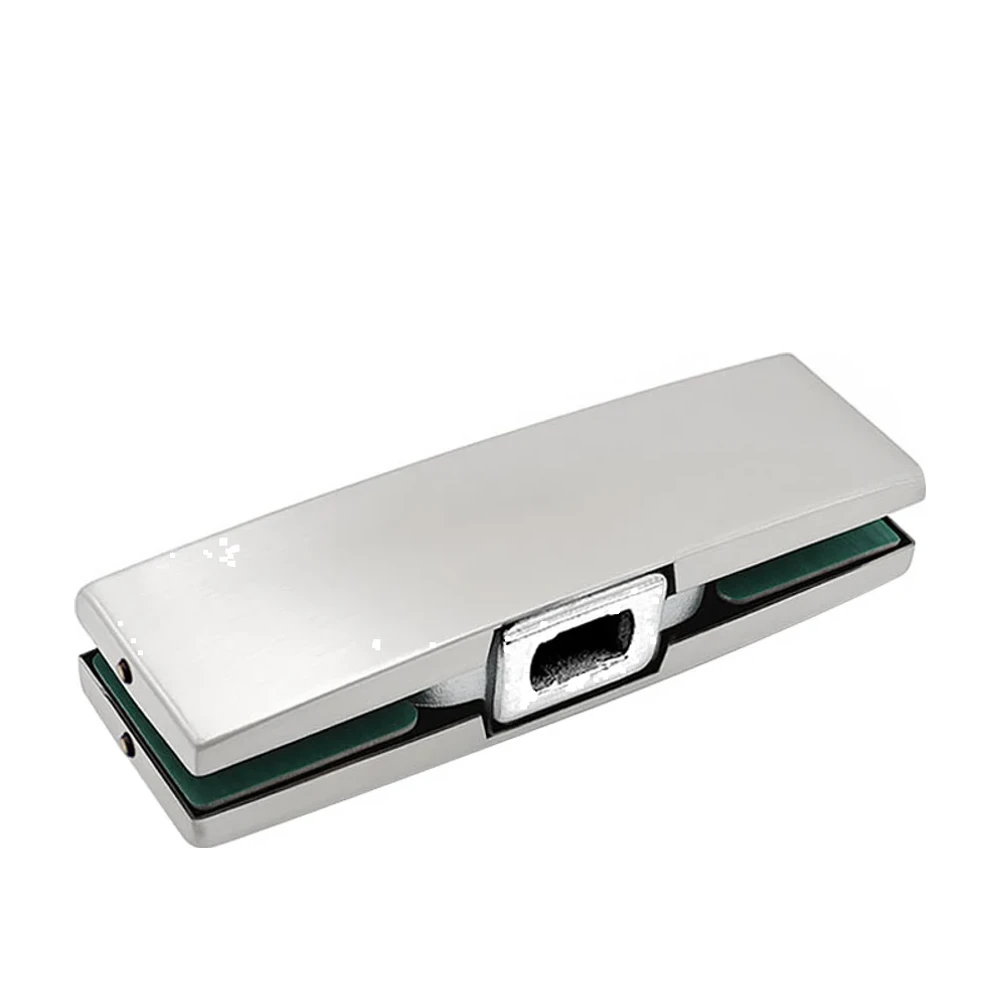
Short answer: choose patch fittings when the door is a single sheet of toughened glass with nothing around it, and a framed glass door when the glass sits in an aluminum or steel frame. The difference that matters is where the hardware fixes. Patch fittings clamp the glass itself, so every fitting needs its cut-out on the glass drawing before toughening and nothing can be added afterwards. On a framed door the lock, the hinges or pivots and the closer fix to the frame, and the glass carries no hardware at all.
Scroll sideways to compare columns. Select a column heading to sort; select it three times to restore source order.
| What holds the glass | The fittings themselves, clamped to the glass | The frame; the hardware fixes to the frame |
|---|---|---|
| Floor spring | Listed by glass thickness: D-1031, D-1051, DZ-2031 (10 to 14 mm), D-3015, D-3016 (8 to 12 mm); leaves of 60 to 200 kg | Listed by door thickness: D-1032, D-1033 (from 42 mm), D-5061 (from 40 mm), D-1067, D-3001 (from 60 mm); up to 600 kg on D-3001 |
| Overhead closer | Not usable: there is no frame head to fix it to | JU-series, 15 to 85 kg across the range |
| Lock | A patch lock on the glass: F123, G130; for a pair, GL125 SS (8 to 10 mm glass) or 410 | A mortise lock case in the stile: AI8530 (30 mm backset), LC02 85×40, LC03 85×45 |
| Glass thickness | Our fittings are listed for 8 to 12 mm | Set by the frame system |
| Holes in the glass | Every fitting needs its cut-out before toughening | None for the hardware |
| Changing the hardware later | Limited to what the cut-outs allow | Lock and closer can be changed in the frame |
7 rows · Source order
HYDE (Canton Hyland, Zhongshan, since 1998) makes the F110, D-3015, AI8530 and LC03 85×45 covered in this article.
Where each one fits
Patch fittings suit an entrance that should read as glass and nothing else: a shopfront, a lobby, an office reception. The leaf runs on a floor spring, the fittings sit in its corners, and the opening has no frame head. The cost of that look is commitment: the glass processor cuts every notch and hole from the hardware drawing, toughening fixes them, and a lock that was not on the drawing cannot be added without new glass.
A framed glass door suits openings that have to behave like ordinary doors: a mortise lock with a cylinder, an overhead closer, a door that may later be rekeyed or have its glass replaced. The frame takes the screws and the lock case, so the hardware can be chosen, changed and serviced the way it is on any metal door.
The floor spring is in both, but not the same one
Our floor springs are listed in two ways, and the listing tells you which door each was built for. The models for frameless glass state a glass thickness: D-1031, D-1051 and DZ-2031 for 10 to 14 mm glass, D-3015 and D-3016 for 8 to 12 mm, carrying leaves of 60 to 200 kg between them. The models for framed doors state a minimum door thickness instead: D-1032 and D-1033 from 42 mm, D-5061 from 40 mm, D-1067 and D-3001 from 60 mm, with D-3001 carrying up to 600 kg. Order the one listed for your kind of door; the spindle and the fixing differ.
The lock decides more than the look
On a frameless door the lock is a patch body clamped to the glass, locking into a floor socket or the next panel: F123 and G130 for a single leaf, GL125 SS (which fits without drilling, for 8 to 10 mm glass) or 410 for a pair. On a framed door it is a mortise lock case set into the stile, and a narrow aluminum stile needs a short backset: AI8530 at 30 mm, LC02 85×40 at 40 mm and LC03 85×45 at 45 mm, all with an 85 mm center distance. Our article on why aluminum doors drop covers what the stile and the hinge side do to that lock over time.
What to send us
For patch fittings: the glass thickness, the leaf size and weight, whether there is glass above the door, and whether the door locks. For a framed door: the stile width, the backset, the door thickness, the leaf weight, and whether the closer goes overhead or in the floor. Either list fits in one email, and it is what turns a description into a parts list.
Questions this answers
What is the difference between patch fittings and a framed glass door?
Where the hardware fixes. Patch fittings clamp the toughened glass itself, so every fitting needs its cut-out before the glass is toughened. On a framed door the lock, hinges or pivots and closer fix to an aluminum or steel frame, and the glass carries no hardware.
Can a frameless glass door take an overhead closer?
Not as a rule: there is no frame head to fix it to. A frameless leaf runs on a floor spring, such as our D-1031, D-1051, D-3015, D-3016 or DZ-2031, which are listed by glass thickness.
■ End of guide. Updated .