
DS013 and DS011 Are Not the Same Kind of Thing
Somebody searched "door stopper ds013 vs ds011" and landed on us. It is a fair question and the answer is that only one of them is a door stopper, DS011 is a flush bolt, which does the opposite job. Here is how to tell three commonly confused items apart before they are on the order.

Johnson LiuDigital Communications, Canton HylandMA Digital Media, Johns Hopkins University
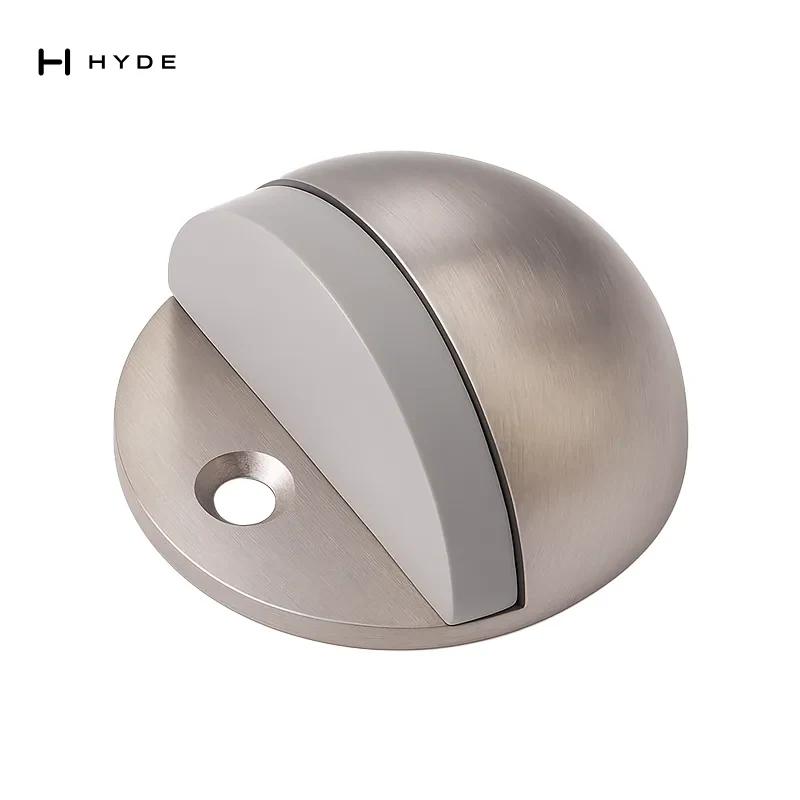

DS013 and DS011 are easy to take for a pair: the two model numbers sit one apart in our own catalog and look like siblings. They are not. DS013 is a door stopper. DS011 is a flush bolt. They are not variants of one product, they are two different products that happen to be numbered next to each other, and if the numbering misled somebody enough to make them search for a comparison then the honest thing is to publish the answer rather than let them work it out from a photograph.
HYDE (Canton Hyland, Zhongshan, since 1998) makes the DS013, DS011 and DS01 covered in this article.
A door stop takes an opening door and stops it before it hits something. That is the whole of the job. DS013 is a zinc alloy floor or wall stop measuring 110 × 66mm (2-5/8"), available in ten finishes. Its whole design problem is arresting a moving door without transmitting the shock into the fixing, which is why the working part is rubber and the metal exists to hold the rubber in the right place and survive being kicked.
A flush bolt is the opposite. It holds a leaf shut and still, and it is fitted into the edge of the door so nothing protrudes. DS011 is a brass flush bolt in nine finishes. On a pair of doors it is what keeps the inactive leaf from moving so the active leaf has something solid to latch against; without it a double door flexes and the lock never feels right no matter how good the lock is. Nothing about it stops a door swinging, that is not what it is for.
The third item in this family of confusions is a door holder, sometimes sold as a hold-open. It keeps a door open on purpose, which is not the same as stopping it. A stop is passive and takes an impact; a holder is active and resists a closing force, often a door closer's. Specifying a stop where a holder was wanted produces a door that closes every time somebody lets go of it, and the complaint that comes back is "the stopper does not work" when the stopper is working exactly as designed.
So the selection is a sequence of three questions, and none of them is about finish. What is the door doing wrong, swinging too far, drifting shut, or moving when it should be still? Where can you fix something, floor, wall, or the door edge? And what is the floor made of, because a stop fixed into 6mm (1/4") of tile over screed is a stop that will come out with the tile.
For stops specifically, projection is the number that decides whether it works, and it is the one most often left off an inquiry. Our range runs from low floor domes to tall wall stops: DS05 is a Ø44 × 24mm (15/16") floor dome, DS09 is 42mm (1-5/8") long, DS010 is a Ø42mm (1-5/8") dome, and DS01 is a stainless steel wall stop 96mm (3-3/4") high with a 70mm (2-3/4") projection on a 34mm (1-5/16") base. That 70mm (2-3/4") is not a styling choice, it is the distance between the wall and the point on the door that will hit it, and if the handle projects further than the stop does, the handle finds the wall first.
One consequence of that worth stating plainly: a door stop is selected against the handle, not against the door. Measure from the wall to the outermost point of the lever or knob when the door is open, and pick a stop at least that long. This is the single most common reason a stop is ordered, installed, and then replaced.
And on our own numbering: DS is not a product-type prefix here. It runs across stops (DS01, DS02, DS05, DS09, DS010, DS013, DS022) and it also carries DS011, which is a flush bolt. We would rather say so than let the sequence imply a family that does not exist. When you send an inquiry, name the job ("floor stop, 70mm projection, satin nickel") and the model number becomes a check rather than the whole specification.
Flush bolts: length is most of the specification
DS011 is one flush bolt; most of ours are numbered FB, and the question buyers search for (FB005, FB001) is almost always a question about length. A flush bolt on a pair of doors does two jobs, one at the top of the inactive leaf and one at the bottom, and the two are usually different lengths for a reason that has nothing to do with appearance: the top bolt has to be operated by someone standing on the floor.
So on a tall leaf the top bolt is long, to bring its lever down within reach, and the bottom bolt is short. That is why the range is published by length rather than as one part. The FB005 is brass in 6, 8, 10, 12 and 24 inch lengths (152, 203, 254, 305 and 610mm). The FB001 family is stainless steel or brass in 8, 10, 12 and 24 inch lengths, and the FB001 SS in 8 inches is published for doors 30–45mm (1-3/16" to 1-3/4") thick. The FB012 is stainless steel from 3 to 10 inches, 30mm (1-3/16") wide. The FB016 is stainless, 7 inches, 24mm (15/16") wide. And our stainless steel flush bolt family, for surface or mortise installation on the inactive leaf of paired doors, is published with a width of 22 and lengths of 4, 6, 8, 10 and 12, without units on that page. They are almost certainly millimeters and inches like their neighbors, but that is a guess, so confirm them with us before ordering.
The lengths are in inches because that is how the market orders them, even where the doors are measured in millimeters. Write both on the order if there is any chance of confusion; a 10 inch bolt ordered as "10" by someone thinking in centimeters is a very short bolt.
Width is the second row, and it is about the door edge, not the bolt. A flush bolt is let into the edge of the leaf, so its faceplate has to fit the edge with timber to spare on either side. A 30mm-wide faceplate on a 35mm (1-3/8") leaf leaves very little either side of the plate; the FB016's 24mm (15/16") plate leaves more. On a thin leaf, pick the bolt by its width first and its length second.
The keep and the socket are part of the bolt
A flush bolt engages something: a keep in the head of the frame at the top, and a socket in the floor at the bottom. Neither is optional and both are forgotten more often than the bolt. The floor socket in particular has to be set into the floor, and, like the floor keep of a top-and-bottom exit device, it belongs with the floor finish rather than after it. On a pair of doors that people walk through all day, a socket that fills with dirt stops the bolt seating and the inactive leaf starts to move again, which is the very problem the bolt was bought to solve. Ask what socket comes with the bolt, and plan for where it will sit before the floor is laid.
Our stops, by type
The DS range is small enough to read in full, and grouping it by what each stop actually does makes the choice quick.
Floor domes and low floor stops sit on the floor where the door face meets them. The DS05 is a stainless steel dome at Ø44 × 24mm (1-3/4" × 15/16"), the DS010 a zinc-alloy dome at Ø42mm (1-5/8"), and the DS09 a zinc-alloy stop 42mm long and 35mm high (1-5/8" × 1-3/8"). Low stops are the least likely to be tripped over and the most likely to be missed by a door with a deep handle, so check the handle before choosing one.
The wall stop is the DS01: stainless steel, 96mm (3-3/4") high, with a 70mm (2-3/4") projection on a 34mm (1-5/16") base. It is the one to use where the floor cannot take a fixing, a heated screed or a finished stone floor, or where the door must stop well short of the wall because the handle projects.
The DS013 works either way, on the floor or on the wall: zinc alloy at 110 × 66mm (4-5/16" × 2-5/8"), in ten finishes, which makes it the easiest of the range to match to the rest of the hardware on a door.
Two more are published with their material and finishes but no dimensions yet: the DS02 in stainless steel and the DS022 in zinc alloy. We will not size them from a photograph. Ask, and we will measure them against the drawing.
What the range does not include is a holder. None of our published stops is described as holding a door open against a closer, so if the door is meant to stay open, that is a question for us rather than a model on this page. When you ask, say how much closing force the holder has to resist, because a light catch loses to a closer every time, and the complaint that follows is always about the wrong product.
One opening, one list
The three products in this article are often bought for the same pair of doors, so it is worth writing them down together. For a typical pair: a long flush bolt at the top of the inactive leaf and a short one at the bottom, with their keep and floor socket; a stop for each leaf chosen against the handle projection; and a holder only if the doors are meant to stay open, with the closing force it has to resist. That is one short list per opening, and it replaces three separate inquiries, each of which, on its own, invites the wrong product.
Questions this answers
What is the difference between flush bolts and door holders?
They are opposites in what they act on. A flush bolt holds a leaf shut and still, fitted into the edge of the door so nothing protrudes, on a pair it is what keeps the inactive leaf from moving so the active leaf has something solid to latch against. A door holder keeps a door open on purpose and resists a closing force, often a door closer's. A third item, the door stop, is passive and simply arrests a moving door before it hits something.
Are DS013 and DS011 variants of the same product?
No. DS013 is a door stopper and DS011 is a flush bolt, two different products that happen to be numbered next to each other. DS is not a product-type prefix in our catalog: it runs across the stops and also carries DS011. We would rather say that than let the sequence imply a family that does not exist.
How is a door stop selected?
Against the handle, not against the door. Measure from the wall to the outermost point of the lever or knob when the door is open and pick a stop at least that long, if the handle projects further than the stop does, the handle finds the wall first. This is the single most common reason a stop is ordered, installed and then replaced. What the floor is made of matters too: a stop fixed into 6mm (1/4") of tile over screed is a stop that will come out with the tile.
Why does a door with a stop fitted still swing shut?
Because a stop was specified where a holder was wanted. A stop is passive and takes an impact; a holder is active and resists a closing force. The complaint that comes back is that the stopper does not work, when the stopper is working exactly as designed.
What length flush bolt does a pair of doors need?
Usually two different lengths: a long bolt at the top of the inactive leaf, so its lever can be reached from the floor, and a short one at the bottom. Our FB005 is brass in 6, 8, 10, 12 and 24 inch lengths; the FB001 is stainless or brass in 8 to 24 inches; the FB012 is stainless from 3 to 10 inches, 30mm wide. Check the faceplate width against the door edge too, on a thin leaf, choose by width first. Flush bolts are ordered in inches, so write millimeters alongside if there is any doubt.
Which door stop holds a door open rather than just stopping it?
None of our published DS stops is described as a holder. A stop only arrests a swinging door; a holder resists a closing force. In our range the DS05 and DS010 are floor domes, the DS09 a low floor stop, the DS01 a stainless wall stop with a 70mm projection and the DS013 a zinc-alloy stop for floor or wall. If a door must stay open, ask, and say how much closing force the holder has to resist.
Related products
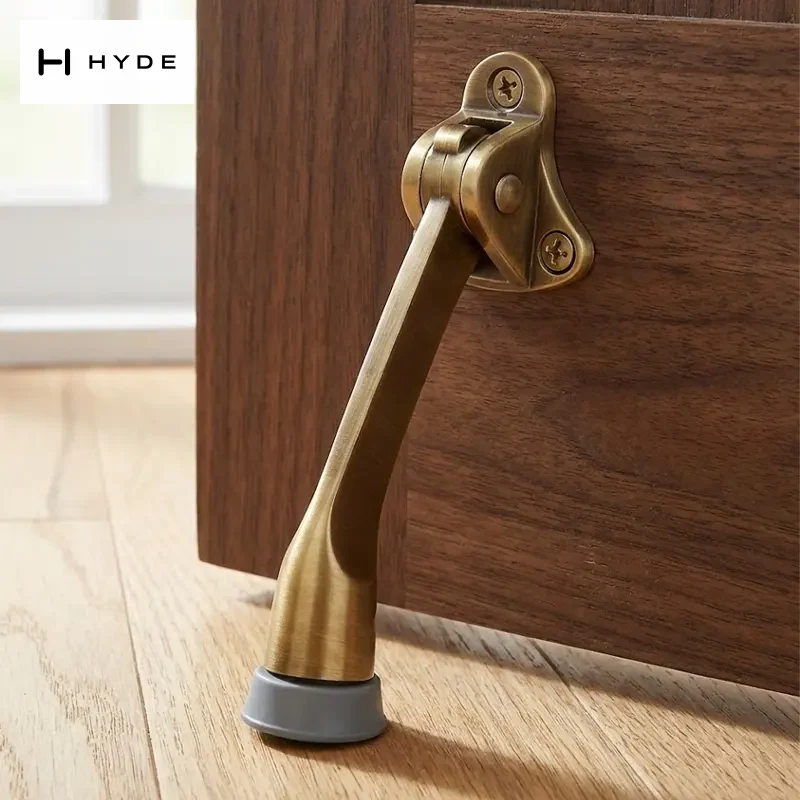
Length 110mm
Door Stopper
Model DS013
Zinc Alloy
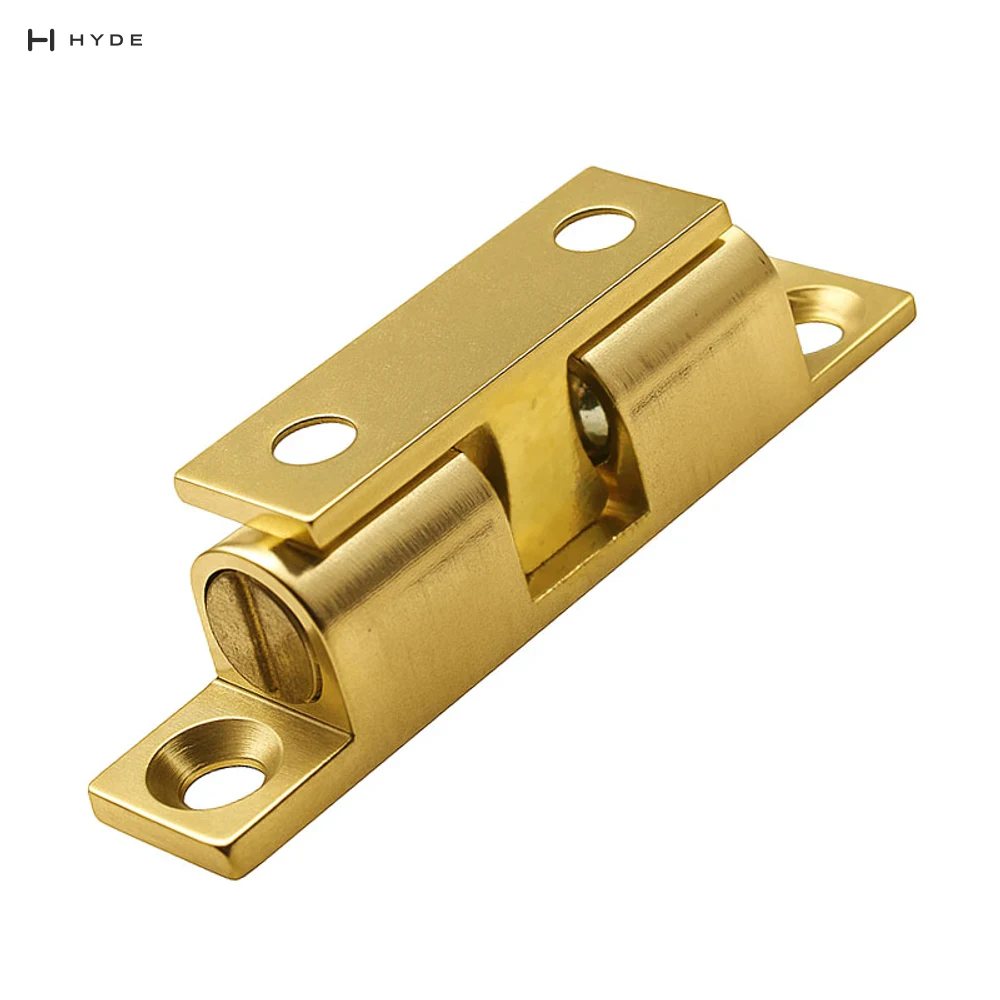
Door Stopper
Model DS011 · Video
Brass
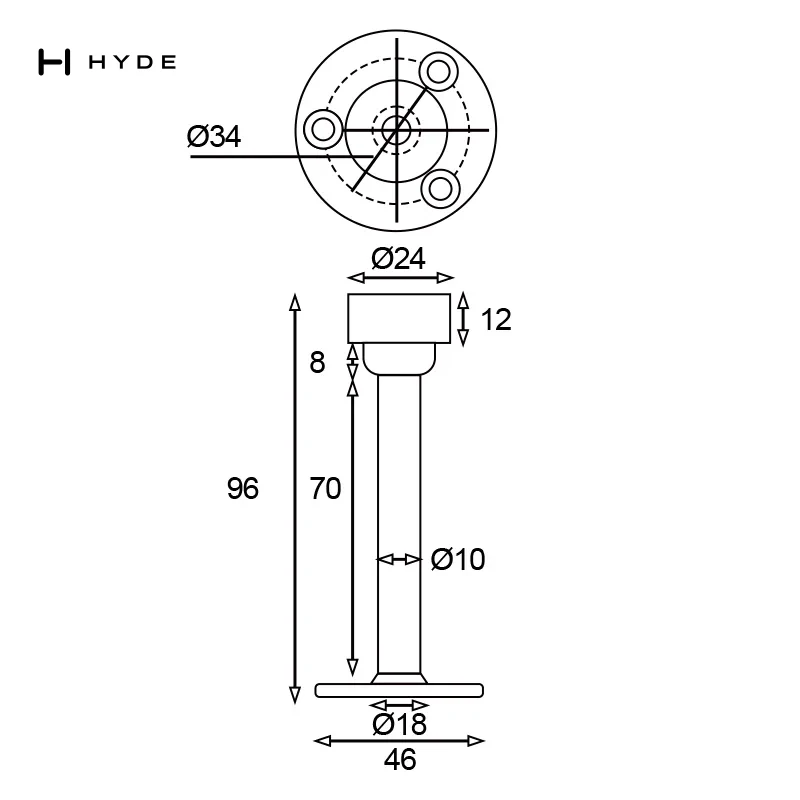
Door Stopper
Model DS01
Stainless Steel
About Canton Hyland — Canton Hyland manufactures panic exit devices, locks and architectural door hardware for commercial and institutional projects, supplying specifiers and distributors internationally.