
Backset and Door Thickness Chart 2026: What 589 Published Models Actually Take
Two numbers decide whether a replacement lock drops into a door that is already machined: the backset and the door thickness range. This is what our published catalogue actually carries — counted from the records rather than quoted from a brochure — with the imperial equivalents, the measuring method, and the one dimension that is not a backset and gets confused with it.
Johnson LiuDigital Communications, Canton HylandMA Digital Media, Johns Hopkins University
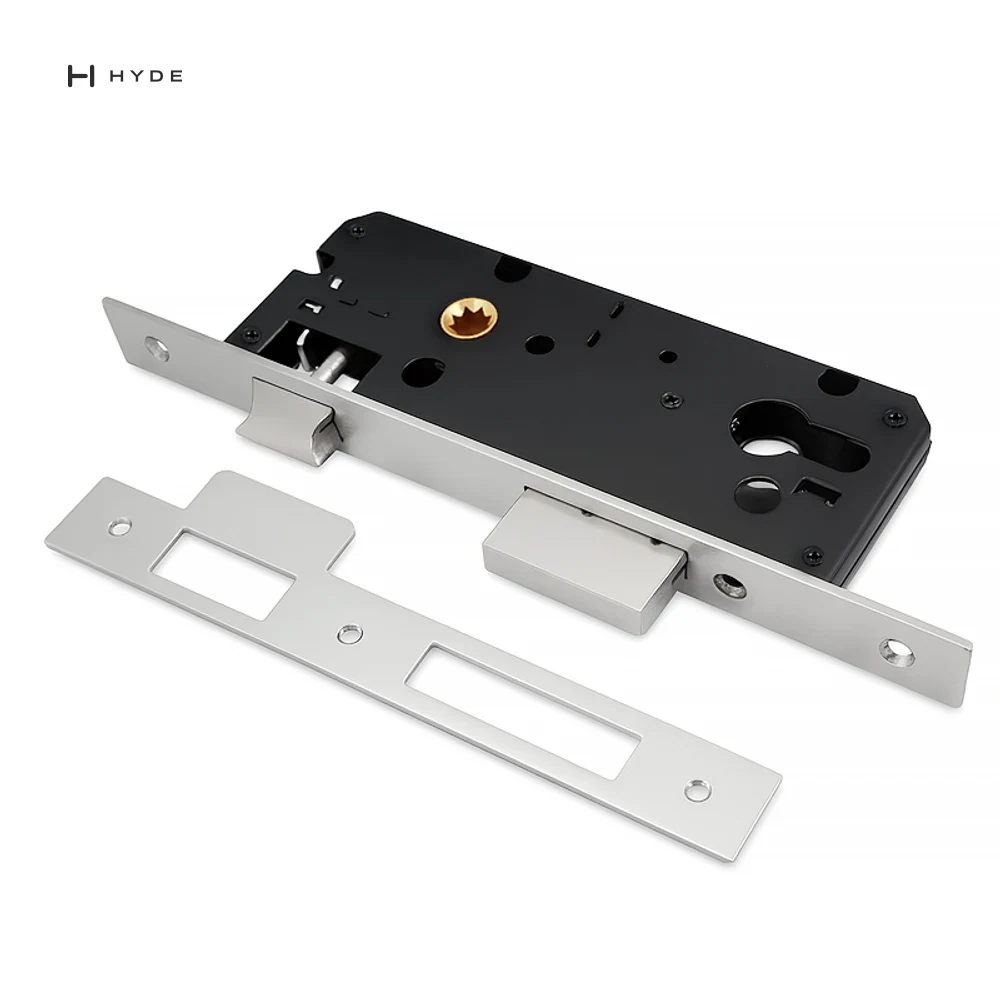
A replacement lock either drops into the door or it does not, and two numbers decide which. The backset, measured from the edge of the door to the centre of the spindle hole, and the door thickness range the lockset is built to take. Get either wrong on a door that is already machined and the options are re-machining the leaf or sending the hardware back.
This page is a count, not a claim. The figures below come from the 589 published records in our own catalogue rather than from a brochure summary, which means they describe what is actually made rather than what is theoretically available.
WHERE THE BACKSET IS MEASURED FROM
From the leading edge of the door — the face the lock's forend sits in — to the centre of the spindle hole. Not to the edge of the spindle hole, and not to the centre of the lock case, both of which are wrong by enough to matter.
On a mortise lock the backset and the centre distance are two different dimensions and they are constantly confused. The backset locates the spindle relative to the door edge. The centre distance locates the cylinder relative to the spindle, and it is the number that decides whether a given handle plate or escutcheon will line up. A lock can have the right backset and the wrong centre distance, and it will fit the mortise while the furniture does not fit the lock.
WHAT THE CATALOGUE CARRIES
Scroll sideways to compare columns. Select a column heading to sort; select it three times to restore source order.
| Adjustable 60/70mm | 2-3/8" / 2-3/4" | 100 | the commonest configuration we publish; the adjustment is physical in the case, so one part number covers both |
|---|---|---|---|
| Fixed 60mm | 2-3/8" | 16 | — |
| Fixed 70mm | 2-3/4" | 5 | — |
| Fixed 50mm | 1-15/16" | 6 | — |
| Fixed 45mm | 1-3/4" | 4 | — |
| Fixed 30mm | 1-3/16" | 4 | narrow-stile and glass door, where there is no room for anything longer |
6 rows · Source order
The adjustable 60/70 case exists because those two backsets cover most of the timber and metal door stock in the markets we ship to.
The pattern to take from that distribution is that 60 and 70 between them account for almost everything, and that the short backsets exist for a specific structural reason rather than as a preference. A 30mm backset is not a smaller version of a 60mm lock; it is what you use when the stile is too narrow to accept one.
DOOR THICKNESS RANGES
Scroll sideways to compare columns. Select a column heading to sort; select it three times to restore source order.
| 35 to 45mm adjustable | 1-3/8" to 1-3/4" | 106 | the standard range; covers the great majority of interior and entrance doors in the markets this catalogue serves |
|---|---|---|---|
| 35 to 50mm | 1-3/8" to 1-15/16" | 34 | — |
| 35 to 55mm standard, 30 to 60mm on request | 1-3/8" to 2-3/16" (1-3/16" to 2-3/8") | 22 | — |
| 8 to 12mm | 5/16" to 1/2" | 7 | glass door fittings — the number describes toughened glass, not a door leaf |
4 rows · Source order
A thickness range is not a tolerance. It is the span over which the spindle, the fixing screws and the cylinder can all reach, and the three do not necessarily run out at the same point. A lockset quoted to 45mm (1-3/4") may accept a 48mm door mechanically and leave the fixing screws two threads short, which holds until it does not.
MEASURING A DOOR THAT IS ALREADY HUNG
Measure the backset on the existing preparation, not on the existing lock. If a previous lock was itself a compromise — and on a door that has been rehung or re-skinned it often was — measuring the lock copies the compromise forward.
The practical sequence is this. Take the door thickness at the lock edge with a caliper rather than a tape, because a tape across a rebated or laminated edge reads long. Take the backset from the door edge to the centre of the existing spindle hole. Take the centre distance from the spindle centre to the cylinder centre. Those three, plus the handing and the existing forend dimensions, are what a factory needs to tell you whether a part fits before anything ships.
WHY THE ADJUSTABLE BACKSET IS WORTH MORE THAN IT LOOKS
An adjustable 60/70 case removes the single most common cause of a wrong order on this category: a schedule that says 2-3/8" for a door that was machined at 2-3/4". Both are standard, both are common, and the difference is 10mm (3/8"), which is small enough to be misread and large enough to make the lock unusable.
It also collapses two part numbers into one for a distributor holding stock, which is why the adjustable versions dominate our published range rather than the fixed ones.
WHAT WE DO NOT PUBLISH HERE
The forend dimensions — the length and width of the faceplate that shows on the door edge — are not stated for every lock case in the catalogue. Where they are published, the dimensioned drawing carries them. Where they are not, we will confirm them against the specific model rather than quote a family figure, because faceplate sizes vary within a family more than backsets do.
That is a gap and it is stated here rather than filled with a typical value. A faceplate quoted from a family and machined into a door is a rebate in the wrong place, and a rebate is not reversible.
Questions this answers
What is a backset on a door lock?
The distance from the leading edge of the door to the centre of the spindle hole. It is measured to the centre of the hole, not its edge, and not to the centre of the lock case. It decides whether the lock drops into an existing mortise.
What backsets does Canton Hyland publish?
Adjustable 60/70mm (2-3/8" / 2-3/4") on 100 records, fixed 60mm on 16, fixed 50mm on 6, fixed 70mm on 5, fixed 45mm on 4 and fixed 30mm on 4. The 30mm entries are narrow-stile and glass-door applications rather than smaller versions of a standard lock.
What is the difference between backset and centre distance?
The backset locates the spindle relative to the door edge; the centre distance locates the cylinder relative to the spindle. A lock can have the correct backset and the wrong centre distance, in which case it fits the mortise while the handle plate or escutcheon does not line up.
What door thickness do most of your locksets take?
35 to 45mm (1-3/8" to 1-3/4") adjustable, on 106 published records. Wider ranges exist: 35 to 50mm on 34 records, and 35 to 55mm standard with 30 to 60mm on request on 22. Glass fittings quote 8 to 12mm (5/16" to 1/2"), which is glass thickness rather than a door leaf.
Can I fit a lock rated to 45mm on a 48mm door?
Not safely. A thickness range is the span over which the spindle, fixing screws and cylinder all still reach, and they do not run out at the same point. A lock that engages mechanically on an over-thick door can leave the fixing screws short, which holds until it does not.
Should I measure the old lock or the door?
The door preparation. If the previous lock was itself a compromise — common on a door that has been rehung or re-skinned — measuring it copies the compromise into the replacement. Take the thickness with a caliper at the lock edge, and the backset from the door edge to the spindle hole centre.
About Canton Hyland — Canton Hyland manufactures panic exit devices, locks and architectural door hardware for commercial and institutional projects, supplying specifiers and distributors internationally.