45 to 90: Reading Our Euro Cylinder Range
In this range the model number is the overall length in millimeters, so 45, 54, 60, 70, 80 and 90 are six lengths rather than six products. All are solid brass. What the letters after the number mean is partly documented and partly not, and this article says which is which.
Insight
Johnson LiuDigital Communications, Canton HylandMA Digital Media, Johns Hopkins University
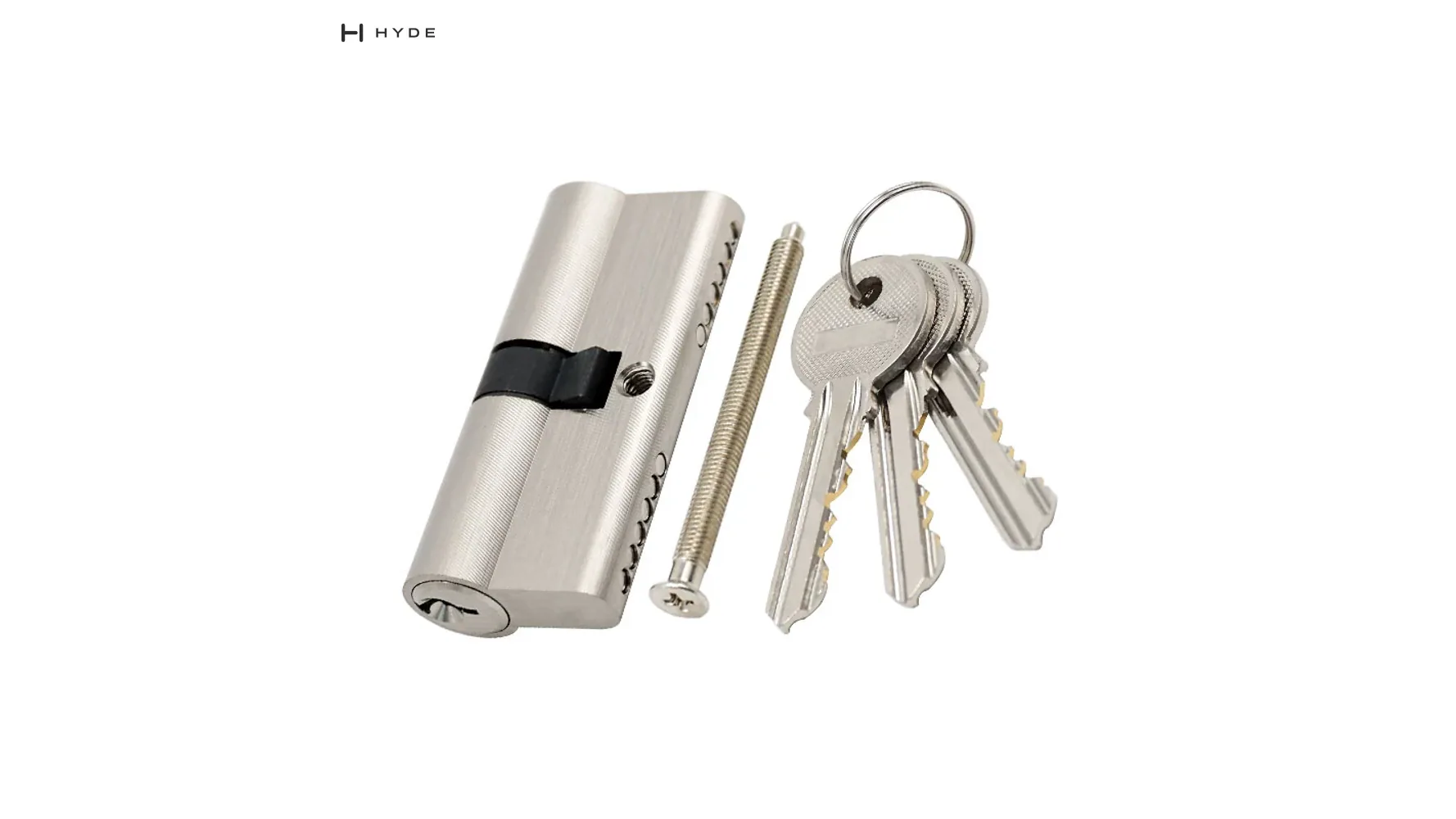
The euro-profile cylinder is the one part of a European door that a buyer can order wrong in the most ways, because almost everything about it is encoded into a short string. In our catalog that string starts with a number, and the number is the total length of the cylinder in millimeters. The selected range runs 45, 54, 60, 70, 80 and 90, which is six lengths of one product rather than six different products.
That total is not the split. A 70mm (2-3/4") cylinder is most often 35/35, but 30/40 and 40/30 are also 70, and they are different parts that fit different doors, the split is measured from the center of the cam outwards, and the cam is where the fixing screw passes through. We have written that out at length in a separate article, because it is the single most common ordering mistake on this component, and this piece will not repeat it.
Every cylinder in this range is published as solid brass. That is worth stating because brass is not the cheapest way to make a cylinder and the difference is not visible from outside: a brass body machines to a tighter tolerance than a zinc casting, which is what keeps a five-pin mechanism turning smoothly after a decade of a key being pushed at it slightly off-axis. It is also the reason these cylinders can carry a BHMA finish number where a zinc-alloy part cannot, A156.18's base groups are steel, brass and stainless, and zinc is not one of them.
The finishes are published as a list rather than per variant: polished brass (PB), chrome plated (CP), satin nickel and the rest of our standard set. Those letters are documented on our finish and order-code pages, and a finish code on a cylinder behaves the same way as a finish code on any other product, it names an appearance, and the BHMA number needs the base metal as well, which here is always brass.
The letters after the finish are the part that is not fully documented, and we would rather say so than invent it. Several variants in this range carry DK, KT or IK, and those are function codes in our own internal system whose meanings the factory has not yet confirmed to us in writing. They are on the list of six order codes we are waiting on, one finish letter and five function letters. Until that comes back, ask for the function in words in your inquiry and we will match it to the code rather than the other way round.
Two lengths in the selected range carry no published specification rows at all: the 60 and the 90. Five variants of the 60 and four of the 90 are in the catalog with photographs and no material, finish or size row. The length is in the model number and that is genuinely all we publish about them today. It is on the factory list with the rest, and until it comes back the honest answer to "what is the 60 made of" is that we will ask rather than that it is brass like its neighbors, even though it almost certainly is.
The 70 is the one to look at first if you are choosing a standard for a project, simply on the weight of the range: nineteen published variants against six for the 80 and three for the 45. That is the length the catalog is built around, and a project standardized on 70mm (2-3/4") has the widest choice of finish and function without a special order. If your doors need something else, the length is a manufacturing variable rather than a stock decision, so ask.
A cylinder is also the component most often keyed, and keying is a separate conversation from length. Any of these can be supplied keyed alike within a group, or built into a master key system, our article on master key levels sets out how many tiers a building actually needs, and the answer is usually fewer than the inquiry asks for. What matters at the ordering stage is that keying is decided before the cylinders are cut, and that the keying chart is a document somebody has to own.
Profile before length
Everything above assumes the door takes a euro profile, and that is the first thing to check, not the length. The profile is the shape of the hole (the keyhole-shaped section a euro cylinder slides into) and a cylinder of the right length and the wrong profile does not go in at all. Our catalog also carries a single oval cylinder, the profile used in several markets outside the euro-profile world: it is published as solid brass, 30mm (1-3/16") with extension sizes optional, with a 6-pin mechanism, three keys, and an external single-cylinder form. If the lock case you are replacing came from a market that does not use the euro profile, send a photograph of the hole before you send a length.
What "anti-theft" in a model name does and does not tell you
Several 70mm variants in this range carry ANTI-THEFT in the model name, 70ANTI-THEFT, 70PB ANTI-THEFT, and three chrome-plated versions carrying DK or KT codes. It would be easy to read that as a security rating. It is not one, and we should say so plainly: the name is how those variants are listed, and none of them publishes a test standard or a test result behind it. Where they publish rows at all, those rows are the same as their neighbors' (solid brass, 70mm, the standard finish list) and one of them publishes none.
A security claim on a euro cylinder means something specific in Europe, and a buyer who needs one should ask for it by name. EN 1303 is the European standard for cylinders, and its classification includes a key-related security grade from 1 to 6 and an attack resistance grade from 0 to D. Those two digits are what a specification is asking about when it says "high security". A product description that says anti-theft, anti-pick or anti-snap without those digits, or without a named test, has told you what the seller hopes rather than what was tested.
The attack a euro cylinder is most often exposed to is mechanical rather than clever. The profile is weakest at the cam, where the body narrows around the fixing screw, so a cylinder that stands proud of the door can be gripped and broken there. Nothing on our pages claims resistance to that attack, and we will not imply it. What any buyer can control is the length: a cylinder chosen so that it sits close to flush with the escutcheon gives an attacker far less to grip than one that sticks out by 10mm (3/8") because the next size up was easier to order. Our door-thickness-to-cylinder-length table exists for exactly that choice.
Protecting the cylinder instead of upgrading it
Where a door genuinely needs more than a standard cylinder, one answer is to protect the cylinder rather than replace it. The XF-1 is a cylinder protector, not a cylinder: it is published as hardened steel at HRC58, for anti-drill and anti-pry protection, fixed by a concealed internal through-bolt, and intended for armoured doors, security doors and entrance doors. It is supplied in PVD, satin, polished and antique finishes. The hardness figure is the useful number here, because it is what a drill bit meets first, and the through-bolt fixing matters as much, a protector held on by face screws can be prised off before anyone touches the cylinder.
A protector is only as good as the door it is fixed to, and it adds depth on the outside face. If you are adding one to an existing door, measure the new projection against the cylinder length, so the protector does not leave the cylinder recessed so far that the key cannot turn it fully.
Keys: how many, and who holds them
The number of keys supplied is published on some variants and not on others. The 47BSIK is published with three or five keys available; the single oval cylinder with three keys, and a normal key or, as an option, what the listing calls a computer key. If the key form matters to your market, ask for a photograph of the key itself rather than relying on the name.
More keys is not more security. Every key is a copy of the access to a door, and the useful question at ordering is not how many come in the box but how many the building needs and who will hold them. On a project, that answer belongs in the keying chart, next to which cylinders are keyed alike, which sit under a master, and which must open to no other key. The chart is the document that outlives the order: when a key is lost in five years' time, it is what tells whoever is responsible which cylinders have to change and which do not.
Reading the range as a whole
Put the published lengths side by side and the shape of the range is clear. The 70mm length has nineteen variants; the 80 has six; the 60 has five; the 90 four; the 45 three; and the 54, 56, 65 and 47 have one or two each. So a project standardized on 70mm has the widest choice of finish and function without a special order, and the further a door is from that length the more worthwhile it is to ask whether the cylinder is a stock item or a production run. Either is possible. Only one of them is fast.
Questions this answers
What lengths does the euro cylinder range cover?
The selected range runs 45, 54, 60, 70, 80 and 90, six lengths of one product rather than six different products, the number being the total length in millimeters. The 70 is the one to look at first if you are standardizing a project: nineteen published variants against six for the 80 and three for the 45. Other lengths are a manufacturing variable rather than a stock decision, so ask.
Why are these cylinders solid brass rather than zinc?
Because a brass body machines to a tighter tolerance than a zinc casting, which is what keeps a five-pin mechanism turning smoothly after a decade of a key being pushed at it slightly off-axis, a difference that is not visible from outside. It is also the reason these cylinders can carry a BHMA finish number where a zinc-alloy part cannot: A156.18's base groups are steel, brass and stainless, and zinc is not one of them.
What do the DK, KT and IK letters on a cylinder mean?
We do not know yet, and we would rather say so than invent it. They are function codes in our own internal system whose meanings the factory has not confirmed to us in writing, they are on the list of six order codes we are waiting on, one finish letter and five function letters. Until that comes back, ask for the function in words in your inquiry and we will match it to the code rather than the other way round.
Why do some lengths have no published specification?
Two in the selected range carry no specification rows at all: the 60 and the 90. Five variants of the 60 and four of the 90 are in the catalog with photographs and no material, finish or size row, the length is in the model number and that is genuinely all we publish about them today. The honest answer to what the 60 is made of is that we will ask, rather than that it is brass like its neighbors, even though it almost certainly is.
Does "anti-theft" in a cylinder's model name mean it has been security tested?
No. Several of our 70mm variants carry ANTI-THEFT in the model name, and none of them publishes a test standard or result behind it; where they publish rows at all, the rows match their neighbors'. A European security claim means an EN 1303 classification, which includes a key-related security grade from 1 to 6 and an attack resistance grade from 0 to D. Ask for those digits, or a named test, rather than relying on a product name.
How can a euro cylinder on a security door be protected?
Choose the length so the cylinder sits close to flush with the escutcheon, because a cylinder standing proud can be gripped and broken at the cam. Where more is needed, a protector such as our XF-1 covers the cylinder: it is published as hardened steel at HRC58 for anti-drill and anti-pry protection, with a concealed internal through-bolt fixing, for armoured, security and entrance doors. Check the added projection against the cylinder length so the key can still turn fully.
Über Canton Hyland – Canton Hyland fertigt Panikverschlüsse, Schlösser und Baubeschläge für Objekt- und öffentliche Bauten und beliefert Planer und Händler weltweit.