
The Door Schedule: How Hardware Is Actually Specified
Projects do not buy locks. They buy door types, and each door type is a set of hardware that has to agree with itself. The document that decides this is the door schedule, and it is worth understanding before you quote against one.
Insight
Johnson LiuDigital Communications, Canton HylandMA Digital Media, Johns Hopkins University
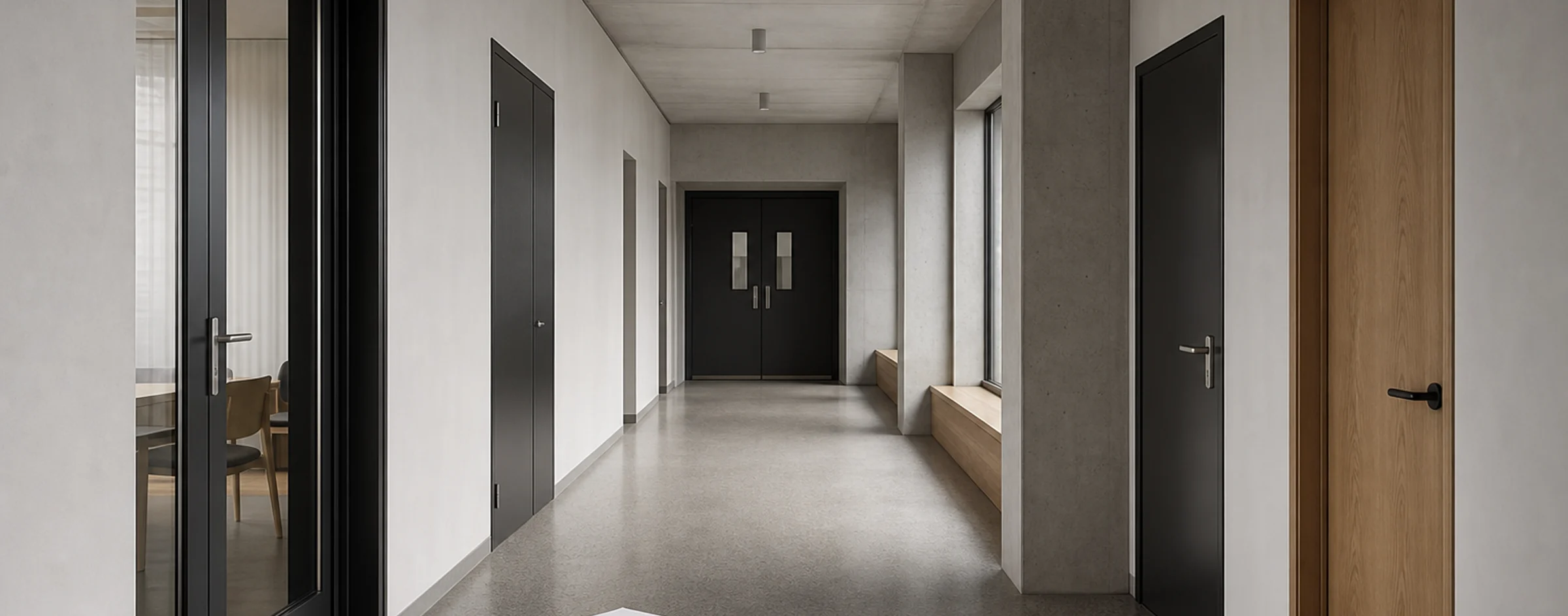
A manufacturer's catalog is organized by product: lock cases here, lever handles there, closers somewhere else. A building is not organized that way. A building is a list of doors, and every door needs a set of hardware whose parts have to agree with each other, the same backset, the same handing, the same fire rating, the same finish. The document that records this is the door hardware schedule, and on a commercial project it is what the order is actually written from.
If you sell into projects and have never seen one, this is roughly what a row looks like. A door type, say a fire-rated cross-corridor door leaf. Its dimensions and handing. Then a hardware set: a lock case with a stated backset and center distance, a lever set on the plate that matches that center distance, a euro cylinder keyed into the building's master system, a pair of hinges rated for the leaf weight, a closer with the right power size, and (because it is on an escape route) an exit device rather than a lock on the egress side. One row. Seven line items. Every one of them has to be compatible with the other six.
Two consequences follow, and they are the reason this document is worth understanding.
The first is that a project buyer is never comparing your lock against a competitor's lock. They are comparing whether your lock fits the set. A case with an 85 mm (3-3/8") center distance and a 55 mm (2-3/16") backset is either right for the plate and the door preparation already specified, or it is not, and no amount of quality argument moves that. This is why the dimensional questions arrive before the price questions, and why a supplier who answers them slowly loses the inquiry before quoting.
The second is that hardware sets are where the quantities live. A schedule does not say two hundred locks. It says thirty of set HW-01, ninety of HW-02, and so on, and each set expands into its line items. A distributor pricing from a schedule needs the sets to expand cleanly into products they can order, which means a manufacturer who can supply the whole set is worth more than a cheaper one who supplies part of it, not because of loyalty, but because a split set means two lead times, two shipments and a coordination risk that lands on the distributor.
The practical implication for anyone reading a schedule for the first time: read down the set, not across the catalog. Take one hardware set and satisfy every line in it before moving to the next. If a line cannot be matched, say so at that point rather than at quotation, because a set with a gap is more useful to the buyer as an early question than as a late surprise.
There are three questions worth asking before you quote against a schedule at all. Which sets are on escape routes, because those are governed by regulation rather than preference and the hardware is not interchangeable with the rest. Whether there is a master key system, because if there is, the cylinders are a single coordinated order and not a per-door line item. And what the finish is across the project, because finish is usually specified once for the whole building and then repeated silently in every row.
The columns, and what each one controls
Schedules vary in layout from one consultant to the next, but the columns that matter are nearly always the same, and each one controls a different decision.
Door number and location tie the row to the drawings; they are how a site team finds the door and how a query gets answered without confusion. Door type and leaf size (width, height and thickness) decide what physically fits: lock case, hinge size, bar length. Material of leaf and frame decides the fixings and sometimes the product. Fire rating decides whether the whole set is governed by a tested assembly rather than by preference. Handing decides which way handed parts are made or assembled. And the hardware set reference points to the list of parts, with a quantity, a finish and usually a remarks column where the keying is recorded.
The two columns most often left blank are handing and leaf thickness, and they are the two that most often turn a correct product into the wrong one on site.
Handing on a schedule
Handing is described in two conventions, and a schedule should say which it is using. North American schedules usually write LH, RH, LHR and RHR (left hand, right hand, and the reverse-bevel versions for doors that open outward). Many European schedules instead describe the direction the door closes, clockwise or anticlockwise, seen from a stated side. The two can describe the same door, but a letter from one convention read in the other is a reliable way to receive a full set of handed parts the wrong way round. Our article on handing (left, right and universal) goes through both, and why a universal part does not remove the need for the column.
The good news for buyers is that many parts are published as reversible. Our cylindrical locks, deadbolts, rim locks and most of our tubular lever sets are published as fully reversible, left or right hand, so handing on those is an assembly step rather than a separate part. Lock cases, some exit devices, closers and anything with a bevelled latch facing one way are where the handing column still has to be right.
One hardware set, written out
Here is the kind of set the row above expands into, written for a hypothetical internal timber door on a single leaf, with an office on one side and a corridor on the other.
HW-02, 1 lock case, 85mm center distance, 60mm backset, euro profile, for timber doors (our LC04 publishes exactly those rows); 1 pair of levers on plate, drilled for an 85mm center distance; 1 euro cylinder, length to suit a 44mm leaf, keyed to the building's master system; 3 hinges, sized to the leaf; 1 door stop, chosen against the lever projection; finish satin stainless throughout.
Every line in that set has to agree with at least one other. The levers have to match the lock case's center distance, or the cylinder hole lands in the wrong place. The cylinder length follows the leaf thickness and the lever plates together. The stop follows the lever. The finish has to be the same on all of them, and if HW-02 appears on ninety doors, every one of those agreements is multiplied by ninety.
Mistakes that come from the layout, not the products
A schedule is a table, and tables produce their own errors.
Pairs counted as one door: a pair of doors is usually one row with two leaves, and some parts are per leaf while others are per opening. Flush bolts, a coordinator and an astragal belong to the pair; hinges and stops belong to each leaf. A quantity copied straight from the row count will be wrong on every pair.
Finish specified once and assumed everywhere: the finish is often written in a general note at the top and then omitted from the rows. A supplier reading rows alone will quote the default finish; a supplier who reads the note will quote correctly. Read the notes before the rows.
Keying in the remarks: keying groups are usually in a remarks column or a separate keying schedule, not in the hardware set. A cylinder line with no keying information is incomplete, however carefully the cylinder is specified.
Revisions: schedules are reissued during a project, and each revision can change sets silently. Quote against a stated revision, write that revision on the quotation, and ask for the change list when a new one arrives rather than re-reading the whole document.
How we reply to a schedule
When a schedule arrives, the reply we aim to send is set by set rather than line by line: for each hardware set, whether we can complete it, complete it except for named items, or not complete it, and for every item we cannot supply, which item and why. That reply is usually more useful to a distributor than a priced list, because it shows at once where a second supplier is needed and how much of the project one order can cover. Prices follow for the sets we can complete, against the revision we read.
Sending the schedule
Any format we can read is better than a summary of it, but some are better than others. A spreadsheet export is best, because the sets can be expanded and counted without retyping. A PDF is fine. A photograph of a printed page is enough to start. Whatever the format, send the general notes and the keying schedule along with the rows (the notes are where the finish and the fire strategy usually live) and include the revision letter, so that our reply and your next revision refer to the same document. A schedule without its notes is a list of doors; with them, it is a specification we can answer.
Our catalog is organized by product because that is how a catalog has to be organized. But the inquiries that turn into orders almost never arrive product by product. They arrive as a schedule, or as a photograph of one, and the answer that wins is the one that reads the set rather than the line. If you have a schedule, send it, the useful reply is which sets we can complete, which we can complete except for one item, and which we cannot, and that reply is faster than a line-by-line quotation.
Questions this answers
What is a door hardware schedule?
The document a commercial order is actually written from. A catalog is organized by product; a building is a list of doors, and every door needs a set of hardware whose parts have to agree with each other, the same backset, the same handing, the same fire rating, the same finish. One schedule row can be seven line items, and every one of them has to be compatible with the other six.
Why do project buyers ask dimensional questions before price?
Because they are never comparing your lock against a competitor's lock, they are comparing whether your lock fits the set. A case with an 85mm (3-3/8") center distance and a 55mm (2-3/16") backset is either right for the plate and the door preparation already specified, or it is not, and no amount of quality argument moves that. A supplier who answers those questions slowly loses the inquiry before quoting.
Why does a schedule quote quantities as sets rather than products?
Because that is where the quantities live. A schedule does not say two hundred locks; it says thirty of set HW-01, ninety of HW-02, and each set expands into its line items. A manufacturer who can supply the whole set is worth more than a cheaper one who supplies part of it, not out of loyalty, but because a split set means two lead times, two shipments and a coordination risk that lands on the distributor.
What should be asked before quoting against a schedule?
Three things. Which sets are on escape routes, because those are governed by regulation rather than preference and the hardware is not interchangeable with the rest. Whether there is a master key system, because if there is, the cylinders are a single coordinated order and not a per-door line item. And what the finish is across the project, because finish is usually specified once for the whole building and then repeated silently in every row.
How is handing written on a door hardware schedule?
In one of two conventions, and the schedule should say which. North American schedules usually use LH, RH, LHR and RHR (left and right hand, and reverse bevel for outward-opening doors). Many European schedules describe the closing direction, clockwise or anticlockwise, from a stated side. Reading one as the other produces a full set of handed parts the wrong way round. Many parts (including our cylindrical locks, deadbolts, rim locks and most tubular lever sets) are published as reversible, but lock cases, closers and some exit devices still depend on the column.
What are the most common mistakes when quoting from a door schedule?
Four come from the table rather than the products: counting a pair of doors as one door when some parts are per leaf and others per opening; missing a finish written once in the general notes; ignoring keying recorded in a remarks column or separate keying schedule; and quoting against an old revision. Read the notes before the rows, quantify pairs per leaf and per opening, and write the schedule revision on the quotation.
عن Canton Hyland — تصنع Canton Hyland أجهزة الخروج الطارئ والأقفال وأجهزة الأبواب المعمارية للمشاريع التجارية والمؤسسية، وتورّدها لواضعي المواصفات والموزعين حول العالم.