
Backset and Center Distance: How to Read a Mortise Lock Case Number
Two numbers decide whether a lock case fits the door in front of you. They are printed in the model number, and getting them wrong is the most common reason a container of hardware cannot be installed.
Insight
Johnson LiuDigital Communications, Canton HylandMA Digital Media, Johns Hopkins University
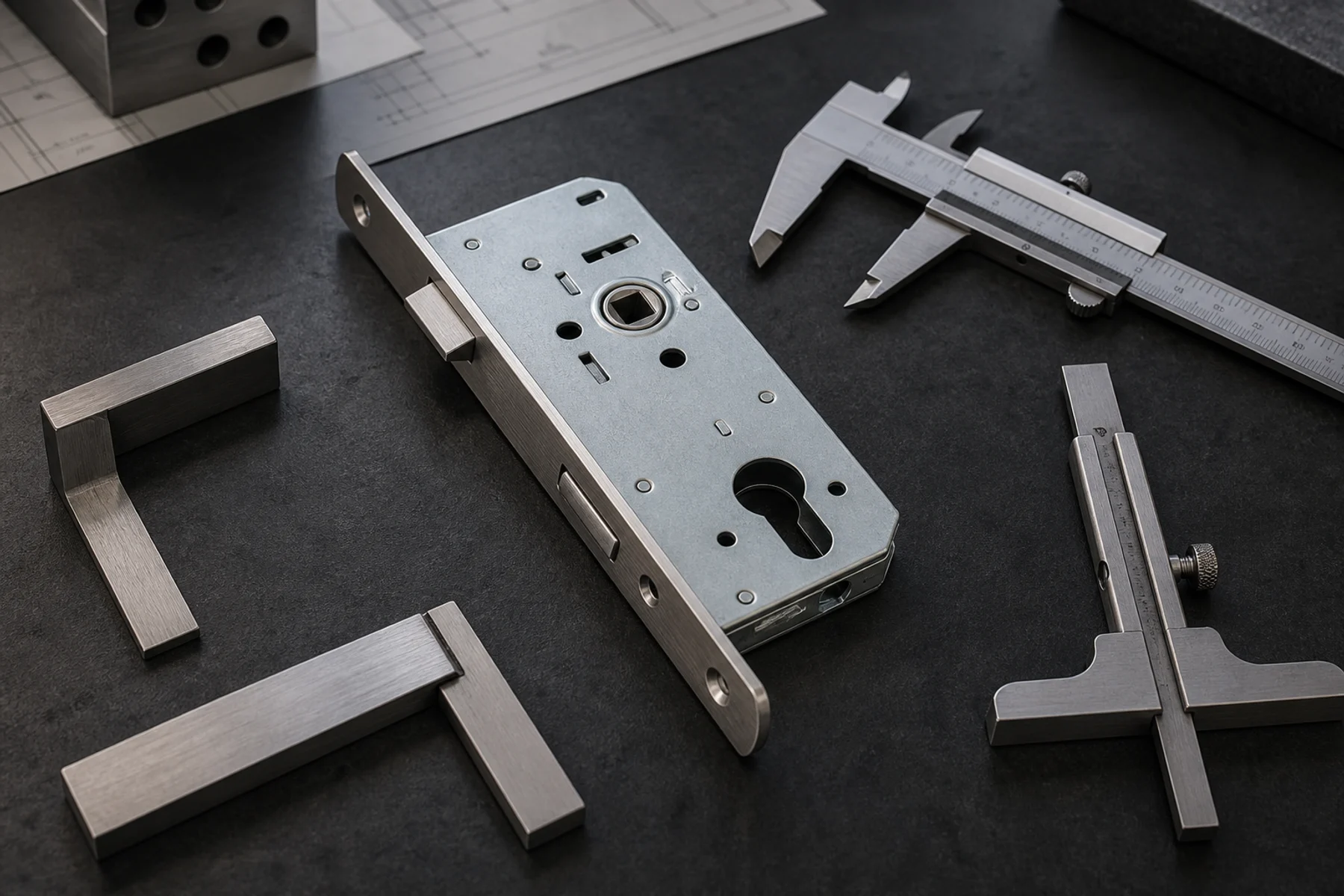
A distributor sends a purchase order for four hundred mortise lock cases. The model number is right, the finish is right, the price is agreed. Eight weeks later the cases arrive on site, the installer offers one up to a prepared door, and the handle spindle sits fifteen millimeters from where the hole is. Nothing is defective. The cases were simply made for a different door preparation, and the only clue was two digits in the model number that nobody read.
This happens often enough that it is worth spelling out exactly what those digits mean, because once you can read them you can specify a lock case from its name alone.
Center distance is the gap between the center of the cylinder hole and the center of the handle spindle, measured along the face of the lock. Backset is the distance from the front edge of the faceplate back to the center of that spindle. Center distance has to match the handle plate or escutcheon you are fitting. Backset has to match how far in from the door edge the door was bored. They are independent of each other, and a lock case is only usable when both agree with the door.
Across the euro-profile range those two figures are the model number. LC08 85×55 is an 85 mm (3-3/8") center distance with a 55 mm (2-3/16") backset. LC21 85×50 is the same 85 mm (3-3/8") center distance on a 50 mm (1-15/16") backset. LC8520 compresses the same information without the separator: 85 mm center distance, 20 mm (13/16") backset. Once you know the convention, a packing list becomes readable at a glance.
Eighty-five millimeters is the figure you will meet most often. It is the standard center distance for euro-profile cylinder locks, and it is why a European handle plate drops onto a case from almost any manufacturer without drilling. Seventy-two millimeters is the other one worth knowing, it is common through Latin American markets, and it is why LC34 50×72 puts the backset first: at 72 mm (2-13/16") center distance the numbers read in the reverse order, so the model name follows the market's own convention rather than ours.
Backset is where the real variation lives, because backset follows the door rather than the standard. Narrow aluminum stiles cannot take a deep case, so 16 mm (5/8"), 17 mm (11/16") and 20 mm (13/16") backsets exist for them, that is what LC8520 at 20 mm and the 16 mm (5/8") sliding-hook cases are for. Timber doors take more, and 45 mm (1-3/4"), 50 mm (1-15/16"), 55 mm (2-3/16") and 60 mm (2-3/8") are the usual span. A 70 mm (2-3/4") backset like the LC7065 puts the handle a long way in from the edge, which is what a wide entrance door with a heavy rail needs.
Two suffixes are worth recognizing while you are reading the number. PS marks a passage case: latch only, no cylinder, for a door that closes but does not lock. And where the model carries a bolt count (LC04 85×60 and LC14 85×50 both run four round bolts alongside the latch) you are looking at a multi-point case meant for a security or entrance door rather than an interior one.
The practical sequence when you specify is short. Measure the door first, not the lock: how far in is the spindle hole bored, and what center distance does the handle plate you intend to use require. Then read those two figures out of the candidate model numbers. Then confirm handing and faceplate dimensions, which the model number does not encode. If you are replacing existing hardware rather than fitting new doors, take the old case out and measure it, a door that was prepared once has already made both decisions for you, and matching it is cheaper than re-boring four hundred doors.
The backsets this catalog actually carries
General advice about backsets is easy to find and not much use. Here is what our own range publishes, counted from the records rather than described:
180 of the 588 records in our catalog publish a backset. Of those, 116 are 60mm / 70mm adjustable, a single case that can be set to either. Fixed 60mm accounts for 23 more. The rest are specials, from 20mm narrow-stile cases to 90mm deep ones, each in single figures.
横にスクロールして列を比較できます。列見出しを選択すると並べ替え、3回選択すると元の順序に戻ります。
| 60 / 70mm adjustable | 116 | The default. One case covers both common door preparations |
|---|---|---|
| 60mm fixed | 23 | Where the preparation is known and fixed |
| 70mm fixed | 5 | Thicker leaf, or a deeper handle set |
| 50mm | 7 | Narrower stile |
| 45mm | 5 | Narrower again |
| 40mm | 3 | Narrow timber or steel stile |
| 30mm | 4 | Very narrow aluminum stile |
| 65mm | 2 | One-off preparations |
| 90mm, or adjustable to 90mm | 4 | Deep backset, wide stile |
| Other: 16, 20, 25, 35 and 55mm | 11 | Specials, one to three records each |
10 rows · 元の順序
The practical reading of that table is one sentence: if your door is prepared to either of the two common backsets, the adjustable case almost certainly fits, and you do not need to decide before ordering. It is the narrow-stile end of the range (30, 45 and 50mm) where the choice is real and where getting it wrong means a new door.
The imperial trap, which is the one that actually costs money
60mm and 70mm are not arbitrary. They exist because they sit next to the two North American standards, and the near-miss between the two systems is where four hundred lock cases go wrong.
横にスクロールして列を比較できます。列見出しを選択すると並べ替え、3回選択すると元の順序に戻ります。
| 2-3/8" | 60.3mm | 60mm | Close enough to interchange in most preparations |
|---|---|---|---|
| 2-3/4" | 69.9mm | 70mm | Close enough to interchange in most preparations |
| 2-1/2" | 63.5mm | none | No metric equivalent. Neither 60 nor 70 |
3 rows · 元の順序
The first two rows are why an adjustable 60/70 case is usually the right answer for a North American door as well as a European one. The third row is the trap. A 2-1/2" backset is common on older North American mortise locks and has no metric neighbor; a 60mm case leaves the lever 3.5mm off the existing hole and a 70mm case is 6.4mm the other way. Neither is a fit, and neither failure is visible until the lock is in the door.
So when a schedule quotes backset in inches, convert it before you order and check which side of the two metric sizes it falls on, rather than assuming the fractions map onto the millimeters.
Center distance: what we publish, and what we do not
We should be straight about this, because it is a gap rather than a strength. Only 34 of the 588 records in our catalog publish a lock center distance, and 22 of those 34 say 85mm. The others are 72mm, 65mm, and a handful of one-offs.
That count is smaller than it looks at first glance, and the reason is worth recording because it caught us out. The same label, Centre distance, was also used on pull handles, where the figure is the fixing pitch between the two mounting points, written as P=425mm and similar. One label, two completely different measurements. We have since split them apart in our own data, and the count above is locks only.
The consequence for you: if you are cross-referencing a lock case and center distance decides the fit, assume we have not published it and ask. On most of the euro-profile range the figure is 85mm, which the model number carries anyway; outside that range, it needs a drawing or a sample.
Measuring a lock you cannot take out of the door
On a refurbishment the case is usually still in the leaf, and both figures can be taken from the face without removing anything.
Backset is from the front edge of the door to the center of the spindle. Put a rule on the face of the leaf, hook it on the lock edge, and read where the center of the handle spindle falls. Take it on the lock edge, not the frame, and do not measure to the edge of the escutcheon, which is a different and always larger number.
Center distance is from the center of the spindle to the center of the cylinder, both of which you can see on the face. Measure between the centers, not between the nearest edges of the two holes, the difference is half a cylinder diameter and it is enough to order the wrong case.
Write both down together with the model number you are replacing, and photograph the lock edge with a rule in frame. Two dimensions plus a photograph will resolve almost any cross-reference; a model number on its own frequently will not, which is where this article started.
One line on the purchase order closes almost all of this: backset in millimeters, center distance in millimeters, and the model you are replacing. Three fields, no fractions, no assumptions about whose standard anybody meant.
Where a dimension is not printed on our product pages, it is because we have not verified it for that model rather than because it does not matter. Ask for the drawing before you order and we will send the one that covers the model on your schedule, or say plainly that it is still being prepared.
Questions this answers
What is the difference between backset and center distance?
Backset is the distance from the front edge of the faceplate back to the center of the handle spindle. Center distance is the gap between the center of the cylinder hole and the center of that spindle, measured along the face of the lock. Center distance has to match the handle plate or escutcheon; backset has to match how far in from the door edge the door was bored. They are independent of each other, and a lock case is only usable when both agree with the door.
How do you read a mortise lock case model number?
Across the euro-profile range the two figures are the model number. LC08 85×55 is an 85mm center distance with a 55mm backset; LC21 85×50 is the same center distance on a 50mm backset; LC8520 compresses the same information without a separator, 85mm center distance, 20mm backset. Once you know the convention, a packing list becomes readable at a glance.
Why is 85mm the usual center distance, and when is it 72mm (2-13/16")?
85mm is the standard center distance for euro-profile cylinder locks, which is why a European handle plate drops onto a case from almost any manufacturer without drilling. 72mm is common through Latin American markets, and it is why LC34 50×72 puts the backset first: at that center distance the numbers read in the reverse order, so the model name follows the market's own convention rather than ours.
Which backset does a narrow aluminum stile take?
A shallow one, 16mm, 17mm (11/16") and 20mm backsets exist because a narrow stile cannot take a deep case, which is what LC8520 at 20mm and the 16mm sliding-hook cases are for. Timber doors take more, with 45mm (1-3/4"), 50mm, 55mm and 60mm (2-3/8") the usual span, and a 70mm (2-3/4") backset like the LC7065 is what a wide entrance door with a heavy rail needs. Backset follows the door rather than the standard.
Canton Hylandについて — 商業施設・公共施設のプロジェクト向けに、パニックデバイス、錠前、建築用ドア金物を製造し、世界各地の設計者と販売代理店に供給しています。