
Mortise Lock Case Comparison 2026: Every Published Backset and Center Distance, Side by Side
32 of our mortise lock cases publish both a backset and a center distance. Here they are in two tables, narrow-stile and standard, with the naming traps and the gaps stated plainly.
Johnson LiuDigital Communications, Canton HylandMA Digital Media, Johns Hopkins University
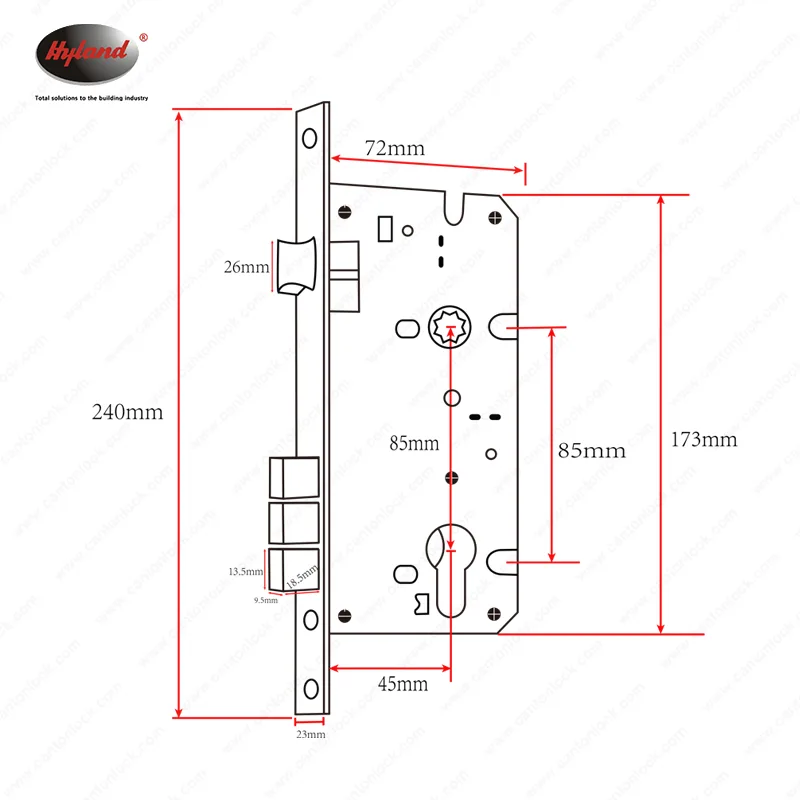
Every mortise lock case is described by two numbers before anything else: the backset, from the face of the door edge to the center of the spindle, and the center distance, from the spindle to the center of the cylinder. Get those two right and the handle and the key line up with the holes in the door. Get either wrong and nothing else about the lock matters, because the holes are already drilled.
This guide lays out every lock case in our catalog that publishes both numbers (32 of the 58 lock-case records, as of September 2026) side by side, so a buyer can find the case that fits a door rather than reading 58 product pages. The tables are generated from the specification rows on those pages; nothing in them is estimated.
HOW TO READ THE TABLES
Both measurements are published in millimeters, with the inch equivalent alongside. Backset is measured from the outer face of the faceplate, not from the case behind it. The difference is the faceplate thickness, and it is enough to put a lever off-center on its rose. Center distance is measured between the center of the square spindle hole and the center of the cylinder hole. Where a record also publishes a cylinder type, a bolt arrangement or a faceplate size, it appears in the last column; "not published" means the record does not state it, not that the feature is absent.
TWO FAMILIES: NARROW STILE AND STANDARD
The first thing the numbers show is that our lock cases fall into two families that do not overlap. Backsets of 20 to 35mm are narrow-stile cases, made for aluminum framed doors whose vertical stile is too narrow to take a conventional lock, and 12 of the 32 are in this group. Backsets of 40mm and above are standard cases for timber and steel doors, and 20 are in that group. Our article on why aluminum doors drop explains why a narrow-stile door needs its own kind of lock case and cannot simply take a short-backset version of a standard one.
Narrow-stile cases, by backset:
Scrollen Sie seitwärts, um Spalten zu vergleichen. Wählen Sie eine Spaltenüberschrift zum Sortieren; dreimal gewählt, stellt sie die ursprüngliche Reihenfolge wieder her.
| LC8520 | 20mm (13/16") | 85mm (3-3/8") | not published | not published |
|---|---|---|---|---|
| LC8520B | 20mm (13/16") | 85mm (3-3/8") | not published | not published |
| LC8520PS | 20mm (13/16") | 85mm (3-3/8") | not published | not published |
| 140 | 25mm (1") | 72mm (2-13/16") | not published | faceplate 183.5 × 20mm |
| LC8525 | 25mm (1") | 85mm (3-3/8") | not published | not published |
| LC8525B | 25mm (1") | 85mm (3-3/8") | not published | not published |
| AI8530 | 30mm (1-3/16") | 85mm (3-3/8") | Euro profile | not published |
| LC8530BK | 30mm (1-3/16") | 85mm (3-3/8") | not published | not published |
| LC8530PS | 30mm (1-3/16") | 85mm (3-3/8") | not published | not published |
| LC9230 | 30mm (1-3/16") | 92mm (3-5/8") | not published | not published |
| LC8535 | 35mm (1-3/8") | 85mm (3-3/8") | not published | not published |
| LC8535B | 35mm (1-3/8") | 85mm (3-3/8") | not published | not published |
12 rows · Ursprüngliche Reihenfolge
Standard cases, by backset:
Scrollen Sie seitwärts, um Spalten zu vergleichen. Wählen Sie eine Spaltenüberschrift zum Sortieren; dreimal gewählt, stellt sie die ursprüngliche Reihenfolge wieder her.
| LC02 85×40mm | 40mm (1-9/16") | 85mm (3-3/8") | not published | not published |
|---|---|---|---|---|
| LC03 85×45mm | 45mm (1-3/4") | 85mm (3-3/8") | Euro profile | not published |
| LC07 85×45mm | 45mm (1-3/4") | 85mm (3-3/8") | not published | faceplate 240 × 23mm |
| LC22 85×45mm | 45mm (1-3/4") | 85mm (3-3/8") | not published | not published |
| LC34 50×72mm | 50mm (1-15/16") | 72mm (2-13/16") | Euro profile | not published |
| LC06 85_50PS | 50mm (1-15/16") | 85mm (3-3/8") | not published | not published |
| LC14 85×50mm | 50mm (1-15/16") | 85mm (3-3/8") | Euro profile | Four round bolts |
| LC21 85×50mm | 50mm (1-15/16") | 85mm (3-3/8") | not published | not published |
| LC33-5572 | 55mm (2-3/16") | 72mm (2-13/16") | Euro profile | not published |
| LC08 85×55mm | 55mm (2-3/16") | 85mm (3-3/8") | Euro profile | not published |
| LC6860 | 60mm (2-3/8") | 68mm (2-11/16") | not published | not published |
| LC04 85*60 | 60mm (2-3/8") | 85mm (3-3/8") | Euro profile | Four round bolts |
| LC05 8560 | 60mm (2-3/8") | 85mm (3-3/8") | not published | not published |
| LC09 85×60mm | 60mm (2-3/8") | 85mm (3-3/8") | Euro profile | not published |
| LC32 65×72mm | 65mm (2-9/16") | 72mm (2-13/16") | not published | not published |
| LC7065 | 70mm (2-3/4") | 65mm (2-9/16") | not published | not published |
| LC7065PS | 70mm (2-3/4") | 65mm (2-9/16") | Euro profile | not published |
| LC7065S | 70mm (2-3/4") | 65mm (2-9/16") | not published | not published |
| LC04 85*70 | 70mm (2-3/4") | 85mm (3-3/8") | not published | not published |
| LC9045 | 90mm (3-9/16") | 45mm (1-3/4") | not published | not published |
20 rows · Ursprüngliche Reihenfolge
THE CENTER DISTANCE DECIDES THE HANDLE
Across the published cases, 85mm (3-3/8") is by far the most common center distance: 22 of the 32, including ten of the twelve narrow-stile cases. The others are 92mm (LC9230), 72mm (four cases: 140, LC34 50×72mm, LC33-5572 and LC32 65×72mm), 68mm (LC6860), 65mm (three cases: LC7065, LC7065PS and LC7065S) and 45mm (LC9045).
That matters because the center distance is shared with the handle. A lever on a long plate, and any trim that carries the cylinder hole on the same backing, is drilled for one center distance, and it only works with a lock case of that same distance. On a new door, pick the center distance first and the handle second. On a replacement, the existing holes have already picked it for you: measure them, and look for that number in the tables before anything else. Our articles on the stainless 9000 levers and on the LH lever range explain how a plate's hole spacing is matched to the case.
Different markets standardize on different center distances, and a supplier who serves several markets will stock several. That is the reason a range like this one carries 85mm alongside 72mm and 92mm: each is the right answer for somebody's doors.
WHAT A SHORT BACKSET COSTS
A narrow-stile case solves one problem and creates another. With a 20 or 25mm backset the spindle sits very close to the door edge, and so does the handle, which means the gap between the handle and the frame, or the adjacent leaf on a pair, is small. A lever with a long return or a knob can trap knuckles against the frame every time the door is opened. That is why narrow-stile doors are usually fitted with narrow-stile levers, pull handles or push pads rather than the handles that suit a timber door, and why the backset should be chosen together with the handle, not before it. If the stile allows 30 or 35mm, the extra space is worth having for the hand alone.
SUFFIXES ON THE MODEL NUMBERS
Several cases carry letters after the numbers: B on the LC8520B, LC8525B and LC8535B; BK on the LC8530BK; PS on the LC8520PS, LC8530PS, LC06 85_50PS and LC7065PS; S on the LC7065S. On our cylindrical locks, PS means passage and BK means privacy, and it is tempting to read these the same way. The lock-case records do not define their suffixes, so we will not decode them here. Where the difference between two variants matters (a latch-only case against a deadlocking one, for example), say which function you need in words, and we will match it to the variant rather than the other way round.
MODEL NAMES DO NOT FOLLOW ONE ORDER
Most of these model names contain the two numbers, and it is tempting to read the lock straight off the name. Do not. The naming is not consistent across the range. LC8530 and LC6860 put the center distance first and the backset second; LC32 65×72mm and LC34 50×72mm put the backset first. The LC7065 variants and LC9045 read correctly only in backset-first order: their records say backset 70mm with a 65mm center, and backset 90mm with a 45mm center. Those two are the outliers in the tables, and if either is the case you want, confirm both numbers with us before ordering.
The rule that follows is short: read the specification rows, never the name. The tables above are built from the rows for exactly that reason.
WHAT THE TABLES LEAVE OUT
Two kinds of gap are worth knowing. First, 26 lock-case records do not publish both numbers and are not in the tables. Some publish only a backset (LC17 at 16mm, LC5845 at 45mm), some only a faceplate, and some nothing yet. Second, most of the cases that are in the tables publish only the two numbers and not the rest of the geometry. Only the LC07 publishes its full set: a 240 × 23mm faceplate, a 173mm case height, 72mm case depth, a 26mm latch throw and an 18.5mm bolt projection.
That second gap matters when you are replacing a lock in an existing door, because faceplate length and case depth decide whether the new case fits the old pocket. Our article on cross-referencing a lock you already buy sets out the six numbers that decide interchangeability; if the case you want publishes only two of them, ask for the other four before ordering, and we will measure them rather than estimate them.
CHOOSING, IN THREE STEPS
First, the door decides the family: an aluminum narrow-stile door takes a case from the first table, a timber or steel door from the second. Second, the backset is set by the door preparation or by where the handle should sit on the leaf, and on a replacement by the old lock. Third, the center distance is set by the handle or trim you intend to use, or by the holes already in the door. Only after those three does the function (latch only, latch and deadbolt, passage) narrow it to one model, and only then does finish enter the conversation.
Send those three facts with an inquiry and the reply can name a case from these tables the first time. Send a model name alone and, as the naming section shows, it may name the wrong one.
Questions this answers
Which center distance is most common on your mortise lock cases?
85mm. Of the 32 lock cases that publish both numbers, 22 use an 85mm center distance, including ten of the twelve narrow-stile cases. The others are 92mm (LC9230), 72mm (four cases: 140, LC34 50×72mm, LC33-5572 and LC32 65×72mm), 68mm (LC6860), 65mm (three cases: LC7065, LC7065PS and LC7065S) and 45mm (LC9045). The center distance must match the handle or plate, so on a replacement measure the existing holes first.
What backset does a narrow-stile aluminum door lock case have?
Between 20mm and 35mm on our range. Twelve published cases fall in that band: LC8520, LC8520B, LC8520PS, 140, LC8525, LC8525B, AI8530, LC8530BK, LC8530PS, LC9230, LC8535 and LC8535B. Standard cases for timber and steel doors start at 40mm and run to 70mm, with one 90mm outlier.
Can I read the backset and center distance from the lock case model name?
Not reliably. The naming is not consistent: LC8530 and LC6860 put the center distance first, while LC32 65×72mm and LC34 50×72mm put the backset first, and the LC7065 variants and LC9045 read correctly only backset-first. Always use the specification rows, which is what the comparison tables are built from.
Do your lock cases publish their faceplate and case size?
Most do not yet. Among the 32 cases with both backset and center distance, only the LC07 publishes its full geometry: a 240 × 23mm faceplate, 173mm case height, 72mm case depth, 26mm latch throw and 18.5mm bolt projection. For a replacement, ask for the faceplate and case dimensions before ordering and we will measure them rather than estimate.
Why do narrow-stile doors need different handles?
Because a narrow-stile lock case puts the spindle, and therefore the handle, very close to the door edge, 20 to 35mm on our range. With a 20 or 25mm backset there is little space between the handle and the frame or the adjacent leaf, and a long-return lever or a knob can trap knuckles. Narrow-stile levers, pull handles or push pads are usual, and a 30 or 35mm backset is worth choosing where the stile allows it.
What do the B, BK and PS suffixes on lock case models mean?
The lock-case records do not define them, so we do not decode them. On our cylindrical locks PS is passage and BK is privacy, but that is not confirmed for lock cases such as the LC8520PS, LC8530BK or LC8535B. State the function you need in words (latch only, deadlocking, passage) and we will match it to the right variant.
Über Canton Hyland – Canton Hyland fertigt Panikverschlüsse, Schlösser und Baubeschläge für Objekt- und öffentliche Bauten und beliefert Planer und Händler weltweit.