
Lever Length, Rose Diameter, Projection: The Stainless 9000 Levers
The 9014, 9007 and 9008 are stainless lever sets on a 53mm (2-1/16") rose for a 35–50mm (1-3/8" to 1-15/16") door. The 9014 publishes a 135mm (5-5/16") lever, 60mm (2-3/8") projection and a 9mm (3/8") rose; the 9007 a 132mm (5-3/16") lever, 63mm (2-1/2") projection and an 8mm (5/16") rose. The 9008 publishes six rows in total, and this article says so rather than filling the gap in.
Insight
Johnson LiuDigital Communications, Canton HylandMA Digital Media, Johns Hopkins University
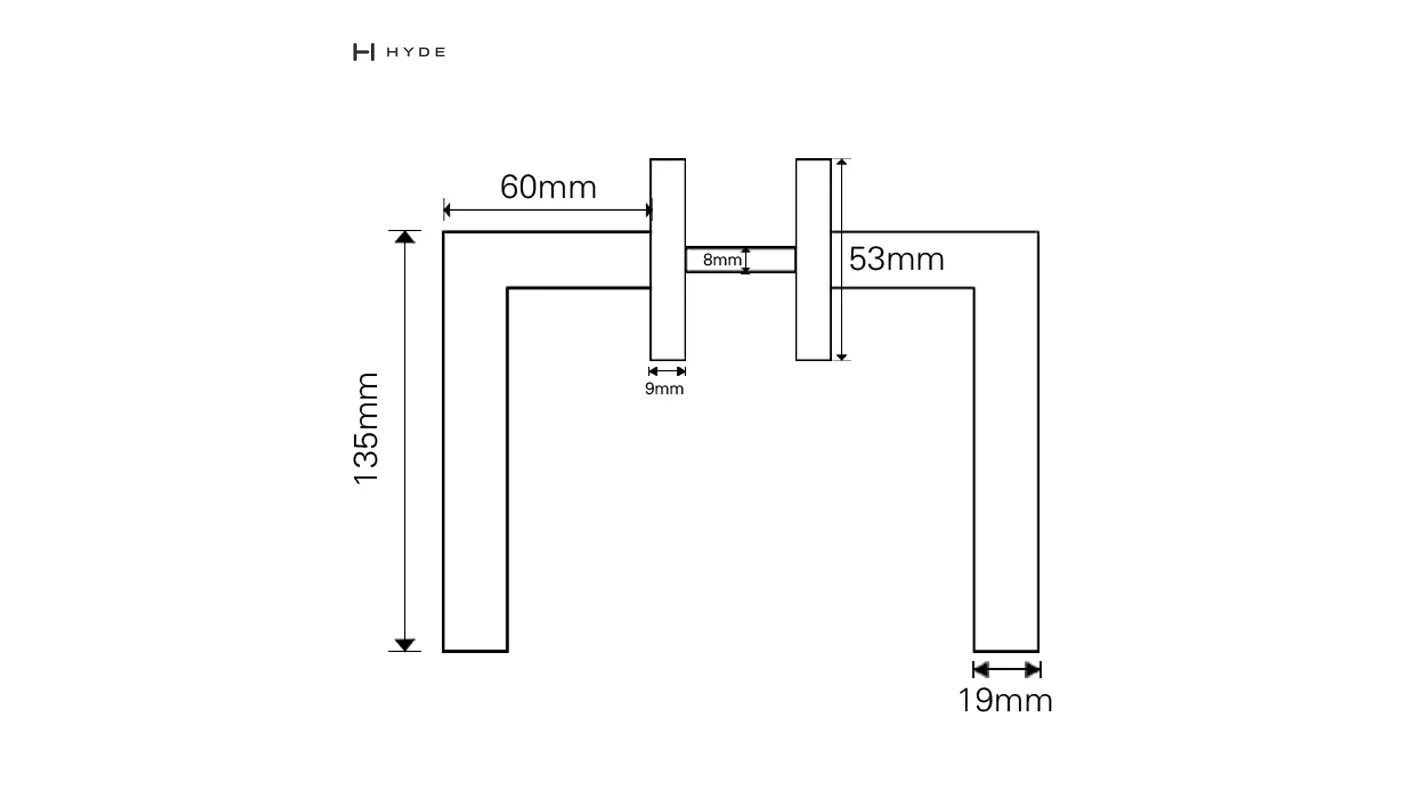
A lever handle is specified by three measurements that most catalogs bury under a photograph: how long the lever is, how wide the rose is, and how far the assembly stands off the door face. Those three decide whether it fits, whether it clashes with the frame, and whether a hand can get behind it. The stainless 9000 levers in our selected range publish all three, so this is a comparison that can be made from the page rather than from a sample.
The 9014 publishes a lever length of 135mm (5-5/16"), a rose diameter of 53mm (2-1/16"), a rose thickness of 9mm (3/8") and a projection of 60mm (2-3/8"), in satin stainless steel, 630 in BHMA numbers, US32D in the older convention, and one of the few finishes on this site that translates to a number without a caveat, because solid stainless is a base group in A156.18 and the finish is worked into the metal rather than plated onto it.
The 9007 is the same idea a few millimeters apart: a 132mm (5-3/16") lever, the same 53mm rose but 8mm (5/16") thick rather than 9mm, a 63mm (2-1/2") projection and a published lever section of 19mm (3/4") with an 8mm spindle. Three millimeters more projection and three less lever is not a styling difference; it changes how the handle sits in a hand and how close the lever end comes to the frame on a narrow stile.
Projection is the measurement that causes site problems and the one buyers check last. It is the distance from the door face to the outermost part of the assembly, and it decides whether the door can open against a wall, whether a lever clears an adjacent door in a pair, and whether the handle catches a coat. Sixty millimeters is normal for a commercial lever; the point is that both of these publish it, so it can be checked against the reveal before anything is ordered.
The rose diameter matters for a different reason: it decides what the lever can cover. A 53mm rose will not hide the preparation left by a lock with a larger rose, so on a refurbishment where existing doors are being re-handled, the old rose diameter is the number to survey. It is a common way for a straightforward like-for-like replacement to turn into a joinery job.
All three take a 35–50mm (1-3/8" to 1-15/16") door, which is a wider range than most of our zinc-alloy lever sets and the reason these are the ones to reach for on a heavier leaf. The cylinder in all three is brass. The bodies are stainless steel, which is what puts them in a different conversation from the zinc-alloy LH range: stainless is the specification for an exterior door, a coastal building or a washroom that gets cleaned aggressively, and zinc alloy is the specification for everywhere else.
The 9008 is in this selected range and publishes six specification rows in total across its two variants: stainless steel, a brass cylinder, a 35–50mm door thickness. No lever length, no rose diameter, no projection. We are not going to infer them from the 9007 sitting next to it in the same series, because a projection copied from a neighboring model is exactly the number that causes a door not to open against a wall. It is on the list of measurements we have asked the factory for.
If you are choosing between them, the practical order is: door thickness first (all three take 35–50mm, so this rarely decides it) then projection against the reveal, then lever length against the stile width, then finish. And if the answer is the 9008, ask us for the three missing figures before the order rather than after, because those are exactly the three that cannot be fixed on site.
Which stainless, exactly
Everything above calls these levers stainless steel, and with one exception that is all the records say: "stainless steel", with no grade. The exception is the 9088 SS, whose record states SUS 304, stamped on the plate. That is worth flagging rather than glossing over, because the grade is precisely what decides whether stainless behaves as a buyer expects. Grade 304 is the usual choice for interior and general exterior use; 316, with its added molybdenum, is the grade for coastal air, swimming pools and aggressive cleaning; and 201 is a cheaper grade that can mark and stain in conditions 304 shrugs off. Our article on stainless steel grades 304, 201 and 316 sets out the differences properly.
Because the grade is not on most of these records, ask for it in writing against the model before ordering anything for an exterior, coastal or washroom door: the very places where a stainless lever is chosen over zinc alloy in the first place. A satin 630 finish looks the same on every grade. It does not last the same on every grade.
The whole stainless lever family, side by side
The 9014, 9007 and 9008 are three of a larger family. Every stainless lever on this site that publishes its geometry is in the table below, taken from the specification rows, so the comparison can be made in one place rather than across nine product pages.
Scrollen Sie seitwärts, um Spalten zu vergleichen. Wählen Sie eine Spaltenüberschrift zum Sortieren; dreimal gewählt, stellt sie die ursprüngliche Reihenfolge wieder her.
| 9003E | 133mm | 53mm | 62mm |
|---|---|---|---|
| 9004S | 135mm | not published | 63mm |
| 9005E | 130mm | 53mm | 62mm |
| 9007S | 132mm | 53mm | 63mm |
| 9014 | 135mm | 53mm | 60mm |
| 9082E | 135mm | not published | not published |
| LH1016 | 130mm | 53mm | not published |
| LH1033 SS | 135mm | 53mm | 68mm |
| NC182 | 86mm | not published | not published |
9 rows · Ursprüngliche Reihenfolge
Read across the table and the family is tighter than the model numbers suggest. Lever lengths sit between 130 and 135mm (5-1/8" to 5-5/16"), the rose is 53mm (2-1/16") wherever it is published, and projection runs from 60mm on the 9014 to 68mm on the LH1033 SS. The one clear outlier is the NC182, with an 86mm (3-3/8") lever: a short lever for a narrow door or a cupboard rather than a passage door.
That tightness is useful on a project. Levers from this family can be mixed across a building without a hand noticing a change, and the choice between them comes down to shape, finish and function rather than size. It also means projection is the figure worth checking model by model: eight millimeters between the 9014 and the LH1033 SS is the difference between a lever that clears a return wall and one that marks it.
Where a pull handle is the better answer
A lever on a rose goes with a latch or a lock, on a door that has to stay shut until someone operates it. A pull handle goes on a door that is held shut by a closer or a magnet, or not held at all, and is simply pushed from one side and pulled from the other. On a shop entrance, a corridor door on a closer or a washroom lobby, a pull handle and a push plate are often the better answer: nothing to turn, nothing to catch, and easier for someone carrying something. On a door that must latch, a pull handle alone is not a lock and should not be specified as one. Pull handles are not part of this lever family, so if a door needs one, ask separately.
Functions: two published, the rest to ask about
On the 9014, two variants publish a function in plain words: the 9014 SSET is entrance (keyed outside) and the 9014 SSBK is privacy (the bathroom function, with a turn button inside), both in satin stainless steel (US32D). Those follow the same suffix logic as our cylindrical locks, where ET is entrance and BK is privacy.
The other variants in the series (9007, 9007E, 9007S, 9008E, 9008S and 9014S) carry an E or S suffix that the records do not explain. It would be easy to guess, and a guess on a function code is exactly how a whole order arrives unable to lock. So we will not decode those suffixes here: tell us the function you need on each door, in words, and we will match it to the right variant rather than the other way round.
Lever shape is a safety choice as well as a style one
Two things about the form of a lever matter beyond how it looks. A lever whose end returns towards the door is less likely to catch a sleeve, a bag strap or a hospital gown than one that ends in a straight, open tip, which is why return-end levers are common in healthcare and schools. And a lever of any kind is easier to operate than a knob for anyone with limited grip, which is why accessibility guidance generally favors levers on doors people with disabilities will use. The 9000 levers publish their length, section and projection, so both points can be checked against the drawing rather than a photograph.
The lever section is the other number a hand notices. The 9007 publishes a 19mm (3/4") section on an 8mm spindle. A section that is too thin feels sharp under load; one that is too thick is awkward for a small hand. Nineteen millimeters sits in the ordinary range for a commercial lever. It is worth comparing directly if you are weighing it against a competitor's handle, because it is a row catalogs often leave out.
Questions this answers
Which three measurements specify a lever handle?
How long the lever is, how wide the rose is, and how far the assembly stands off the door face. Those three decide whether it fits, whether it clashes with the frame, and whether a hand can get behind it. The 9014 publishes a 135mm lever, a 53mm rose 9mm thick and a 60mm projection; the 9007 a 132mm lever, the same 53mm rose at 8mm thick and a 63mm projection.
Why does projection matter more than buyers expect?
Because it decides whether the door can open against a wall, whether a lever clears an adjacent door in a pair, and whether the handle catches a coat, and it is the measurement checked last. It is the distance from the door face to the outermost part of the assembly. The point of publishing it is that it can be checked against the reveal before anything is ordered.
Why does the rose diameter matter on a refurbishment?
Because it decides what the lever can cover. A 53mm rose will not hide the preparation left by a lock with a larger rose, so on a refurbishment where existing doors are being re-handled, the old rose diameter is the number to survey. It is a common way for a straightforward like-for-like replacement to turn into a joinery job.
Why does the 9008 not publish a lever length or projection?
Because the factory has not given us those figures yet, and we will not infer them from the 9007 sitting next to it in the same series, a projection copied from a neighboring model is exactly the number that causes a door not to open against a wall. The 9008 publishes stainless steel, a brass cylinder and a 35–50mm door thickness. If it is the model you want, ask us for the three missing figures before the order rather than after.
What grade of stainless steel are the 9000 lever handles?
Most records say stainless steel without stating a grade; the 9088 SS is the exception, stating SUS 304 stamped on the plate. Ask for the grade in writing against the model before ordering. It matters most exactly where stainless is chosen: grade 304 suits interior and general exterior use, 316 is the grade for coastal air, pools and aggressive cleaning, and 201 is cheaper and can stain where 304 would not. A satin 630 finish looks identical on all three.
How do your stainless levers compare in size?
They are a tight family. Among the stainless levers on this site that publish their geometry, lever lengths run 130 to 135mm, the rose is 53mm wherever it is published, and projection runs from 60mm on the 9014 to 68mm on the LH1033 SS. The NC182 is the outlier with an 86mm lever, for narrow doors or cupboards. Check projection model by model against any return wall.
Über Canton Hyland – Canton Hyland fertigt Panikverschlüsse, Schlösser und Baubeschläge für Objekt- und öffentliche Bauten und beliefert Planer und Händler weltweit.