
200,000 Cycles: What the LH Lever Range Is Actually Rated For
LH852, LH853, LH855, 808 and 6491 share a published cycle life of 200,000 operations, a 60/70mm backset, a 35–45mm (1-3/8" to 1-3/4") adjustable door thickness and a solid steel zinc-plated chassis behind a zinc-alloy lever. What separates them is the function set and the shape, and only one of the five offers a dummy.
Insight
Johnson LiuDigital Communications, Canton HylandMA Digital Media, Johns Hopkins University
Erwähnte Produkte
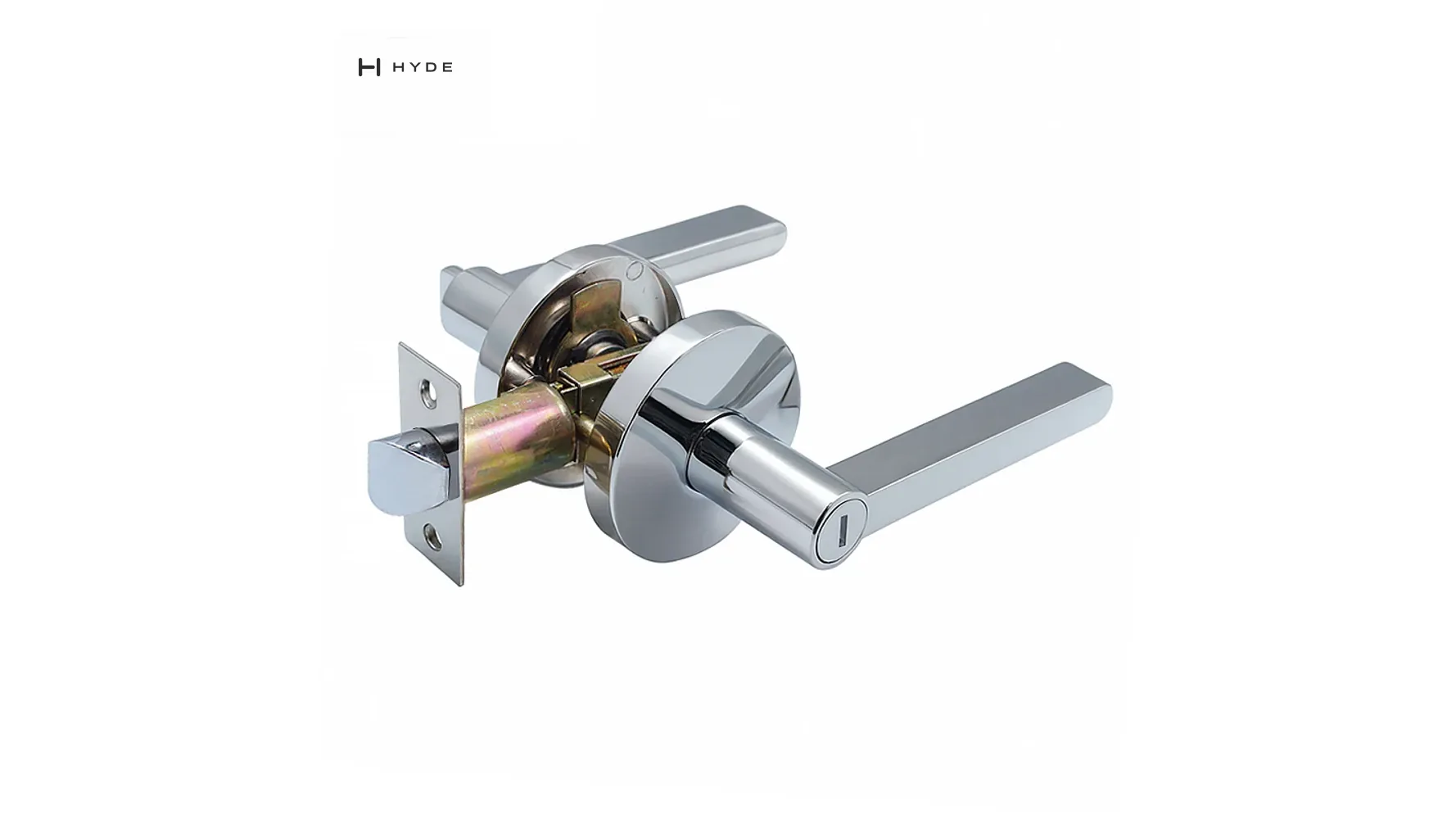
Five lever sets in our selected range (LH852, LH853, LH855, 808 and 6491) publish the same cycle life: 200,000 operations. That number is the most useful thing on their specification sheets and also the most easily misread, so it is worth being precise about what it describes and what it does not.
A cycle is one full operation: lever down, latch retracted, lever released, latch returned. Two hundred thousand of them is a service expectation for a door in normal use, not a warranty and not a grade in the ANSI sense, A156 grades exit devices and locks on cycle counts, and we hold no ANSI/BHMA certification, so this figure is our own published expectation rather than a graded result. Stating it that way is the difference between a specification and an advertisement.
What makes the number credible is the construction behind it, and that is published too. The lever itself is zinc alloy. The chassis is solid steel, zinc plated for corrosion resistance. That division is deliberate: the lever is the visible part and zinc casts into shapes steel cannot, while the chassis is the part that carries the load every one of those 200,000 times, and it is steel. A lever set that is zinc all the way through wears at the spindle, and it does it long before the finish shows any sign of it.
The dimensions are shared across all five: a 60/70mm backset and a door thickness of 35mm (1-3/8") to 45mm (1-3/4") adjustable, with the LH853 also published at 60mm (2-3/8") on some variants. All five are fully reversible, left or right hand, so handing is an assembly matter rather than a separate part number, which is worth knowing when a schedule arrives with the handing column empty, as they often do.
Where they separate is function. The LH855 is published with the widest set: entrance, privacy, passage or dummy. A dummy is a lever fixed to the door with no mechanism at all, used on the inactive leaf of a pair or on a cupboard, and it is the one function buyers routinely forget to order and then improvise on site with a working set. If your schedule has inactive leaves on it, that is the model to ask about first.
The 808 is the one to look at where the finish is doing the work. It is published in antique brass (US5) and matt black, and antique brass is a relieved finish (color worked back off the high points) rather than a plating with one uniform tone. That is why it is not translatable to a single BHMA number, as our finish-code article explains, and also why it looks different on a lever than on a flat rose. Order a sample of the actual lever rather than a finish chip.
All five are published as keyable alike with deadbolts, or master keyed. That is the row that turns a lever range into a project specification: the lever set, the deadbolt above it and the cylinder in the door next to it can be one keying group, which is what a building manager is actually buying. The number of levels that group needs is a separate decision and usually a smaller one than the inquiry assumes.
The trim material is published as zinc die-casting electro-plated, or solid brass. That is a genuine choice rather than a grade, solid brass is the option where the door is exterior or coastal, and the electro-plated die casting is the option everywhere else. Say which one you want at inquiry, because it is not a finish decision and cannot be changed by picking a different finish code.
What the 62 lever entries on this site are
The five sets above are not a sample of a varied range; they are typical of it. Of the 62 lever-handle entries on this site, 56 are tubular lever sets that publish the same core rows described above: a 60/70mm backset, a 35–45mm door, 200,000 cycles, a solid steel chassis, full reversibility and keying alike with deadbolts. So the choice between them is function, finish and trim material, not construction, and a buyer comparing two of them on cycle life or backset will find nothing to separate them.
The other six publish no specification rows yet: 819 PBET, 8803 SNBK, 8803 SNET, 8806 SSBK, 8806 SSET and LH851. Several carry the same function suffixes as the rest of the range (BK for privacy and ET for entrance, as on our cylindrical locks), but a suffix is not a specification. We are not going to give those six the rows of their neighbors. Ask, and we will confirm them against the drawing.
Choosing between the five, by what each is published in
Since construction does not separate them, here is what does: the functions and finishes each family is actually published in, counted from its variants on this site.
Scrollen Sie seitwärts, um Spalten zu vergleichen. Wählen Sie eine Spaltenüberschrift zum Sortieren; dreimal gewählt, stellt sie die ursprüngliche Reihenfolge wieder her.
| LH852 | 5 | entrance, privacy, passage | black nickel, gun metal, satin stainless (US32D) |
|---|---|---|---|
| LH853 | 8 | entrance, privacy, passage | chrome, satin nickel, black nickel |
| LH855 | 4 | entrance, privacy (the base record also lists passage and dummy) | satin nickel, black nickel |
| 808 | 4 | entrance, passage | antique brass (US5), matt black, satin nickel |
| 6491 | 2 | entrance | satin nickel, satin stainless (US32D) |
5 rows · Ursprüngliche Reihenfolge
Two practical readings follow. For a building that needs every function in one finish, the LH853 is the widest published set, with entrance, privacy and passage all three in satin nickel (its chrome versions cover privacy and passage only). For a darker scheme, the LH852 is the family published in black nickel across all three functions, and the 808 adds matt black on the entrance function. And if the schedule has inactive leaves, the LH855 is the one family whose record names a dummy function, which is worth confirming for the finish you need before ordering.
A tubular set is the whole lock
It is worth being clear about what a tubular lever set is, because it decides the door preparation. The set carries its own latch in a bored hole: a round hole through the face of the door and a smaller one into its edge. The levers, the latch and the keyed cylinder are one product, which is why the specification talks about backset, cycle life and function. A door with a rectangular pocket cut into its edge for a mortise lock case is a different door, and a tubular set is not the right part for it; tell us which preparation you have before choosing.
The 35–45mm door range is the other row to check early. It covers most internal timber doors. A heavier or thicker leaf needs a lever with a wider range, and on this site that means the stainless 9000 series, published for doors of 35–50mm (1-3/8" to 1-15/16"). Our article on the stainless 9000 levers compares that family model by model.
Projection and lever length: the numbers that meet the wall
The LH sets do not publish projection or lever length, and those are the two figures that decide what the lever hits. For reference, the stainless levers on this site that do publish them sit at a lever length of 130 to 135mm (5-1/8" to 5-5/16") and a projection of 60 to 68mm (2-3/8" to 2-11/16"), which is the ordinary range for a commercial lever. If a door opens against a return wall or sits close to the next door in a corridor, ask for the projection of the LH set you are considering before ordering it.
Projection is the figure to carry across to the rest of the door. It sets how much clearance the lever needs from a wall when the door is fully open, and it is the number our article on door stops tells you to choose a stop against: a stop shorter than the lever's projection lets the lever reach the wall first.
Replacing levers on existing doors
On a replacement, three things from the old set decide the new one, and none of them is the finish. The backset, measured from the door edge to the center of the bored hole, which on these sets has to be 60 or 70mm. The door thickness at the lock position, not at the edge of a panelled door. And the marks the old rose left on the door: a new rose has to cover the screw holes and the paint line of the old one, so measure what the old one covered before choosing. A like-for-like replacement that leaves a crescent of bare timber round the new rose is the most common reason a re-handling job turns into a decorating job.
Keying a building's worth of lever sets
Because every published set in the range keys alike with our deadbolts or into a master key system, the keying decision is the one that turns a list of lever sets into a building. Decide which doors share a key, which sit under a master, and which must open to no other key, and send that with the order. Cylinders are pinned before they are packed, so keying decided after the order means reopening it, and our article on master key systems sets out how many levels a building actually needs (usually fewer than the inquiry asks for).
For a quotation on this range, four rows are enough: function per door, backset, leaf thickness, and whether any of it is keyed together. The cycle figure is the same across all five, so it will not choose between them; the function set and the trim material will.
Questions this answers
What does a 200,000 cycle rating mean on a lever handle?
A cycle is one full operation (lever down, latch retracted, lever released, latch returned) so it is a service expectation for a door in normal use. It is not a warranty and not a grade in the ANSI sense: A156 grades locks on cycle counts and we hold no ANSI/BHMA certification, so this is our own published expectation rather than a graded result. Stating it that way is the difference between a specification and an advertisement.
Why is the lever zinc alloy but the chassis steel?
Because they do different jobs. The lever is the visible part and zinc casts into shapes steel cannot; the chassis is the part that carries the load every one of those 200,000 times, and it is solid steel, zinc plated for corrosion resistance. A lever set that is zinc all the way through wears at the spindle, and it does it long before the finish shows any sign of it.
Which lever model covers a dummy or inactive leaf?
The LH855, which is published with the widest function set: entrance, privacy, passage or dummy. A dummy is a lever fixed to the door with no mechanism at all, used on the inactive leaf of a pair or on a cupboard, and it is the function buyers routinely forget to order and then improvise on site with a working set. If your schedule has inactive leaves on it, ask about that model first.
Is the trim material a finish choice?
No, and it cannot be changed by picking a different finish code. The trim is published as zinc die-casting electro-plated, or solid brass, and that is a genuine choice rather than a grade: solid brass is the option where the door is exterior or coastal, and the electro-plated die casting is the option everywhere else. Say which one you want at inquiry.
Are all your lever handles the same kind of lock?
Nearly all. Of the 62 lever-handle entries on this site, 56 are tubular lever sets with the same published core: 60/70mm backset, 35–45mm door, 200,000 cycles, a solid steel chassis, full reversibility and keying alike with deadbolts. The other six (819 PBET, 8803 SNBK, 8803 SNET, 8806 SSBK, 8806 SSET and LH851) publish no specification rows yet, so ask before ordering one. A tubular set needs a bored door, not a mortise pocket.
How far does a lever handle project from the door?
The LH sets do not publish projection, so ask for it on the model you are considering. For reference, the stainless levers on this site that publish it sit at 60 to 68mm projection with lever lengths of 130 to 135mm. Carry the projection across to the rest of the door: a door stop should be at least as long as the lever's projection, or the lever will reach the wall first.
Über Canton Hyland – Canton Hyland fertigt Panikverschlüsse, Schlösser und Baubeschläge für Objekt- und öffentliche Bauten und beliefert Planer und Händler weltweit.