
A Brass Piano Hinge Is Usually Not Brass
In this trade "brass piano hinge" almost always names the finish, not the metal. Ours is iron under a matt black or polished brass finish, in 1", 1-1/4", 2" and 3" widths, and our own catalog claimed stainless steel until 16 September, which is a good illustration of how the confusion survives.
Insight
Johnson LiuDigital Communications, Canton HylandMA Digital Media, Johns Hopkins University
المنتجات المذكورة
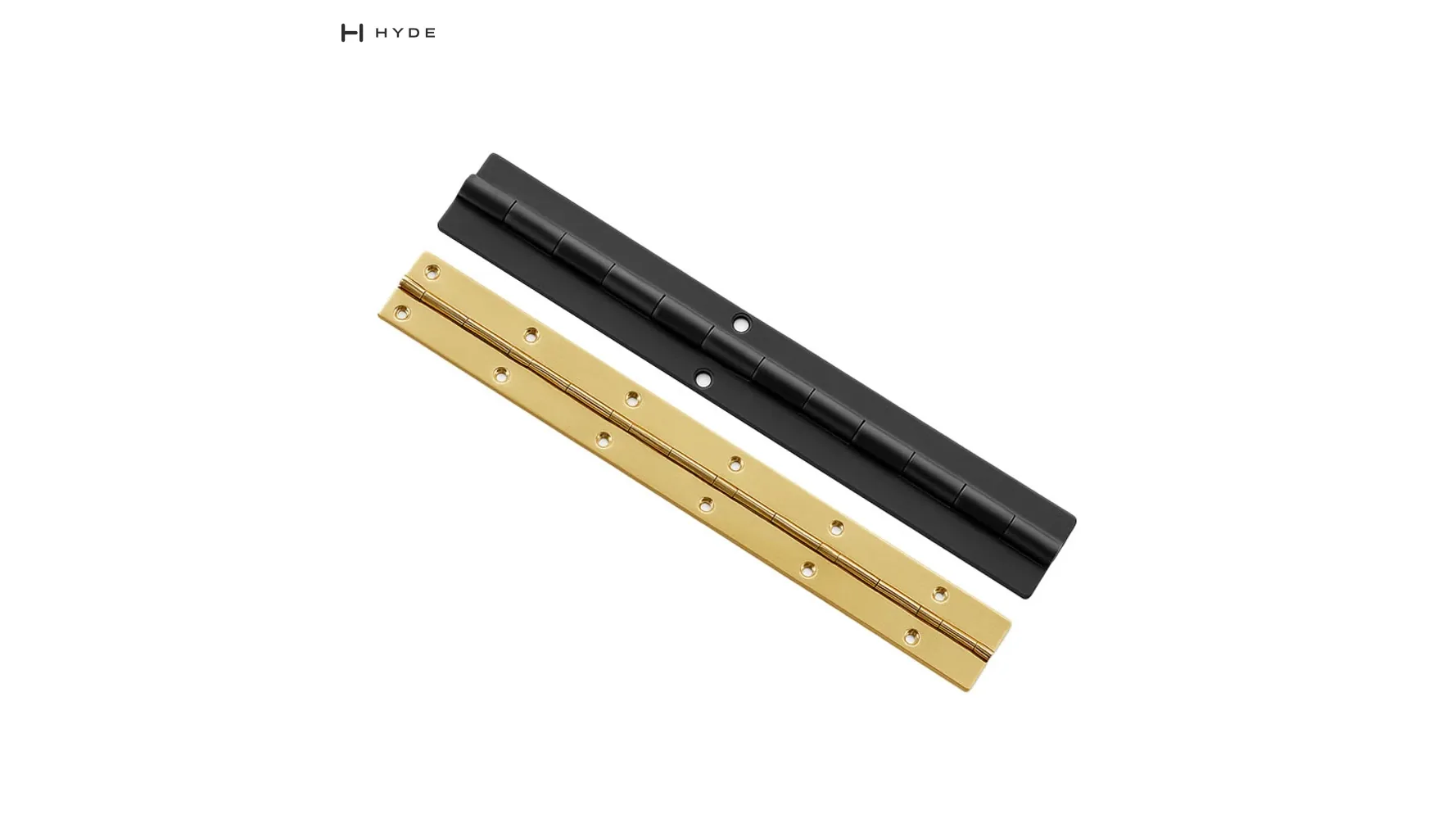
Search for a brass piano hinge and almost everything you find will be an iron hinge with a brass finish on it. That is not a scam and it is not sloppy writing by the suppliers; it is how this product has been named in the trade for a century. But it is the reason a buyer can order what they believe is a solid brass continuous hinge and receive a steel one that looks identical, and the difference only appears in year three, on the outside of a building, as rust bleeding out from under the plating.
A piano hinge (a continuous hinge, in a specification) is one long hinge instead of three short ones. It runs the whole height of the leaf, so the load is carried along the entire edge rather than concentrated at three knuckles. That is why it turns up on piano lids, on lockers, on toolbox lids, on access panels and on any door that is thin, long or handled roughly enough that a conventional butt hinge would eventually tear out of it.
Because it carries load everywhere rather than at three points, the material matters less for strength than people assume and more for corrosion than people expect. An iron continuous hinge is stiffer than a brass one of the same section (brass is the softer metal) so "upgrading" from iron to solid brass is not a structural improvement. What solid brass buys is that the metal under the surface is the same metal as the surface, which is the whole question on an exterior or a coastal opening.
This is the same trap our article on finish codes describes in the North American system, and it is worth naming as one idea rather than two. In ANSI/BHMA A156.18, 626 is satin chrome on a brass base and 652 is satin chrome on a steel base: identical in a photograph, different in every other respect. "Brass piano hinge" is that distinction collapsed into a product name, and the name keeps the half that photographs well.
Our own catalog had it wrong, and it is worth saying exactly how wrong because it shows what the error looks like from the inside. The record read model "Brass Piano Hinge", material "Stainless Steel 304", and a width field that had been mangled in an import into 1"1-1/4 "2 "、3". Three claims, and no two of them could both be true. It stayed that way until somebody searched for what buyers were actually typing, found the query, and looked at the record behind it.
What it says now is what the factory told us on 16 September 2026: the leaf is iron. The widths are 1 inch, 1-1/4 inch, 2 inch and 3 inch. The photograph on that page shows two of them, one in matt black and one in a polished brass finish, and the brass one is the reason the model is called what it is. The stainless steel claim is gone, because it was never true.
What we still do not publish on that record is the part a specifier needs next: the length it is supplied in, the leaf thickness, the pin material, the knuckle pitch and any load figure. Those are five dashes, not five estimates. We know the hinge is iron and we know the four widths; we have not been given the rest, and a leaf thickness invented from a photograph is exactly the kind of number that gets a submittal rejected. Ask and we will go back to the factory with your question rather than answering it ourselves.
For the wider range, counted on 22 September 2026: this site publishes 29 hinge records. Nineteen are stainless steel in various grades, four are iron (the Brass Piano Hinge, BL027, IH01 and F100 SS), two are solid brass (B024 and B025), and four carry no material row yet. If your specification says brass and means the metal, say so in those words, because a finish code will not carry that meaning and a model name plainly does not either. If it says brass and means the color, an iron or stainless leaf with a polished brass finish is cheaper, stiffer and entirely legitimate, as long as everybody knows which one was ordered.
One more name that does not match its metal
Recounting the range for the paragraph above turned up one more case of exactly the problem this article is about, and it would be odd to write about names that mislead and then leave it unmentioned.
It is the F100 SS. The SS in the model name reads as stainless steel; the material row on the record says iron. One of those two is wrong, and we do not yet know which. Until the factory confirms it, treat the F100 SS as unconfirmed on material and ask before ordering it anywhere corrosion matters.
The four hinge records with no material row at all (AAH024, BL029, SSH021 and the record titled Stainless Steel Door Hinge) are the other half of the same lesson. A hinge called stainless steel with an empty material row is a name, not a specification. Until the row is filled, treat the material as unconfirmed, whatever the title says, and ask for it in writing. The same applies to any supplier, not only to us.
How to tell what a hinge is made of
None of this should depend on trusting a label, ours included, so here are the checks a buyer can make with a sample in hand.
A magnet: iron and ordinary steel are strongly magnetic; brass and copper are not magnetic at all. That one test separates a brass-finished iron hinge from a solid brass one in a second. Stainless steel is the complication: grade 304 is essentially non-magnetic as annealed but can become slightly magnetic where it has been bent or worked, and grade 201 is often weakly magnetic. So a weak pull means "probably stainless, check the grade", a strong pull means iron or steel, and no pull at all on a yellow hinge means brass or copper.
A cut edge or a hole: plating covers the faces; it does not always cover the inside of a screw hole or a cut end. Look there, or file a small hidden corner. Brass is yellow all the way through. A plated iron hinge shows gray under the color.
Weight, with care: brass is denser than steel, so a solid brass hinge is noticeably heavier than a steel one of the same size, but only in a side-by-side comparison of identical dimensions, which is rarely what you have.
The document, not the page: for a project, ask for the material in writing against the model number and finish on your order. A test report or a mill certificate for the material is better still. A product page (including this one) is a description; the purchase order is the specification.
Continuous hinge or butt hinges
A piano hinge is the right answer on a long, thin or roughly handled leaf, but it is not automatically the better hinge. Butt hinges are easier to adjust, easier to replace one at a time, and the normal choice on a standard door. Ball-bearing butt hinges carry a heavy or frequently used leaf smoothly at three or four points, and our range lists them by size with a bearing count in the model code, the 4BB suffix on many of the records above.
A continuous hinge earns its place where the leaf itself is the weak point: a lid or panel that would twist between three hinges, a locker door that is slammed a thousand times a term, an access panel where tamper resistance matters because there is no exposed knuckle to attack. On a conventional timber door, three good butt hinges usually outperform a continuous hinge of doubtful material.
What a continuous-hinge specification has to say
Because this is a product that is so often misnamed, the specification has to carry more than usual. The material, in words ("solid brass", "stainless steel 316", "iron with polished brass finish") rather than a color or a name. The finish, separately. The length, and whether it is supplied in stock lengths to be cut or cut to size. The open width, which is what our 1, 1-1/4, 2 and 3 inch figures describe. The leaf thickness, the pin material and whether the pin is fixed or removable. And the hole pattern, if the hinge has to meet existing holes.
We can answer the first two and the width for the Brass Piano Hinge today, and not the rest. Write the rest into your inquiry anyway: each unanswered line is a question we will take to the factory rather than a number we will estimate for you.
Where the metal question actually costs money
Indoors, a plated iron hinge and a solid brass one can serve side by side for decades and nobody will ever know which is which. The difference is paid for outdoors: on an exterior door, a garden gate, a boat, anything within reach of salt air or a swimming pool. There the plating is eventually breached (at a knuckle that wears, a screw head that is driven, an edge that is knocked) and what happens next depends entirely on the metal underneath. Iron rusts and stains the finish around it; solid brass darkens but does not bleed. For those openings the choice is really between solid brass and a suitable stainless grade, and our article on stainless steel grades 304, 201 and 316 covers which grade belongs where.
Questions this answers
Is a brass piano hinge actually made of brass?
Usually not. Almost everything sold as a brass piano hinge is an iron or steel continuous hinge with a brass finish on it. Ours is iron under a matt black or polished brass finish. It is not a scam and not sloppy writing, it is how the product has been named in the trade for a century.
What is a piano hinge?
A continuous hinge: one long hinge instead of three short ones, running the whole height of the leaf so the load is carried along the entire edge rather than concentrated at three knuckles. That is why it turns up on lockers, toolbox lids, access panels and any door thin, long or handled roughly enough that a butt hinge would tear out of it.
Is a solid brass continuous hinge stronger than an iron one?
No. Brass is the softer metal, so an iron continuous hinge is stiffer than a brass one of the same section. What solid brass buys is that the metal under the surface is the same metal as the surface, which is the whole question on an exterior or coastal opening.
How can I tell if a hinge is solid brass or brass-plated?
Use a magnet first: iron and steel are strongly magnetic, brass and copper not at all, so no pull on a yellow hinge means brass or copper and a strong pull means plated iron or steel. Stainless 304 can be slightly magnetic where worked and 201 often weakly so. Then look at a cut edge or inside a screw hole, where plating may not reach: brass is yellow all the way through. For a project, get the material in writing against the model and finish on your order.
Should I use a continuous piano hinge or butt hinges?
Butt hinges on a standard door: they are easier to adjust and replace, and ball-bearing butts carry a heavy leaf smoothly. A continuous hinge is right where the leaf is the weak point: a long lid or panel that would twist between three hinges, a heavily used locker door, or an access panel where there should be no exposed knuckle. On a conventional timber door, three good butt hinges usually beat a continuous hinge of doubtful material.
How many hinges do you publish, and in which metals?
Twenty-nine hinge records as of 22 September 2026: nineteen stainless steel in various grades, four iron (the Brass Piano Hinge, BL027, IH01 and F100 SS), two solid brass (B024 and B025) and four with no material row yet. The F100 SS carries SS in its name but iron in its material row, so treat its material as unconfirmed. If you need solid brass, say so in words; a finish code or a model name will not carry that meaning.
عن Canton Hyland — تصنع Canton Hyland أجهزة الخروج الطارئ والأقفال وأجهزة الأبواب المعمارية للمشاريع التجارية والمؤسسية، وتورّدها لواضعي المواصفات والموزعين حول العالم.