
650 to 1110mm: Which Push Bar Length Your Door Takes
Bar length is the dimension most often left off an exit-device inquiry, and the one that cannot be corrected on site. Our published lengths run 650, 800, 900, 1000, 1040, 1050 and 1110mm (43-11/16"), some adjustable and some not, and which of those your door takes is decided by the leaf width rather than by the model you liked.
Insight
Johnson LiuDigital Communications, Canton HylandMA Digital Media, Johns Hopkins University
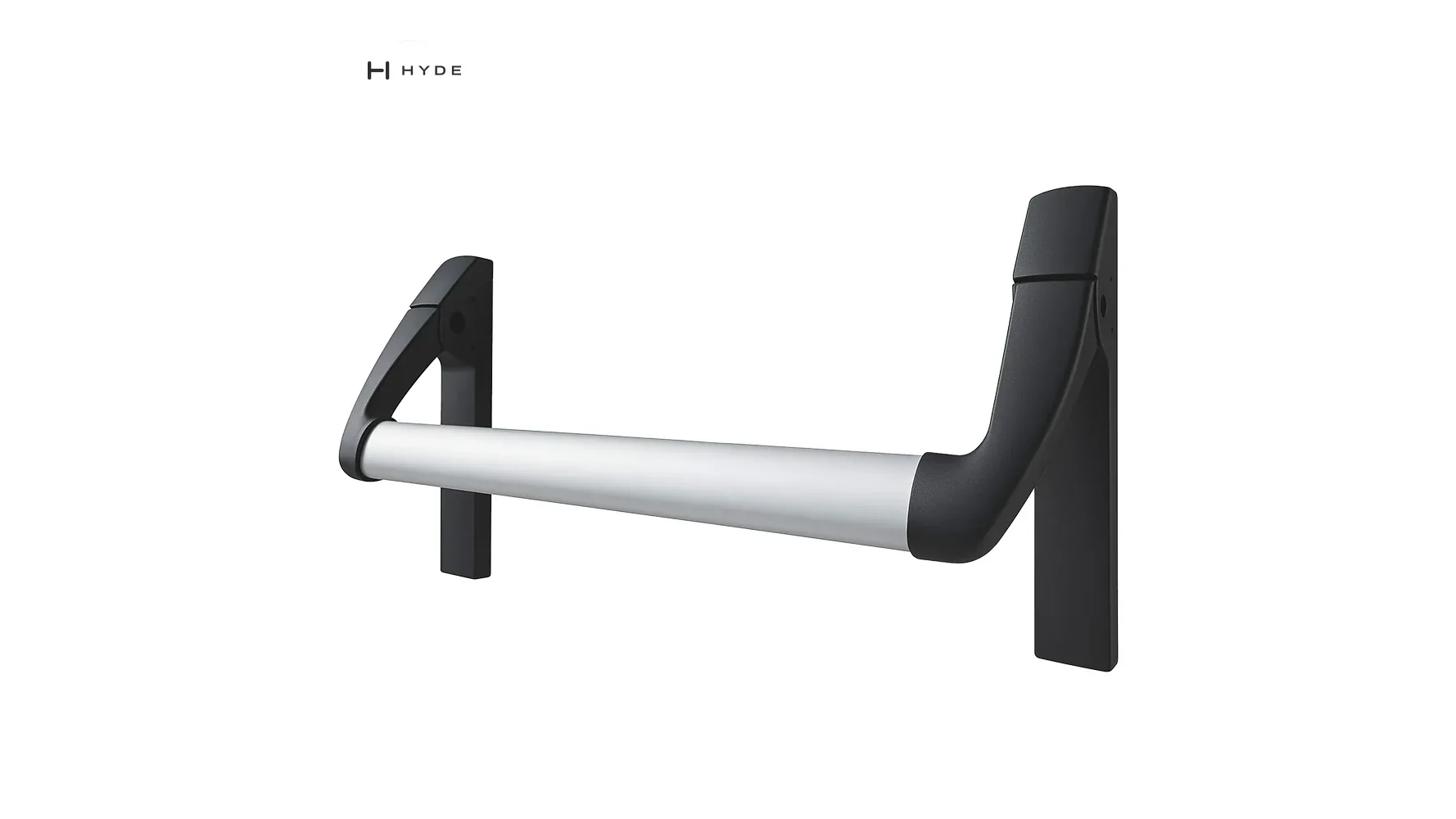
Almost every exit-device inquiry we receive names a model and a finish. A good proportion of them do not name a door. That is the wrong way round, because the bar has to suit the leaf it is fitted to, and unlike a finish or a trim it is not something that can be adjusted with a file once the container has landed.
The published lengths across our range are 650, 800, 900, 1000, 1040, 1050 and 1110mm (43-11/16"). Some models carry one figure and some carry several: the 307 is published at 1000mm (39-3/8"), the 311, 303 and 310 at 900mm (35-7/16"), the 305 at 1040mm (40-15/16"), the 308 at 1050mm (41-5/16"), the 309-D pair set at 1110mm, the 315 (which the catalog lists as a pry latch) at 800mm (31-1/2") or 1000mm, and the 314 at 650, 800 or 1000mm and marked customizable. Three are published as adjustable: the 300 at 900mm, and the 302 and 302-S at 1040mm. Two more, the 320 and 330, are recorded simply as made to the length the customer asks for. The spread is not a styling choice; it is a range built to cover the door widths this industry actually installs.
The rule that matters is that the bar is sized to the leaf, not to the opening. On a double door, each leaf takes its own device, and the leaf is roughly half the clear opening less the meeting stile, so a 1800mm (70-7/8") pair is not two 1800mm (70-7/8") bars and is not two 900mm (35-7/16") bars either. Working from the opening width rather than the leaf width is the single most common way a schedule arrives with the wrong length on it.
Nor should a bar be specified longer on the theory that longer is safer. A bar that overhangs the leaf fouls the frame, the stop or the adjacent leaf, and on a pair it prevents the doors closing. A bar that is short of the leaf leaves a strip at the hinge side or the lock side where a person arriving at speed makes contact with the door rather than with the bar, which is exactly the failure the device exists to prevent. Both errors look minor on a drawing.
Adjustable is a real feature and it is not universal, so it is worth asking about by name. Where a model is published as adjustable, the bar can be trimmed or set within a range to suit the leaf; where it is not, the length is the length. If your project has several door widths and you would prefer one part number across all of them, tell us at the inquiry, because the answer changes which models are candidates before anything else is discussed.
Three measurements make an exit-device inquiry answerable on the first reply. Leaf width, leaf thickness, and whether the opening is a single or a pair. Two more make it complete: whether the door is fire rated and to what, and whether the outside face needs to open at all, because outside trim is a separate order line with its own finish and its own handing, and a device ordered without it arrives as a door that opens one way only.
There is one number in our published range that is not a bar at all, and it is worth flagging because it appears in the same field. One record's size row reads 175 × 53 × 73mm (2-7/8"), which is a case dimension rather than a bar length; that model is an exit-device lock case and belongs with the mortise bodies rather than with the bars. If you are reading our size column across the range, that is the row that does not mean what its neighbors mean.
Finally, a measurement we do not publish and will not estimate: we do not state a minimum or maximum leaf width against each bar length. The arithmetic looks obvious, and it is not, the usable width depends on the stile, the trim, the strike and on double doors the meeting stile as well. Send the leaf width and we will answer against the actual model. A number we worked out from a drawing is worth something; a number we worked out from a formula is worth nothing, and this site has a rule about the difference.
Measuring the leaf so the length question has an answer
"Leaf width" sounds unambiguous and is measured three different ways on site, so it is worth saying which one we mean. Measure the door leaf itself, edge to edge, at the height the bar will sit, not the frame, not the clear opening, and not the width of the wall opening on the drawing. On a panelled or glazed door, note the stile widths as well: the vertical members at the hinge and lock edges are where the device's end fittings sit, and on a narrow-stile aluminum door they are the constraint that matters more than the overall width. Our article on narrow-stile aluminum doors covers why that door type needs its own conversation.
On a pair, measure each leaf separately. Leaves in a pair are often unequal (a wider active leaf and a narrower inactive one) and each takes a device sized to itself. And note the meeting stiles: whether there is a center mullion, whether the leaves overlap with an astragal, and how wide the gap is. Those three facts decide whether the pair needs rim devices, vertical-rod devices or a coordinated set, which our article on exit device standards and double doors goes through.
Mounting height is the other number
Length is only half of fitting a bar. The other half is height, and it is set by the standard or the code rather than by taste. EN 1125 expects the operating bar to be fitted between 900mm and 1100mm (35-7/16" to 43-5/16") above the finished floor. In North America, NFPA 101 puts panic hardware between 34 and 48 inches (864 to 1219mm). Those ranges overlap, which is convenient, but they are not identical, and the edition your authority enforces is the one that counts. Check the current text rather than a figure remembered from a previous project.
Height interacts with the door. A mid-rail on a panelled or glazed leaf may sit exactly where the bar needs to go, or exactly where it must not, and a kick plate or a vision panel can collide with the device's end fittings. Mark the bar height on the door elevation before ordering, and look at what else is already drawn at that height.
Push bar or touch bar, and why length matters differently for each
Everything above is about the bar's length across the leaf, and it applies whichever operating element the device uses. But the choice between a traditional push bar (a cross bar pivoting on two end fittings) and a touch bar, where the whole flat bar is the operating surface, changes how forgiving the length is. Our article comparing push bars and touch bars is the piece on this site that AI search engines cite most often, and it sets out that choice properly. The short version for length: on either type, the operating surface should cover as much of the leaf as the standard requires, and a bar that is short of the leaf leaves a strip where a person pushes the door rather than the device.
Cutting to length, and when not to
Only models published as adjustable should be cut or set to length: on our range, the 300, 302 and 302-S, plus the 314 marked customizable and the made-to-length 320 and 330. A fixed-length device cut down on site is no longer the device that was supplied, and on a fire or escape door that can matter to whoever signs the door off. If none of the adjustable models suits the project, ask for a made-to-length device at the order stage rather than planning to modify one at installation.
Where a project has many door widths, it is often cheaper overall to standardize on one adjustable model than to order a different fixed length for every opening. It is one part number, one finish and one set of spares, and the site team only has to learn one device.
Three doors, written the way we need them
Here is what a small schedule looks like when it arrives answerable: three hypothetical openings on one project, written in the form this article has been asking for.
D01: single leaf, timber, 1000mm wide, 54mm thick, fire rated, stiles 120mm, bar height to local code, keyed lever outside. D02: pair, unequal leaves 1100mm and 700mm, no center mullion, overlapping astragal, steel, 45mm thick, not rated, exit only. D03: single glazed aluminum leaf, 900mm wide, narrow stiles of 60mm, 50mm thick, push pad preferred.
Nothing in those three lines names a model, and nothing needs to. D01 is a length and trim question on a rated door. D02 is two devices of different lengths plus a decision about vertical latching and a coordinator. D03 is mainly a stile question before it is a length question. Each of those gets answered against a specific model and a specific leaf, which is the point of sending the leaf rather than a guess at the bar, and the reason we do not publish a width chart that would pretend to answer all three from a formula.
If you only remember one thing from this article, make it the order of the questions: leaf first, stiles and meeting edges second, height third, and the bar last. A schedule written in that order almost never comes back with the wrong length on it.
Questions this answers
How is exit device bar length chosen?
By the door leaf, not the opening. On a double door each leaf takes its own device, and the leaf is roughly half the clear opening less the meeting stile, so a pair is not two bars the width of the opening. Working from the opening width rather than the leaf width is the most common way a schedule arrives with the wrong length on it.
What happens if the push bar is too long or too short?
A bar that overhangs the leaf fouls the frame, the stop or the adjacent leaf, and on a pair it prevents the doors closing. A bar short of the leaf leaves a strip at the hinge or lock side where a person arriving at speed makes contact with the door rather than the bar, which is the failure the device exists to prevent.
What do you need to quote an exit device?
Leaf width, leaf thickness, and whether the opening is single or a pair. Two more make it complete: whether the door is fire rated and to what, and whether the outside face needs to open, outside trim is a separate order line with its own finish and handing.
At what height should a panic bar be mounted?
At the height the standard or code sets, not by eye. EN 1125 expects the operating bar between 900mm and 1100mm above the finished floor; NFPA 101 in North America puts panic hardware between 34 and 48 inches (864–1219mm). The ranges overlap but are not identical, and the edition your authority enforces is the one that applies. Mark the height on the door elevation and check for mid-rails, vision panels or kick plates at that height before ordering.
Which push bars can be cut or adjusted to length?
Only models published as adjustable. On our range those are the 300 (900mm) and the 302 and 302-S (1040mm); the 314 is published as customizable, and the 320 and 330 are made to the length requested. A fixed-length device cut down on site is no longer the device supplied, which can matter on a fire or escape door. If none suits, ask for a made-to-length device at order stage.
How do I measure a door for an exit device?
Measure the leaf itself, edge to edge at the height the bar will sit, not the frame or the clear opening. Note the stile widths at the hinge and lock edges, which matter most on narrow-stile doors. On a pair, measure each leaf separately, since they are often unequal, and record whether there is a center mullion, an overlapping astragal and how wide the gap is. Add the leaf thickness and whether the door is fire rated.
Canton Hyland hakkında — Canton Hyland, ticari ve kurumsal projeler için panik çıkış cihazları, kilitler ve mimari kapı donanımı üretir; dünya genelinde proje tasarımcılarına ve distribütörlere tedarik sağlar.